

Every Presidents’ Day, Americans remember George Washington as the general who won independence and the statesman who stepped away from power. Less often remembered is something equally important for understanding the early republic: Washington was a committed supporter of American manufacturing, and the first major economic act of the new government reflected that conviction. Without this commitment, the nation would not have survived.
His presidency began with symbolism that was anything but accidental.
A suit made in America
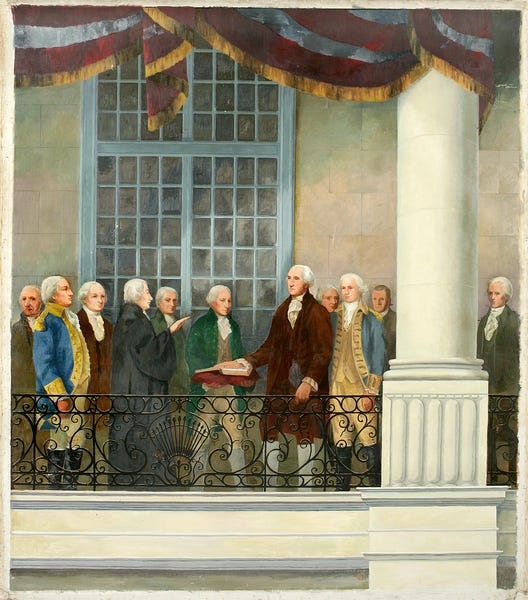
When Washington traveled to New York for his inauguration in 1789, he consciously chose clothing that carried political meaning. Influenced by a public call urging American leaders to wear domestically produced goods, he commissioned a suit made from American wool produced at the Hartford Woolen Manufactory in Connecticut.
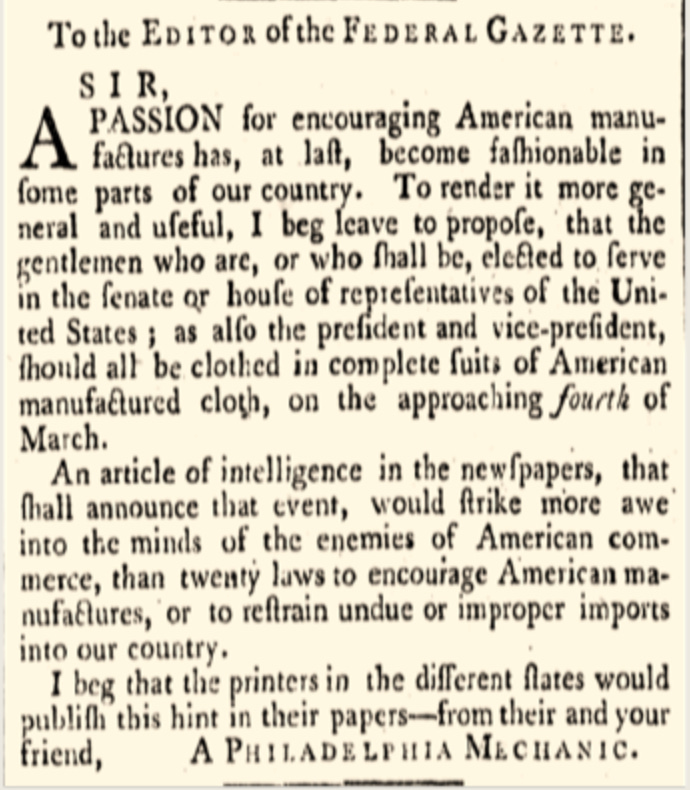
The suit was not simply fashion. It was messaging.
At a moment when the new nation was economically fragile and heavily dependent on foreign manufactures, Washington chose to stand before Congress in material produced by American workers. This suit was a statement of national identity and self-sufficiency, emphasizing that Washington wanted to support domestic industry through personal example.
Historians often forget one of the greatest challenges that Washingtons army faced. Due to the tyrannical acts of the British government that drove the Americans to Revolution, (such acts as the Iron Act, the Wool Act, and the Hat Act), Americans were not legally allowed to develop their own products of iron, of wool, or even manufacture their own hats. Thus, during the war, American soldiers were woefully unclothed.
General Washington would never forget the horror of seeing his men die of exposure, shivering to death in the frosty winds of Valley Forge. The general was determined that as President, he would never allow the Nations troops nor its civilians to be dependent on another nation for their clothing.
Washingtons symbolic gesture came before the age of campaign branding or modern economics departments. Yet the message was clear: political independence required productive independence, and Washington stood with American manufacturers.
Washington himself expressed this sentiment directly, writing in 1789 that he would take pleasure in encouraging “the manufactures of my Country.”
The first act of the new government
After the administration of oaths, the new federal government quickly moved to establish itself financially. After establishing the law on the taking of oaths, the first act of the very First Congress was the Tariff Act of 1789.
Washington, determined to never see the nation dependent on foreign textiles again, signed this act on July 4, 1789. This tariff act served two primary purposes:
It raised revenue for a government burdened by war debt
It offered protection to emerging domestic manufacturers and established a path forward for the domestic procurement of textiles
Before the republic had a standing bureaucracy, before many executive departments even existed, Congress and the president agreed that revenue and industry had to be secured first. The tariff was the answer.
Thus the history is clear to us upon review. The early United States did not begin as a free trade experiment. It began with tariffs. It began with PROTECTION.
Washington, Hamilton, and the question of national development
Washington’s economic instincts aligned more frequently with Alexander Hamilton than with Thomas Jefferson when it came to building national economic capacity.
Hamilton argued for a strong national financial system, federal assumption of debts, and policies that encouraged manufacturing and credit formation. Jefferson preferred a more agrarian republic and was skeptical of what he saw as centralized economic power.
One of the clearest examples came in 1791, when Washington signed legislation creating the First Bank of the United States after intense debate within his cabinet. Jefferson opposed the bank on constitutional grounds, while Hamilton defended it as necessary for national development. Washington ultimately sided with Hamilton’s interpretation on this and other issues.
His decision was not merely technical. It reflected a broader philosophy that national strength required institutions capable of fostering commerce, industry, and stable public finance.
In other words, Washington repeatedly chose the path of establishing domestic political and economic institutions. These institutions would permit the way forward for the United States to realize and defend the independence it had just fought a bloody war to win.
A founding lesson for Presidents Day
The image of Washington in a brown American-made suit standing on the balcony of Federal Hall is more than a picturesque story from the founding era. It tells us something about the assumptions built into the republic itself.
The first president understood that sovereignty was not only defended on battlefields. It was also reinforced in workshops, mills, and factories.
Washington’s example suggests a simple proposition that later generations would repeatedly rediscover: political independence is fragile without industrial strength.
On Presidents Day, it is worth remembering that America’s first president was not only a soldier and statesman. He was, in the language of today, a tariff man.
Thanks for reading! If you enjoyed, please share with your friends, and consider substring to the Tariff Times.
If you would like to learn more about the early development of the United States textile industry, consider purchasing the following book.
Manufacturing Advantage: War, the State, and the Origins of American Industry, 1776–1848 ( Book Review linked HERE)
To understand the importance of domestic manufacturing, particularly within todays context, please consider buying my friend John Gardners book
“Manufacturing Local” (Book Review Forthcoming)