

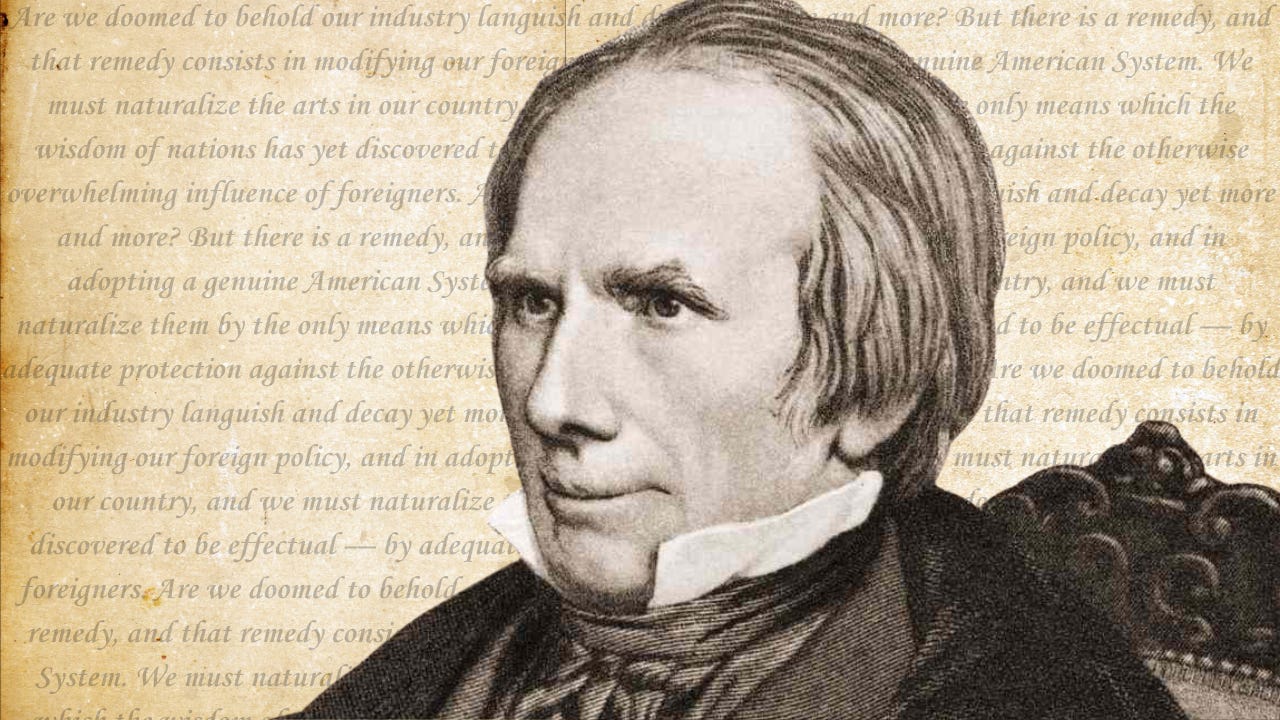
In our first article in our series leading to the April 12th Birthday of Henry Clay, we made the case for why his American System matters more in 2026 than it did in the 19th Century.
Today we step back and let the man speak for himself.
Clay was one of the great orators of the 19th century in an era when oratory was the primary medium of political life and audiences sat for hours to hear a great speaker work through an argument.
From those great oratory performances come these quotes that reveal how Clay thought: about industry, about nationhood, about the relationship between economic structure and human freedom. Read them slowly.
Why don’t Congressmen speak like this today?
On the Law of National Wealth:
“The measure of the wealth of a nation is indicated by the measure of its protection of its industry; and that the measure of the poverty of a nation is marked by that of the degree in which it neglects and abandons the care of its own industry, leaving it exposed to the action of foreign powers.”
Speech on American Industry, House of Representatives, March 30–31, 1824.
Clay offered this not as opinion but as empirical law, demonstrated by a table of nations he laid before Congress that very day. Britain, which protected its industry most aggressively, was the wealthiest nation on earth. Spain, which had abandoned its domestic industry to chase colonial gold, was among the poorest. France and Ireland fell exactly where the theory predicted. Clay looked at this evidence and stated what he believed to be a universal principle: protection builds wealth, neglect breeds poverty.
He was not alone in demonstrating it. Friedrich List, in his National System of Political Economy, traced the same pattern across the economic history of nations, showing that every country that achieved industrial greatness did so through protection, not in spite of it. Henry C. Carey, the greatest economist the American School produced, went further still. In The Slave Trade, Domestic and Foreign, he documented what free trade left in its wake wherever it went: not prosperity, but dependency, extraction, and the degradation of labor. Two centuries of economic history have not refuted these men. They have confirmed them at every turn.
On the Remedy for Industrial Dependency:
“Are we doomed to behold our industry languish and decay yet more and more? But there is a remedy, and that remedy consists in modifying our foreign policy, and in adopting a genuine American System. We must naturalize the arts in our country, and we must naturalize them by the only means which the wisdom of nations has yet discovered to be effectual — by adequate protection against the otherwise overwhelming influence of foreigners.”
Speech on American Industry, House of Representatives, March 30–31, 1824.
Clay was speaking about British manufacturing dominance in 1824. Substitute Chinese manufacturing dominance and the sentence requires no other revision. Today, cheap goods flow into American markets from a rival state that has never practiced anything resembling free trade . China subsidizes its industries, manipulates its currency, and uses economic penetration as a tool of strategic competition. The apologists for this arrangement dress it up in the language of friendship and consumer benefit. Temu delivers a plastic widget to an American doorstep for three dollars, and somewhere a factory town dies. Clay understood that what looks like abundance at the point of consumption can be dependency at the level of national productive capacity. For him, protection was the condition under which American industry could take root, mature, and guard itself against the coercion of foreign influence.
On the Nature of so-called Free Trade:
“The call for free trade is as unavailing as the cry of a spoiled child, in its nurse’s arms, for the moon or the stars that glitter in the firmament of heaven. It never has existed; it never will exist. Trade implies at least two parties. To be free, it should be fair, equal, and reciprocal.”
Defense of the American System, Senate, February 2–6, 1832.
This is Clay at his most devastating. He is not defending protectionism on the back foot — he is exposing free trade doctrine as a fantasy that has never existed anywhere on earth. A nation that unilaterally opens its markets while its rivals maintain tariffs, subsidies, and industrial policy has not achieved free trade. It has achieved submission dressed up in the language of principle. That argument was true in 1832. It was true in 1994. It remains true today. So true in fact, that Robert Lighthizer, who was the USTR under the first Trump administration wrote a book literally titled “No Trade is Free.”
On who the American System Actually Serves:
“I stand here as the humble but zealous advocate, not of the interests of one state, or seven states only, but of the whole Union.”
Defense of the American System, Senate, February 2–6, 1832.
This single sentence separates Clay from every caricature of protectionism that his opponents constructed then and that critics construct now. He was not arguing for manufacturers against farmers. He was not arguing for the North against the South. He was arguing for a political economy structured to serve the whole republic, every region, every interest, every section, through the binding coherence of a genuinely national market. His critics never successfully answered this framing. Neither have theirs. And today, that argument is even harder to dismiss on sectional grounds. The deindustrialization of the last thirty years did not spare any region of the country. It hollowed out the Rust Belt and the Sun Belt alike, gutted factory towns in Ohio and textile communities in the Carolinas, and left no section of the Union untouched. The man who said he spoke for the whole Union was right then. The evidence that he was right is now spread across every corner of the map.
On what the American System Actually Produced:
“This transformation of the condition of the country from gloom and distress to brightness and prosperity, has been mainly the work of American legislation, fostering American industry, instead of allowing it to be controlled by foreign legislation, cherishing foreign industry.”
Defense of the American System, Senate, February 2–6, 1832.
Clay was not speaking in abstractions. He had the receipts. In the seven years before the Tariff of 1824, under free trade conditions, the assessed value of real estate in New York City fell by nearly six million dollars. In the seven years after it passed, that value rose to nearly ninety-six million. Exports increased. Navigation expanded. Cities grew. Every prediction the opponents of the American System had made — that it would destroy commerce, devastate agriculture, and ruin the public revenue — had failed, in Clay's words, utterly. He stood before the Senate with the data in his hands and made a simple argument: we tried the foreign system, and it produced gloom and distress. We tried the American System, and it produced brightness and prosperity. The results were not theoretical. They were measurable, documented, and undeniable.
On the Nature of American Allegiance:
“I know no South, no North, no East, no West, to which I owe any allegiance. My allegiance is to this Union.”
Senate floor, in response to a southern senator who taunted Clay about his sectional loyalty. Documented in multiple contemporary sources including Bartleby’s collection of Clay’s speeches and remarks.
Clay spent thirty years trying to hold the republic together against the centrifugal forces of sectionalism. He understood, more clearly than almost any of his contemporaries, that the American System was not merely an economic program. It was a nation-building project. The tariff, the bank, the internal improvements: these were instruments for creating a people who thought of themselves as Americans first and southerners or northerners second. That project failed in his lifetime. Lincoln finished it, at enormous cost.
On Preferring Principle to Power:
“I would rather be right than be President.”
Senate floor, February 7, 1839, during a speech on abolition petitions in which Clay refused to pander to either abolitionists or slaveholders, knowing it would cost him the 1840 Whig nomination — which it did.
Clay ran for President three times and lost each time. He watched men he considered his intellectual inferiors — Jackson, Polk, Harrison — win the office he had spent his career pursuing. He said this knowing exactly what it would cost him. He was not indifferent to power. He wanted it desperately. But he wanted it in service of something, and when forced to choose between the something and the power, he chose the something. It is the line that defines his character better than any biography could.
What these quotes reveal, taken together, is a mind that was always working on the same problem from different angles: how does a free republic organize itself to actually become great, and what does it owe the people who live within it?
Those are not 19th century questions. They are the questions of this moment, in this country, with this set of challenges.
Continuing on through this celebration we will work through the answers Clay developed and the tradition he founded and on April 12th, his birthday, we will make the case for what those answers look like in 2026.
PREVIOUS ENTRANCE IN THIS SERIES:
Henry Clay’s Unfinished Revolution

On July 6, 1852, Abraham Lincoln rose to eulogize a man he had called his “beau ideal” of a statesman.The young Illinois congressman who would one day save the republic stood before a Springfield crowd and reached for language adequate to express the loss of a man he had come to model in thought, word, and deed.
PRIMARY SOURCE:

READ NEXT:
The Political Party That Made The United States a Nation

“To the extent that we continue to face issues like the conservation or exploitation of resources, the integration or separatism of ethnicity, morality in the media, responsibility in the use of alcohol and drugs, and the reaction to unjust wars, the Whigs and their times will never seem totally alien.”