

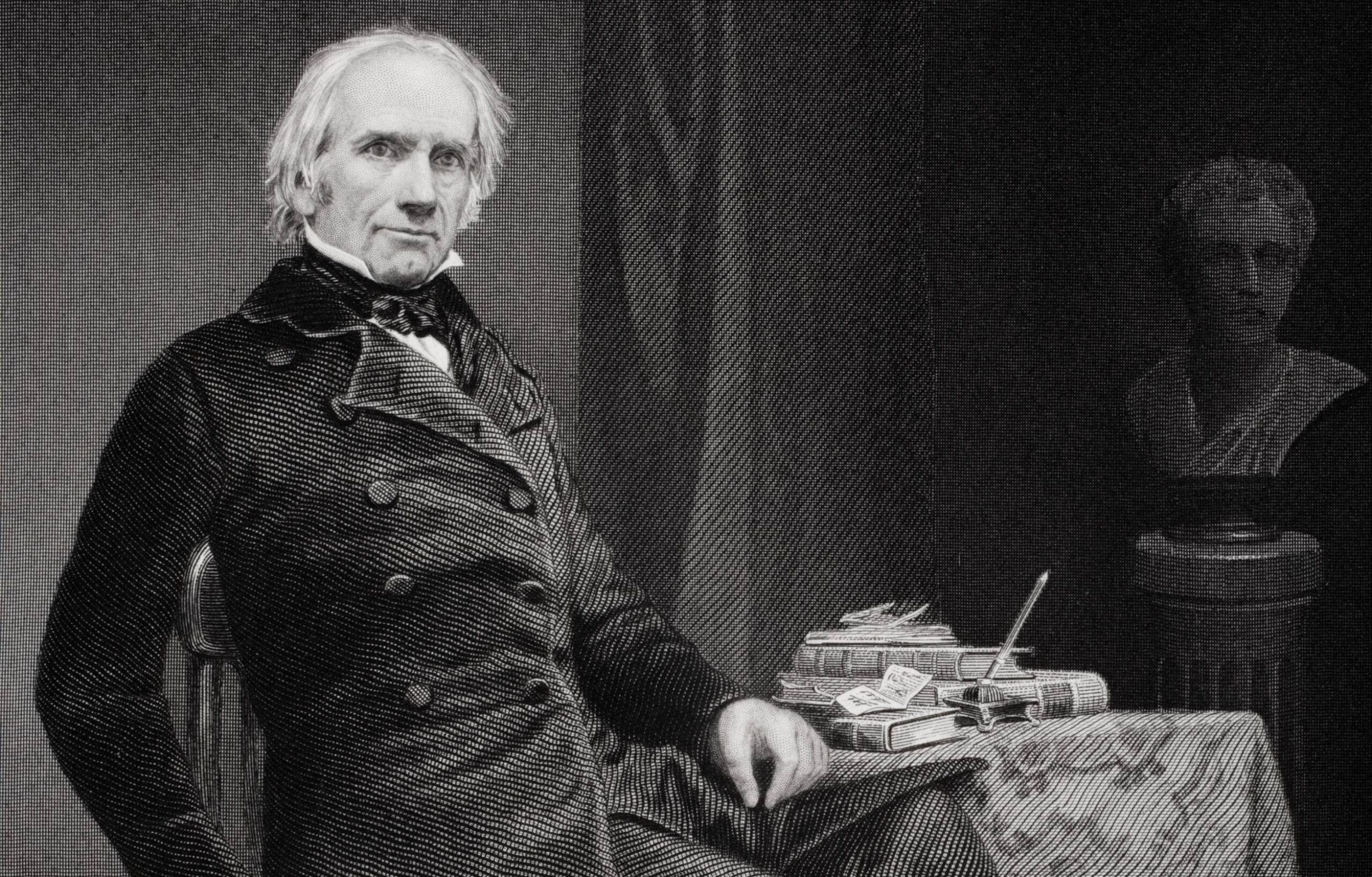
On July 6, 1852, Abraham Lincoln rose to eulogize a man he had called his “beau ideal” of a statesman.The young Illinois congressman who would one day save the republic stood before a Springfield crowd and reached for language adequate to express the loss of a man he had come to model in thought, word, and deed.
What Lincoln said that day is worth revisiting.
“He loved his country partly because it was his own country, but mostly because it was a free country; and he burned with a zeal for its advancement, prosperity and glory, because he saw in such, the advancement, prosperity and glory of human liberty, human right and human nature.”— Abraham Lincoln, Eulogy for Henry Clay, July 6, 1852
Lincoln understood something that most of Clay’s eulogists missed.
Clay was not merely a statesman or a compromiser or a creature of the Senate chamber. He was, above all things, a builder. He was a man who had looked at the young republic and saw not just what it was: but what it could become. Always pragmatic, he did not sit daydreaming. He worked to organize the political economy of the nation to bring his vision about.
The grief in Lincoln’s voice that day was not just for a mentor and a political hero. It was for a man that represented the best ambition of the Nation itself.
Even Clay’s rivals deeply mourned his passing.
Lincoln reminded his audience of something easy to forget. Henry Clay had been born in 1777 — the first year of American independence — an obscure child of undistinguished parents in a Virginia backwater, entering the world at the very moment the nation itself was fighting for its life.
The infant republic and the infant child began the race of life together. For seventy-five years they traveled hand in hand. The nation passed its perils and emerged free, prosperous, and powerful. The man reached his manhood, his middle age, his old age, and died. As Lincoln put it simply: "In all that has concerned the nation the man ever sympathised; and now the nation mourns for the man."
But Clay’s death and legacy symbolize not the end of the Republic, but the foundations upon which our Nation grew and became a great power. His spirit lives on through that vision of the American System he envisioned and worked to build, and what this generation is being called to finish.
The Architecture of Greatness
To understand what Clay attempted to build with his “American System” you have to understand the crisis he was answering. In the years after the War of 1812, the young American republic faced an existential economic threat that its founders had not anticipated.
British manufactured goods, cheaper and more refined than anything American workshops could produce, flooded the domestic market. Nascent industries folded. The political independence won at Yorktown was revealing itself to be economically hollow. A nation that could not make its own cloth, its own iron, its own tools, remained in every meaningful sense a colony.
While the American revolution had won the former colonies the rights to their own representatives and systems of Government, its dependence remained on the empire and old world it had ostensibly left. As we explored in our review of Lindsay Schakenbach Regele's Manufacturing Advantage, this was not merely an economic embarrassment but a substantial national security crisis. American troops had begun the War of 1812 practically unable to clothe or arm themselves. The crisis of dependency was not theoretical. It had been written in blood.
Clay’s answer was architectural. The American System rested on three pillars that were designed not as separate policies but as a single coherent structure.
Protective tariffs would strengthen the domestic market and create an atmosphere safe for the development and thriving of national industries. A national credit architecture, then represented by the Second Bank of the United States, would work to direct capital toward productive development and the American System's third pillar, internal improvements. Internal improvements, as we explored in our review of Daniel Walker Howe's Political Culture of the American Whigs, meant something far broader to Clay and the Whigs than roads and canals. They were projects that would bind the domestic market together, shortening the distance between farmer and manufacturer, between raw material and finished good, and between regions that might otherwise remain strangers to each other. They were seen as a critical ingredient for unifying the different sectional interests so prevalent in the early republic, where state and regional identities often took precedence above national ones.
These three legs held each other up. The tariff generated revenue for improvements. The improvements deepened the domestic market that the tariff was protecting, and made the nation more productive and unified. The credit institution financed both. Remove any one and the structure weakened. Remove two and it collapsed.
What Clay understood, and what his successors consistently failed to fully realize, was that the American System was not a menu of policies from which a legislator could order selectively. It was an integrated vision of how a free republic deliberately builds the economic foundations of its own greatness, and how a democracy binds a people together.
The Incomplete Revolution
The American System did not fall to better arguments. It fell to the structural contradictions of the republic it was trying to build.
The southern economy was not simply hostile to Clay’s vision but rather in its own logic, rationally wary of it. The plantation system depended on the free export of cotton and tobacco to British and European markets, and on the cheap importation of the manufactured goods that southern planters needed but did not produce. A protective tariff raised the price of those imports.
Internal improvements, financed by tariff revenue, were seen as primarily benefiting the manufacturing regions of the North and West. And a national bank, with its power concentrated in the north with figures such as Nicholas Biddle, was treated as extremely suspect from southerners.
From inside the plantation economy, the American System could look less like national development and more like a northern program being imposed on a southern way of life at southern expense. That perception was not entirely without foundation, the American system did threaten the agrarian slave system, but ultimately the System’s architects believed sincerely, and rightfully, that its benefits would ultimately flow to every region.
John C. Calhoun — who had once been among the System’s most eloquent advocates — pivoted to become its most dangerous opponent after James Madison’s veto of the Bonus Bill in 1817 denied federal funding for the internal improvements Calhoun himself had championed. That veto was, in retrospect, the original sin. Without the binding infrastructure that internal improvements would have provided, the System’s ability to demonstrate concrete benefits to the South evaporated. What remained looked, to southern eyes, like taxation in service of northern industry. The structure was severed before it could prove itself whole. And after the tariff of 1828, commonly referred to as the “tariff of abominations” was passed, Calhoun would lead opposition against the tariff in South Carolina, becoming the first Vice President to resign.
When South Carolina threatened to secede due to the tariff, Andrew Jackson sent federal troopers to enforce its collection. But on the question of the bank, Jackson would choose differently. The Bank War of the 1830s dismantled the credit architecture. The great democratic populist who styled himself the champion of the common man against the moneyed elites succeeded primarily in destroying the one institution capable of directing national capital toward national development.
Abraham Lincoln came closest to the complete vision. With the Morrill Tariff, the transcontinental railroad, the land grant colleges, the Homestead Act, the Republican program of the 1860s was the most serious attempt to implement the American System. For the first time the three pillars stood together, however briefly, and the results were historic. The United States industrialized at a pace the world had never seen. But even Lincoln’s achievement was incomplete.
The alleged and often overstated corruption of the Grant era, much of it tied to railroad financing, poisoned the well of internal improvements for a generation. And without a permanent architecture of national investment — without something like the Bonus Bill Clay and Calhoun had originally imagined — the System’s productive gains flowed upward into the great industrial trusts rather than outward into the national community.
When the progressive critique of concentrated industrial power arrived at the turn of the century, the protectionists struggled to adapt. They had built the tariff. But they had never finished building the American system. And so free trade orthodoxy landed its killing blow not by winning an argument but by pointing at the wreckage: You said protection builds civilization. You built Standard Oil.
The Experiment That Failed
Manchester liberalism won the universities after that, and it held them for a century. But it did not win policy immediately.
The Republican Party of the 1920s maintained the protective tariff tradition, passing the Fordney-McCumber Tariff of 1922 and later the Smoot-Hawley Tariff of 1930. American industry remained substantially protected. What these administrations could not do, and largely did not attempt, was revive the internal improvements architecture that the corruption of the railroad era had discredited. The tariff stood. The binding infrastructure did not. And without it, the System's productive gains continued flowing upward into concentrated capital rather than outward into a deepened national market. When the Great Depression arrived, free traders had their weapon. They blamed Smoot-Hawley, absolved the financial system, and used the wreckage to write protection out of respectable economic thought entirely. The indictment was always more convenient than it was accurate. But it stuck.
The Washington Consensus of the 1990s was Manchester liberalism’s culmination — a global bet that deep economic integration would liberalize rivals, flatten geopolitical competition, and deliver prosperity through comparative advantage. Factory by factory, supply chain by supply chain, the American industrial base was allowed to migrate abroad on the theory that what replaced it would be better. The economists had models. The models said it would work.
It did not work. The communities hollowed out by deindustrialization did not transition smoothly into the knowledge economy. The geopolitical rival that was supposed to liberalize under the civilizing influence of trade became instead the world’s dominant manufacturer and a systematic adversary. The supply chains that undergird American military and technological power now run through that adversary’s territory. The political independence maintained at enormous expense since 1945 has become, again, economically contingent.
Henry Clay saw this coming. Not because he was a prophet, but because his intellectual tradition had worked out, with considerable precision, exactly why external market orientation produces dependency rather than development. The road to national greatness runs through the depth of the domestic market, not the breadth of global trade.
The American School of economics — Clay, Hamilton, Henry Carey, Friedrich List, Erasmus Peshine Smith — built a complete and coherent theory of how nations actually develop. They were defeated not by better arguments but by sectionalism, by the Bank War, by the corruption of the railroad era, and ultimately by the cultural capture of American universities by a tradition that had begun as a British export.
They were right. We can demonstrate now, with the hindsight of a globalization experiment that has run its course, that they were right. And that changes everything about what this moment requires.
The Revolution Unfinished
Over the next nine days, leading to Henry Clay’s birthday on April 12th, this publication will make that case in full. We will trace the intellectual foundations of the American System from Hamilton’s Report on Manufactures through Carey’s demolition of Ricardian free trade doctrine. We will examine why the System was never completed and what that incompleteness cost. We will reckon honestly with the objections of the System’s critics and give their strongest arguments their due before dismantling them.
And on April 12th, we will attempt something more ambitious: a full account of what the 21st Century American System looks like. Not as nostalgia. Not as a revival of 19th century policy instruments. But as a coherent program adequate to the conditions of the Fourth Industrial Revolution. The tariff is back. But tariffs alone were never the point. The internal improvements, the binding infrastructure of national productive capacity, were always the deeper argument. In the 21st century, that means fusion energy and AI infrastructure and transcontinental water systems and the deliberate expansion of the American productive frontier in ways that Clay himself would have recognized instantly, even if the technologies would have astonished him.
The boy was born with the republic. The man spent his life trying to build it into something worthy of its own promise. The tradition he founded was defeated before it could be completed. But incomplete is not the same as wrong. And 2026 is not 1852.
Clay’s revolution is unfinished. It is time to finish it.
This is Day One of Ten. Each day through April 11th, APTL will publish a new piece in this series, biographical, theoretical, historical, polemical, all building toward the April 12th capstone: a full account of the 21st Century American System.
Subscribe to follow the series as it unfolds.
READ NEXT:

How America Developed Its First Military-Industrial Complex

The American War of Independence was demonstrably a reaction to the policy of the English Crown which prohibited the growth of American manufacturing, fostering dependence on Great Britain and her factories. Under acts such as the Iron Act of 1750 and the Hat Act of 1733, American colonists were restricted from the basic liberty of manufacturing their o…
The Political Party That Made The United States a Nation

“To the extent that we continue to face issues like the conservation or exploitation of resources, the integration or separatism of ethnicity, morality in the media, responsibility in the use of alcohol and drugs, and the reaction to unjust wars, the Whigs and their times will never seem totally alien.”
what a great article! thank you
Henry Clay's American System was never implemented and the Hamiltonian style system, as far as it was partially implemented, was undone in the 1830s during the Bank War. From the 1830s until well after WW2 the United States pursued a policy of deliberate economic, governmental, scientific, fiscal redundancy and operated with substantial legal/regulatory and policy variability, and had decentralized banking/finance/monetary system with very pluralized capital formations. And the Federal government was the smallest of the three levels of government in regards to overall revenue intake and spending. Thats the opposite of Hamilton and Clays' intentions. The core of Henry Clay's envisioned order was implemented with advent of the so called Neoliberal Era.