

The American War of Independence was demonstrably a reaction to the policy of the English Crown which prohibited the growth of American manufacturing, fostering dependence on Great Britain and her factories. Under acts such as the Iron Act of 1750 and the Hat Act of 1733, American colonists were restricted from the basic liberty of manufacturing their own pots, pans, and other works of iron, and even from manufacturing their own hats. Other simple articles were effectively prohibited, with these acts and others enforcing a state of imperial subservience on the United States in favor of British manufacturers.
Such a state was not entirely dissimilar to the actions of the British East India Company in India at the time. While native manufacturing within India was punished, with artisans even having their hands forcibly removed for violations of English prohibitions, raw resource export industries were encouraged. The East India Company profited greatly from the extraction, transport, and insurance of lucrative and exploitative trade. As historians Emma Rothschild and Arthur Schlesinger have pointed out, American colonists were rightfully afraid of similar treatment and even the possible establishment of British East India Company representation within the Americas, given the prohibitive laws being established, exemplified by the aforementioned acts.
In this state of forced subservience and under the threat of barbarism, American merchants and plantation owners such as George Washington, who relied heavily on exporting raw resources in exchange for British manufactured goods, were increasingly squeezed. Many landholders saw rising debts as a result of British policy. American manufacturing, when attempted at all, was quickly ruined or rendered uncompetitive against British manufacturers supported by political representatives who placed metropolitan interests first, without the consent or input of the colonists. The time for resistance had come, and the ongoing American Revolution was born.
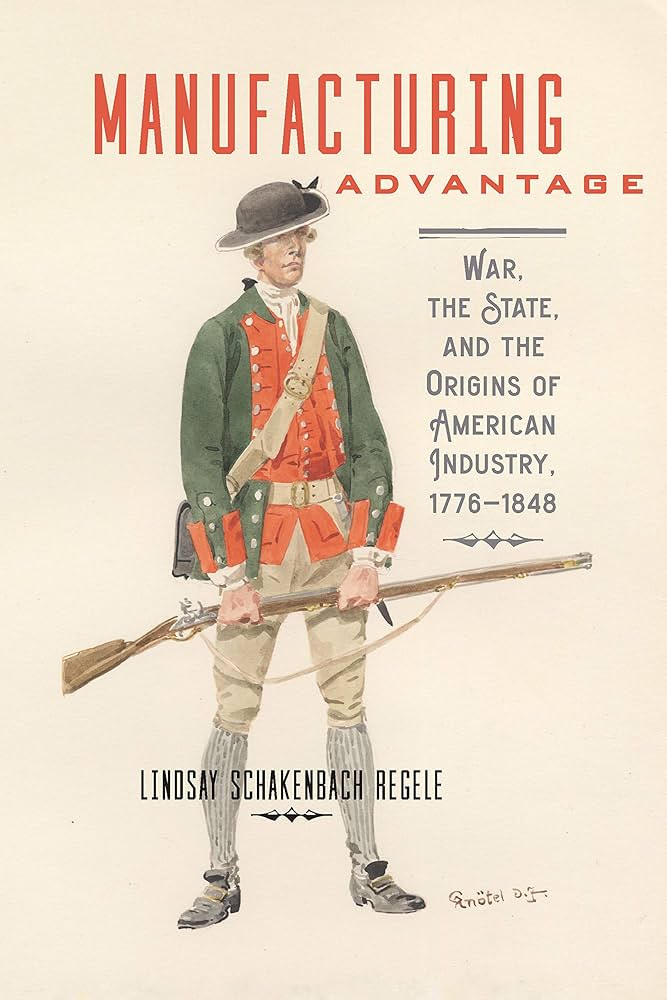
Lindsay Schakenbach Regele’s work, Manufacturing Advantage: War, the State, and the Origins of American Industry, captures and chronicles the growth of two particular American industries in response to these dire circumstances following the War of Independence. She studies how the American textile and weapons industries developed from miserable conditions at the war’s outset, through the War of 1812, and ultimately through the end of the Mexican-American War. American troops began the War of Independence practically naked. The textile industry within the United States was virtually nonexistent and entirely incapable of clothing the Patriot Army. While limited weapons manufacturers, mostly small private enterprises, were able to partially supply the army, without the importation of French muskets the Patriot forces would have been nearly unarmed.
Recognizing these constraints, the early governments of the American colonies and the future United States experimented with various means to support and incentivize the development of these two critical industries. Recognizing textile and arms manufacturing as essential to the national security of the fledgling republic, American policymakers employed protective tariffs, cash advances, and other subsidies to encourage the development of military-industrial sovereignty. By the time of the War of 1812, the nation had unfortunately not done enough. Once again, the United States struggled to clothe and arm its militias and relied heavily on imports. Yet once again, wartime necessity provided the impetus for policymakers to recognize the urgent need to foster and protect domestic industry.
In response to the War of 1812, the nation’s embrace of protective tariffs and industrial policy finally cemented the development of military-industrial sovereignty. While the United States would not again formally declare war until the Mexican-American War, ongoing conflicts with Native American tribes in Florida and across the western frontier required sustained investment in arms production. Initially centered at Harpers Ferry and later particularly in Springfield, Massachusetts, the arms industry, alongside textiles, became concentrated in New England. Entire factory towns organized around industrial economies emerged along the region’s rivers.
Through protective tariffs and industrial subsidies, a nation once unable to clothe its soldiers became the foremost arms producer in the world. American weapons supplied the independence movements of Latin America and played prominent roles even in European conflicts. This industrial capacity protected the United States from threats both on the frontier and abroad. During the Mexican-American War, the U.S. Army, though often outnumbered, prevailed with ease due to the abundance and superiority of its firearms, including the new revolvers produced by Samuel Colt. At the same time, American textiles, not British textiles, were beginning to dominate Latin American markets.
Dr. Lindsay Schakenbach Regele’s book is a superb study of these early industries. Her writing is concise, clear, and well sourced. My primary criticism is that the work is so effective and engaging that I wished it were twice as long. While the book provides a sufficient and coherent overview of the historical development of these industries, Dr. Regele’s evident mastery of the subject leaves the reader eager for greater depth. It would be particularly valuable to see a more detailed examination of the specific tariffs and industrial policies that proved most effective, how industries responded to them, and how manufacturers organized to advocate for their own interests.
That said, this breadth is also the book’s strength. By painting a wide historical picture rather than narrowing its focus too tightly, Manufacturing Advantage accomplishes exactly what it sets out to do. A more granular approach might have weighed the work down unnecessarily. Nevertheless, I sincerely hope Dr. Regele will supplement this excellent study with a deeper and more focused analysis in the future.
Dr. Regele, thank you for the excellent read.
If you enjoyed this book review, please consider subscribing to The Tariff Times.
Furthermore, if you wish to read Dr. Regele’s book, please purchase through the following link. As an Amazon Affiliate, I get a small commission when you purchase through my link. All commissions earned will be reinvested into my new project, The American Protective Tariff League. Thanks and happy reading!
Manufacturing Advantage: War, the State, and the Origins of American Industry