

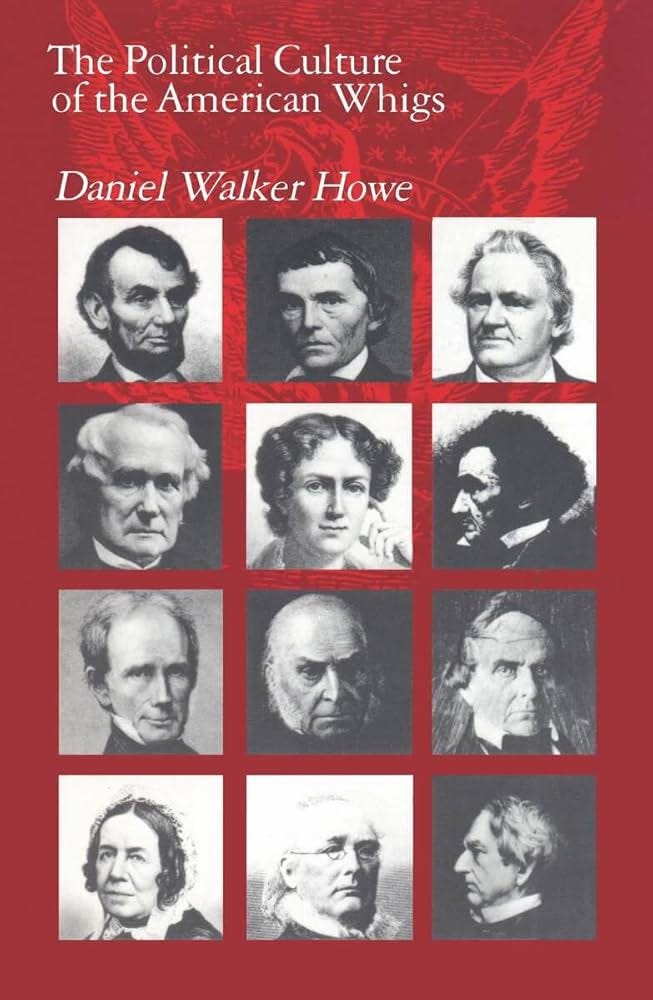
“To the extent that we continue to face issues like the conservation or exploitation of resources, the integration or separatism of ethnicity, morality in the media, responsibility in the use of alcohol and drugs, and the reaction to unjust wars, the Whigs and their times will never seem totally alien.”
Daniel Walker Howe’s portrait of the political culture of the American Whig Party is highly illuminating. At once progressive and highly conservative, at once champions of social improvement and defenders of social order, Whig leaders were the personification of an American ethic of ordered liberty. The transformation of the United States from an amalgamation of semi-independent states into a coherent nation-state, with a recognizable national character and developmental purpose, owes much to the project of which the Whig Party was the chief political champion.
From Henry Clay’s “American System,” to Henry C. Carey’s nationalist political economy, to Horace Mann’s construction of a public school system, the Whigs sought to build not merely policies, but institutions, habits, and a national civilization. Central to this project was what might be called the American School of Political Economy: a protectionist, developmental, and explicitly national economic doctrine that understood industry, infrastructure, education, and finance as instruments of moral and social as well as material progress.
It is here that Howe’s account becomes especially illuminating. The Whiggish worldview was not merely moralistic, nor merely technocratic, but an attempt to reconcile order and progress, hierarchy and improvement, through a consciously designed political economy. This perspective also shaped the Whig approach to what would become the greatest problem of the age: the plantation system of the South. While Howe’s book is not about slavery as such, it becomes clear that the American School represented an implicit scientific and economic critique of the slave system. The plantation economy was not merely morally objectionable to many Whigs, but socially regressive, anti-developmental, and fundamentally incompatible with a modern, industrial, nationally integrated republic.
In the context of industrialization, where inequality could rise even as general prosperity rose with it, this Whiggish synthesis of order and progress was not inherently unstable. But the continued dominance of the plantation system, and its expansion into new territories, increasingly represented not only a moral problem but a civilizational and economic one: a rival social system standing in direct opposition to the Whig vision of national development. It is no surprise, then, that the Whig movement eventually collapsed under the weight of the Kansas-Nebraska Act and the irreconcilability of these two systems. Yet the Whiggish tradition itself did not disappear. It formed the mind of a generation, and of one American in particular, Abraham Lincoln, who would ultimately preside over the violent resolution of this contradiction. Ultimately, the Whig party was the vessel by which a truly national consciousness arose out of a country whose people often put local identities before national feeling, and the Republican party would come to form the foundation by which this national identity would wield political power.
Daniel Walker Howe’s work is technically superb. After setting the stage with the context and foundations of the Whig Party, he moves on to examine several of its key figures. More than providing a biography, however, Howe uses these characters to reveal the true personality and ethos of the Whig movement itself. You leave this book not merely knowing these figures, but feeling as though you have encountered them as living personalities. He occasionally gestures toward psychological or sociological interpretations typical of his era, but never in a way that distracts from the substance of the work.
Howe’s writing is clear and focused, and the chapters work both as a unified whole and as stand-alone essays. Few historical works are as well designed in their overall structure. One does not regret the time spent reading this book.
The Political Culture of the American Whig Party is an outstanding work. While far less famous than The Age of Jackson, it is among the best books for understanding American politics and political economy in the nineteenth century. Any reader interested in the Whig Party, the American School, or the developmental origins of the American nation-state will learn a great deal from it.
Rating: 5/5
If you enjoyed this book review, please consider subscribing to The Tariff Times.
Furthermore, if you wish to read Daniel Walker Howe’s book, please purchase it through the following link. As an Amazon Affiliate, I get a small commission when you purchase through my link. All commissions earned will be reinvested into my new project, The American Protective Tariff League. Thanks and happy reading!
The Political Culture of the American Whig Party by Daniel Walker Howe
One thing I wish to clarify. The friction between the hierarchal nature of the Whigs vision of ordered liberty, and their dedication to moral and social progress, was at once the seed of their genius while furthermore the root of their demise. This tension manifested itself in disputes between southern Whigs and others less intent or otherwise cautious of addressing the slave question, and dedicated abolitionists who were often seen as dangerous radicals. The result of the inability to resolve this question within the party lead to its collapse after the Kansas-Nebraska act, in which frustrations had boiled over and the coalition split. However, the Republican Party would arise from the very best sentiments of the Whig party, with all of its national attitude, and all of its crusading impulses toward the moral and national progress of the American Republic. In a certain sense, the Republican Party was the militant step child of the Whigs. A thorough analysis of the history of the Republican Party is on my docket for one of the next books for me to read. For that purpose, I will be reading “Grand Old Party: A History of the Republicans” by Lewis L. Gould. Feel free to read with me, although I have quite a few books I need to read and finish before I get to this, most notably right now “Three Days at Camp David…”