

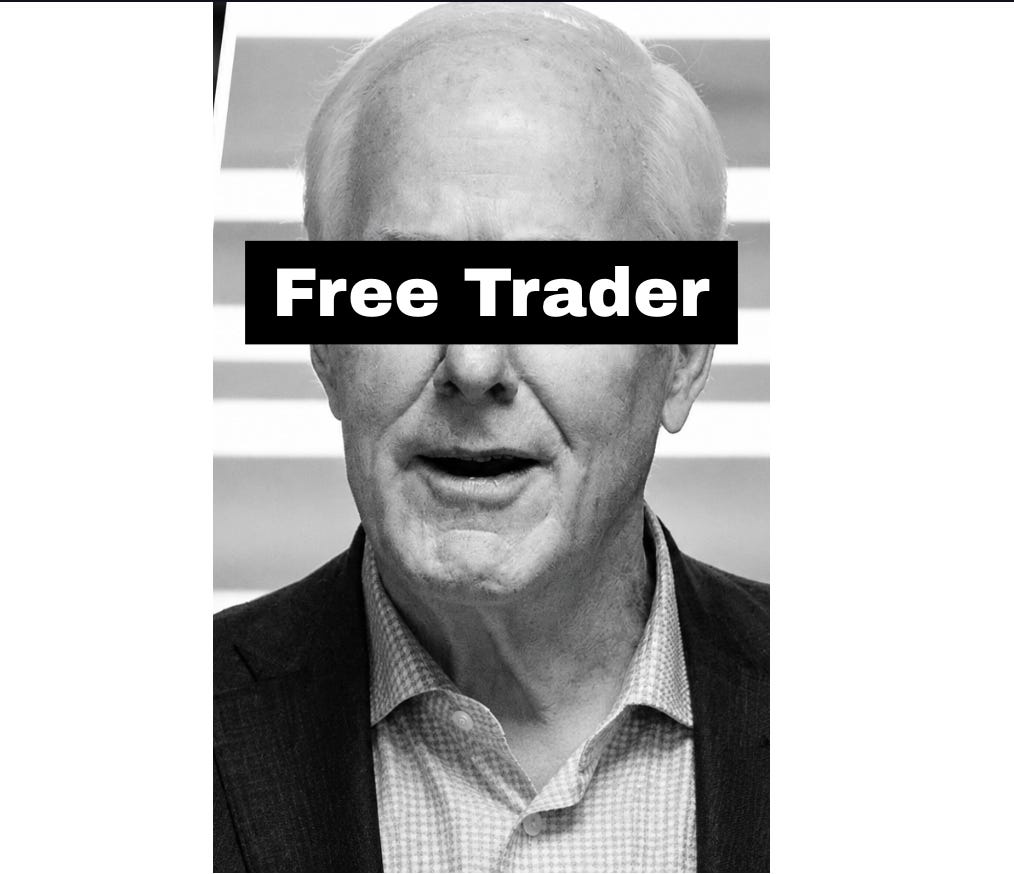
Today, Texas Republicans will decide whether John Cornyn will have the opportunity to return to the Senate for a fifth term. Over the past 23 years, Cornyn has been one of the fiercest advocates for free trade in the upper chamber, and has made it part of his agenda to dismantle the protection that built American industry and now sustains the American worker.
For instance, in April of last year, barely a fortnight after President Trump’s decisive action on Liberation Day, Senator Cornyn sat down with his local ABC News affiliate in Dallas and explained how hopeful he was that the 90-day pause on tariffs would give space to “negotiate, hopefully what amounts to zero tariffs.” He went further: “If we can get an opportunity to get to zero [tariffs] – to me that’s the goal.”
Perhaps you think this is a one-off. John Cornyn is not hiding what he is truly about. Later that same month, on CBS News Texas, Cornyn stated: “Ultimately, I think the goal should be zero tariffs, especially between friends and allies.” Zero tariffs? In the early days of the Republic, even most free traders recognized the need for some tariffs, even at low rates, as a means of raising government revenues and funding the federal establishment. Cornyn, by embracing a call for zero tariffs, is doing more than rejecting the historic engine of American development. He is pursuing a policy that is deliberately destructive of American industry, a policy that delivered us the China Shock, the post-1980 collapse of labor’s share of national income, and the fentanyl-saturated wreckage of communities across our nation.
This is not a man who has reluctantly come around to President Trump’s trade agenda. This is a man waiting it out, hoping that the next President will once again abandon American workers and industry, and embrace a vision of “free trade” that results in the devastation of our national security and the uplift of the Chinese Communist Party.
A Record, Not a Rumor
Senator Cornyn’s free trade convictions are not new and not subtle. In November 2016, after Donald Trump shocked the political establishment with the greatest political upset in modern American history, Cornyn told the Texas Tribune that he hoped “after emotions cool” the country would “take a more reasoned approach” to trade.
By a “reasoned approach,” Cornyn did not mean the American System of Protection, which built the United States into the industrial superpower it became in the twentieth century. He meant the approach that governed the Washington Consensus — the fantasy that free trade would transform nations like China into democracy-loving allies, eager to partner with the United States in spreading peace, love, and prosperity around the globe. Cornyn lamented that without voices “explaining the benefits of trade for everybody,” the “more shrill, less responsible voices” would fill the vacuum.
Translation: the voters who elected Donald Trump on a protectionist platform were shrill and irresponsible.
Cornyn’s record of selling out American workers and industry does not stop with his open-borders policy on trade. It extends to his open-borders policy on illegal immigration. In January 2017, when the first Trump administration floated a border adjustment tax to help fund the border wall, Cornyn led the Senate skepticism. He told reporters he had “concerns” and warned that a refiner had told him gasoline prices might rise by 30 cents. Cornyn was named in trade press as a key Senate obstacle to the proposal. The border adjustment tax died. The wall did not get built that term. The trade deficit with Mexico kept growing.
In March 2018, when President Trump invoked Section 232 to impose steel and aluminum tariffs to protect strategic American industry, Cornyn’s contribution to the national conversation was this: “My constituents are worried about the cost of their beer cans. It’s a concern.” A trade subcommittee leader from a state that produces steel, oil, and beef reduced the case for industrial protection to the price of aluminum cans on a Texas porch. It is the kind of unserious objection that defines a worldview.
In November 2022, as ranking member of the Finance Committee’s trade subcommittee, Cornyn went further still. He used his platform to advocate that the United States join the Comprehensive and Progressive Agreement for Trans-Pacific Partnership — the multilateral free trade pact that President Trump had wisely withdrawn the United States from in his first term. Three years ago, with USMCA freshly negotiated and the limitations of the old order increasingly clear, the senior senator from Texas was working to drag America back into the same trap.
Cornyn continued to hedge his bets on a post-Trump, open-borders Republican Party deep into 2024. While campaigning to replace Senator McConnell as Senate GOP leader last August, Cornyn told Axios that across-the-board tariffs were “problematic.” This was three months before the election in which the American people would once again elect President Trump on a mandate explicitly built on across-the-board tariffs.
Beyond standing against tariffs, Cornyn did not even have the decency to present a unified face for our country and the administration in early February 2025, when President Trump issued the first round of tariffs against Mexico, Canada, and China. There is a saying in Washington that “politics stops at the water’s edge” — that bickering should end and political leaders should present a united front when dealing with international relations, national security, and foreign policy. At this critical moment, Cornyn told the Texas Tribune: “It’s a little hard to separate the negotiation tactics from reality. There comes a point at which tariffs add cost to consumers.”
Beyond the reality that this is the standard caricature, recited from memory, the kind of objection that does not survive critical or long-sighted examination, his unwillingness to stand united with the President and our country at such a critical moment reflects his unwillingness to be a representative of America rather than a representative of an ideology. A senior senator from the President’s own party should never act this way on the very day that a signature economic policy of the President takes effect.
The Chairman Who Will Not Lead
All of this matters more, not less, because of what John Cornyn does in the Senate today. He is not merely a member of the Senate Finance Committee. In the 119th Congress, Senator Cornyn serves as the Chairman of the Senate Finance Subcommittee on International Trade, Customs, and Global Competitiveness — the single Senate subcommittee with primary jurisdiction over American trade policy. He is also one of five Republican senators designated as a Congressional Trade Advisor on Trade Policy and Negotiations.
The trade gavel is in his hand. And he has used it to call for zero tariffs.
This is no small matter. On February 20, 2026, the Supreme Court ruled 6-3 in Learning Resources, Inc. v. Trump and Trump v. V.O.S. Selections, Inc. that the International Emergency Economic Powers Act does not authorize the President to impose tariffs. The IEEPA tariffs — the reciprocal architecture announced on Liberation Day, the fentanyl tariffs on Canada, Mexico, and China — terminated four days later. The legal foundation of the most ambitious restructuring of American trade policy since the Reciprocal Trade Agreements Act of 1934 was knocked out from under it.
What was the response from the chairman of the Senate’s trade subcommittee? Not a bill granting the President clear statutory tariff authority. Not legislation cementing the reciprocal structure into law. Not a meaningful response to the currency manipulation, transshipment, and forced technology transfer that the President’s tariffs were designed to combat. Instead: hearings about Australian non-tariff barriers to Texas beef exports, where the very first move by Cornyn at USTR Greer’s April 2025 testimony was to pivot the conversation from American producer protection to foreign market access for American exporters. The first frame leads to “zero tariffs.” The second frame leads to the American System. Cornyn knows the difference. He chose the first frame on purpose.
Henry Clay understood the difference. Henry Carey understood the difference. E. Peshine Smith, whose Manual of Political Economy laid out the doctrine that powered post-Civil War American industrialization, understood the difference. The protective tariff was never primarily about prying open foreign markets for American exports. The protective tariff was about building the integrated domestic economy that made American workers the most productive on earth. Cornyn’s framework — reciprocity as a path to zero — inverts this entirely. It treats the American market as a bargaining chip to be traded away rather than as a strategic asset to be defended.
The Senate Finance Committee was where the protective tariffs of 1861, 1890, and 1922 were built. It is where they are being slowly suffocated today, with John Cornyn as one of the senior morticians.
The Choice
Ken Paxton has not written a treatise on the American System. He is not, as far as anyone has documented, a student of Henry Carey or Friedrich List. But he is a man who understands what time it is. He understands that the President’s trade agenda is the most important domestic policy initiative in two generations, and he is running to defend it without reservation, without “reciprocity-toward-zero” caveats, and without one foot already out the door waiting for the political climate to cool.
That matters. The next six years will determine whether the protective turn becomes the new American consensus or a brief Trump-era interlude before the Cornyns of the world reassert control. Texas Republicans have the chance today to send a senator who will fight for the agenda, not slow-walk it from the chairmanship of the very subcommittee where the agenda will live or die.
The Republican Party of Henry Clay was built on protection. The Republican Party of John Cornyn has spent forty years apologizing for it. The choice on the ballot today is, in a small way, the choice between those two parties.
Get to zero, John Cornyn said. The voters should answer in kind.
Thank you for this succinct piece on Cornyn. As a lifelong Texan, at least until 2018 when I moved to the Rockies, it was with great pleasure to see Cornyn’s resounding defeat. Paxton is a powerhouse and I predict he’ll trounce the abominable and blasphemous Talarico.