

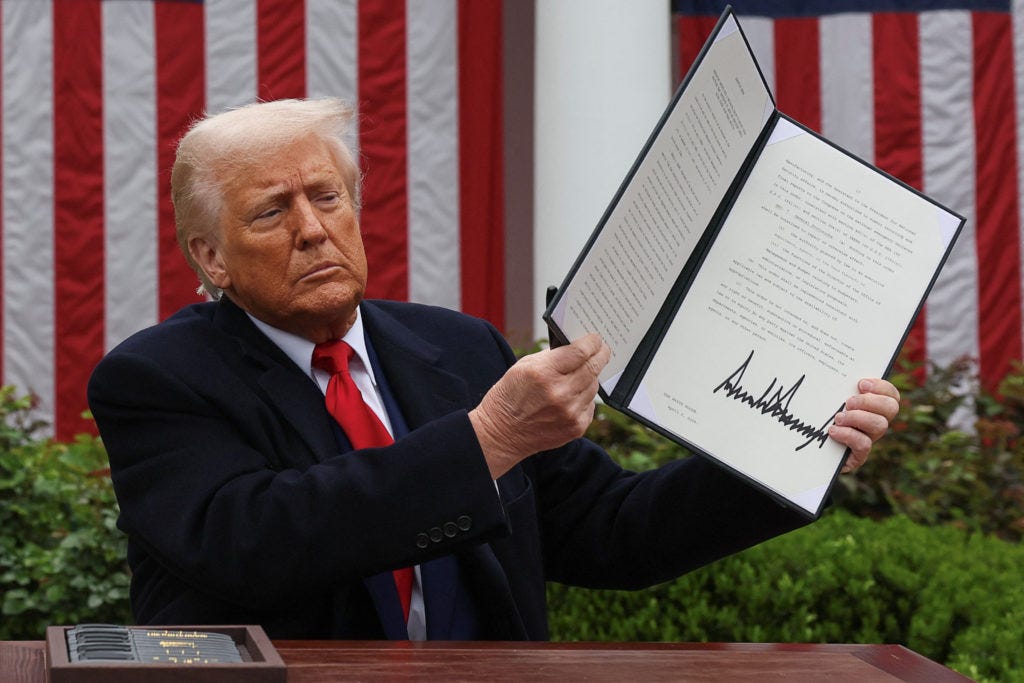
A year ago today, on April 2, 2025, Donald Trump stood in the Rose Garden and did something no president had dared to do in nearly a century.
The tariffs announced on what the President rightly called Liberation Day struck back against five decades of slow, deliberate hollowing-out of American manufacturing, produced by free trade.
Since then, the President’s tariffs have been contested in their legal architecture, and met with the predictable howls of a Washington commentariat that has not built a factory or carried a shift in its life. But all of the resistance, and the many setbacks, have yet to change what Liberation Day actually was.
Liberation Day was the most consequential act of economic statecraft in over a hundred years. Thanks to President Trump, a door has opened for Protectionists that the enemies of the American system had sealed shut. Finally, on the 250th anniversary of the country’s Declaration of Independence, tariffs have retaken their rightful place as a key ingredient for American statecraft.
We have reason both to celebrate and to demand more. The President delivered a paradigm shift, but the Congress has yet to deliver.
The Good
Let’s begin with what has been won.
In the months following Liberation Day, companies announced more than $1.7 trillion in new American manufacturing commitments including semiconductor fabs in Arizona and Texas, pharmaceutical plants across the South, battery facilities in Tennessee, glass and component lines from Kentucky to California.
Apple alone has pledged $600 billion in domestic investment over four years. TSMC, the world’s most advanced chipmaker, committed $165 billion to its Arizona expansion — the largest single foreign direct investment in American history. IBM pledged $150 billion. Micron, $200 billion. Eli Lilly and Johnson & Johnson together committed tens of billions more to domestic pharmaceutical production.
These historic investments make it clear that manufacturers are voting with their capital on a simple proposition: that America is open for production again. Tariff revenue reached $264 billion in the 2025 calendar year — nearly five times the prior year’s total. Manufacturing new orders for durable goods, capital equipment, and industrial machinery rose meaningfully in the months following Liberation Day, reversing a years-long decline.
The American Compass’s analysis of Census Bureau data showed new orders for nondefense capital goods climbing through the second half of 2025, precisely the signal that genuine reindustrialization sends. Job openings in the manufacturing sector, which had been falling steadily, halted their descent on Liberation Day and began to reverse.
And consider what was accomplished geopolitically. For decades, Americans faced what might be called the long surrender. A Giant Sucking Sound in which American workers saw their jobs move toward countries with state-subsidized competitors and, in the case of China, documented forced labor that no American company could legally replicate at home.
That era is gone, President Trump ended it. No future administration will be able to pretend that free trade is a neutral policy. That is a civilizational achievement.
The Bad
And yet, the investment pledges, however enormous, have not fully translated into factories on the ground, because capital does not move toward uncertainty. The source of that uncertainty is not the President’s ambition but instead the absence of a Congress willing to match it.
In February, the Supreme Court ruled in Learning Resources, Inc. v. Trump that IEEPA does not authorize the President to impose tariffs, on the grounds that a tariff is a tax, and the taxing power belongs to Congress. The decision was legally debatable. IEEPA explicitly grants the President broad authority to regulate and restrict foreign commerce in response to national emergencies — and the notion that Congress, in drafting that language, intended to exclude the most ancient and effective tool of commercial statecraft strains credulity.
Tariffs are not merely taxes. They are instruments of statecraft, increasingly critical to national defense. The President’s lawyers argued as much, and they were not wrong.
But the Court drew its line, and we must reckon with what that line reveals. A great President and a determined executive branch are not, by themselves, enough.
The President used every tool available to him. He was bold where his predecessors were timid, clear-eyed where they were credulous, and willing to absorb enormous political cost in defense of the American manufacturer. And still, the architecture was not there to sustain what he built.
That is the deeper scandal: not the Court’s ruling, but what the ruling exposed. The President should not have had to govern trade policy through emergency declarations. He did so because Congress abdicated.
For decades, the legislature quietly surrendered its tariff authority to international agreements, to executive branch deference, to the soft pressure of a free-trade donor class that had no interest in seeing protection institutionalized in law. The result was a President fighting with one hand, improvising what a generation of protectionist legislators should have already built.
That generation does not yet exist in sufficient numbers. Building it in the Congress, in the committee staffs, in the think tanks and law schools that feed the legislature is the work of a decade, and the raison d'être for The American Protective Tariff League. Congress must step up to meet the President.
The Way Forward
What should Congress do?
The answer is clear, and it has precedent going back to the founding of the Republic.
1. Codify Liberation Day
First, Congress must codify the Liberation Day tariff structure in law. The reciprocal framework the President announced is sound policy: a universal floor rate applied for revenue, with higher protective rates for nations that undercut American business and maintain systematic barriers against American exports. It is also precisely the kind of policy that should have been in the United States Code from the beginning. Congress's decades of abdication on tariff policy forced the President to pursue economic sovereignty through executive order.
Thus, Congress should pass permanent legislation establishing the rate structure, with appropriate authority for the executive to negotiate modifications within defined bands. That predictability is what turns a trillion dollars in investment pledges into factories on American soil.
2. Create a New Tariff Schedule
Second, Congress must reform the Harmonized Tariff Schedule itself. The current schedule is a monument to the free-trade consensus designed to minimize friction, not to protect industry.
A reformed schedule should include both specific duties and ad valorem rates, structured not merely for revenue but explicitly for protection.
This is how Hamilton designed the original system in his Report on Manufactures. It is how Alexander Dallas, facing a Treasury hollowed out by war, used the tariff to rebuild American solvency and lay the ground for Clay's American System. It is how the McKinley Tariff worked. Specific duties protect against foreign dumping and currency manipulation in ways that percentage rates cannot.
A combined system, thoughtfully designed, can protect the infant industries of the twenty-first century — semiconductors, pharmaceuticals, advanced manufacturing, clean energy equipment — in the same way that the Morrill Tariff of 1861 protected the industries of its own age.
3. Direct Revenue toward Internal Improvements
Third, and perhaps most importantly, Congress must direct the revenue.
In 1817, John C. Calhoun introduced the Bonus Bill, which would have directed the bonus paid by the Second Bank of the United States toward a permanent fund for internal improvements: roads, canals, harbors, the physical infrastructure of a continental economy. James Madison, who had given an inaugural speech supporting and promoting this kind of bill, made a perplexing decision on the final day of his Presidency to veto the bill.
Henry Clay spent the next three decades trying to revive the principle: that tariff revenue and the national bank’s resources ought to be directed toward the infrastructure that would make American manufacturing competitive. The Erie Canal was built and railroads followed. But the systematic connection between protective revenue and internal investment was never fully institutionalized at the federal level.
Now is the time to make that connection permanent. The tariff revenue flowing into the Treasury — $264 billion in 2025 alone — should not simply disappear into the general fund.
Congress should establish a dedicated Infrastructure and Reindustrialization Account, funded by a defined portion of customs duties, directed toward the physical investments that make domestic manufacturing possible: ports, roads, rail corridors, energy infrastructure, and the workforce training programs that will staff the new factories.
This is not pork barrel spending. It is the proper direction of revenue that would not exist without the protective system that generated it.
Madison vetoed the Bonus Bill on his last day in office because he believed Congress had not yet authorized the use of those particular funds for that particular purpose. Congress today needs no such authorization. The purse is theirs. The revenue is real. The only thing missing is the will to direct it toward Reindustrialization.
The American System of the 21st Century
The President has done the hard political work. He demonstrated that the American people would support a robust national economic policy. He made clear that the free-trade consensus was a creation of donor-class opinion, not popular will. He proved that manufacturing communities respond to a president who fights for them. He broke the intellectual spell.
What he has handed Congress is not merely a political mandate. It is a blueprint. The outlines of the American System of the twenty-first century are already visible in what the President’s tariffs set in motion — and what a determined legislature could now make permanent.
Imagine a Harmonized Tariff Schedule rebuilt from the ground up by protectionists rather than free traders — one that defends semiconductors, pharmaceuticals, steel, and advanced manufacturing with the same deliberateness that the Morrill Tariff once defended iron and wool. Imagine a reciprocal tariff framework enshrined in statute, giving the executive the flexibility to negotiate and respond while guaranteeing American industry the long-term certainty it needs to invest. Imagine tariff revenue — $264 billion in a single year — directed not into the general fund but into a dedicated infrastructure account, funding the ports, rail corridors, energy grid, and workforce training programs that will make the new factories viable for generations.
This is not a fantasy. It is precisely what Hamilton proposed in his Report on Manufactures, what Clay fought for across thirty years in the Senate, and what Lincoln’s Congress briefly achieved with the Morrill Tariff and the Pacific Railroad Acts. The formula has always been the same: protect the industry, capture the revenue, build the infrastructure, and let the cycle repeat. America did it before. It made us the greatest manufacturing nation the world had ever seen. We can do it again.
But it requires a Congress that understands what is being asked of it. Not a Congress of caretakers content to manage decline, but one with the vision to see that the President has opened a door that protectionists have been locked out of for nearly a century — and the courage to walk through it.
What remains is the legislative work. The work of codifying the revolution so that it outlasts any single administration. The work of building a tariff schedule worthy of Hamilton’s vision. The work of directing the revenue toward the infrastructure that Clay understood as the indispensable third leg of the American System. The work, in short, that only Congress can do.
Liberation Day was the declaration. The law has yet to be written. Congress should get to work.
READ NEXT:
How America Developed Its First Military-Industrial Complex

The American War of Independence was demonstrably a reaction to the policy of the English Crown which prohibited the growth of American manufacturing, fostering dependence on Great Britain and her factories. Under acts such as the Iron Act of 1750 and the Hat Act of 1733, American colonists were restricted from the basic liberty of manufacturing their o…