
Tariff Times Daily: A Replicable Framework for Future Trade Deals?
Todays Tariff Times covers USTR Greer at the Hudson institute, developments at the CIT, complaints by The United Steelworkers, and more.

THE BOTTOM LINE
Tuesday’s policy signals point toward something larger than any individual negotiation: the United States is beginning to define the terms on which trade in Fourth Industrial Revolution industries will operate. The minerals plurilateral, now explicitly designed as a replicable framework, is now an emerging architecture for how Washington intends to structure trade relationships in the strategic sectors that will determine industrial leadership through the coming decades. Pharmaceutical supply chains are already identified as the next application. The EU’s entry into substantive talks on the Digital Markets Act, a first, reflects the same dynamic: standards for how digital markets operate in the transatlantic space are now being actively contested, not assumed. The DOE’s $69 million minerals processing competition targets the gap between extraction and refining — the precise chokepoint where raw material advantage can still be captured by foreign processors — and represents the kind of internal improvement investment that completes what tariff policy alone cannot.
The USW’s warning about AFA softening at Commerce deserves to be read as the most important cautionary note of the day. Trade remedy enforcement is the operational layer that gives industrial policy its teeth. A minerals plurilateral and a reindustrialization agenda mean considerably less if the antidumping mechanism is quietly losing its deterrent function at the agency level. The steelworkers are right to raise the alarm. Standards set at the diplomatic table have to be enforced at the administrative one.
TODAY’S STORIES
USTR: Minerals Plurilateral Could Serve as Template for Pharmaceutical Supply Chains
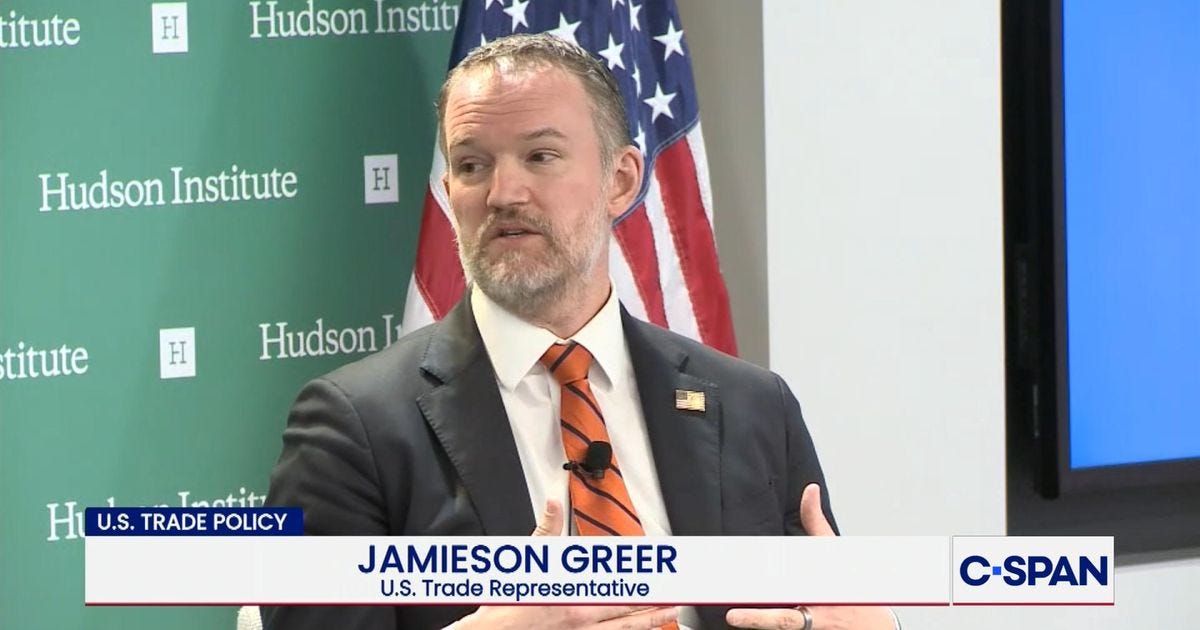
USTR Greer, speaking at the Hudson Institute on Tuesday, said the plurilateral critical minerals agreement under development could provide a model for future work on pharmaceutical supply chains, including generics. The comment extends the logic of the minerals initiative into new industrial territory: rather than crafting separate bilateral arrangements sector by sector, Washington is building a replicable framework for any area where U.S. supply chain exposure creates strategic vulnerability. Pharmaceuticals are among the most obvious candidates, and the minerals track is now the proof of concept.
Hudson Institute
Greer: EU Engaging on Digital Markets Act for the First Time
For the first time, the European Union has begun substantive discussions with the United States on the Digital Markets Act and related digital trade concerns, USTR Greer confirmed Tuesday. Greer described the conversations as sensitive but ongoing. EU digital regulations have long functioned as barriers to American technology firms operating in European markets; the fact that Brussels is now at the table reflects what consistent trade leverage can produce in areas where diplomatic pressure alone had previously made little headway.
Hudson Institute
CIT Selects New Lead Case for IEEPA Tariff Refund Litigation
Court of International Trade Judge Richard Eaton dismissed the Atmus case and lifted a stay in a separate case that will now serve as the primary venue for his dialogue with U.S. Customs and Border Protection on tariff refunds. Eaton has jurisdiction over thousands of importer suits seeking refunds on tariffs imposed under the International Emergency Economic Powers Act. The choice of a new flagship case will shape the procedural framework under which all of those claims proceed, making it a significant development in the legal architecture around executive tariff authority.
Inside Trade
USW Raises Concerns About Weakening of AFA Enforcement at Commerce
The United Steelworkers has warned Commerce Secretary Lutnick that the department may be systematically reducing antidumping duty rates on foreign producers who refuse to cooperate with investigations, citing a preliminary palladium case involving Russian sources as a specific example. Adverse facts available is the mechanism that holds non-cooperating foreign producers to a penalty rate; consistent reduction of those rates would erode the deterrent function of the trade remedy system. The union’s warning is worth taking seriously: trade remedy enforcement is the operational layer beneath tariff policy, and its integrity matters for domestic producers and workers in ways that headline tariff rates alone do not capture.
The United Steelworkers
DOE Opens $69 Million Competition for Critical Mineral Processing Technology
The Energy Department’s Office of Critical Minerals and Energy Innovation announced a funding opportunity of up to $69 million for industry-led projects to prototype critical mineral processing technologies. The initiative targets a persistent gap in the domestic supply chain: the United States has significant mining potential but limited refining and processing capacity, which means raw materials extracted domestically can still pass through foreign-controlled processing before reaching end users. This funding round is one of the more direct investments aimed at closing that gap.
Department of Energy
ON THE RADAR
U.S. equity markets saw sharp intraday swings Tuesday, with over $330 billion wiped in a single session, as tariff uncertainty continues to weigh on investor positioning (r/MarketVibe)
WSJ assessed whether century-high tariffs are reshaping trade flows as intended, a useful ground-level inventory of what has and has not moved one year in (YouTube/WSJ)
Bloomberg aired Krugman’s argument that tariffs cannot restore manufacturing employment; the case rests on specific assumptions about labor mobility and capital allocation that are worth examining on their own terms. The American Protective Tariff League has already published the answer within The Tariff Times. While Tariffs are the critical ingredient, internal improvements and national credit are necessary to fully realize the “American System” that made the United States an industrial superpower. (YouTube/Bloomberg Television)
John Deere agreed to pay $99 million and open its repair software to farmers for a decade after losing a class action lawsuit, a significant right-to-repair result with implications for how equipment manufacturers use IP to structure service dependencies (Reddit/r/InterstellarKinetics)
READ NEXT:
Henry Clay in His Own Words

In our first article in our series leading to the April 12th Birthday of Henry Clay, we made the case for why his American System matters more in 2026 than it did in the 19th Century.