
Tariff Times Daily: President Hits European Autos and Parts With 25 Percent Tariff
President invokes Section 232 raising auto and parts tariffs to 25 percent; United States and Poland sign the first EU-member critical minerals framework; USGS discovers massive lithium deposits

THE BOTTOM LINE
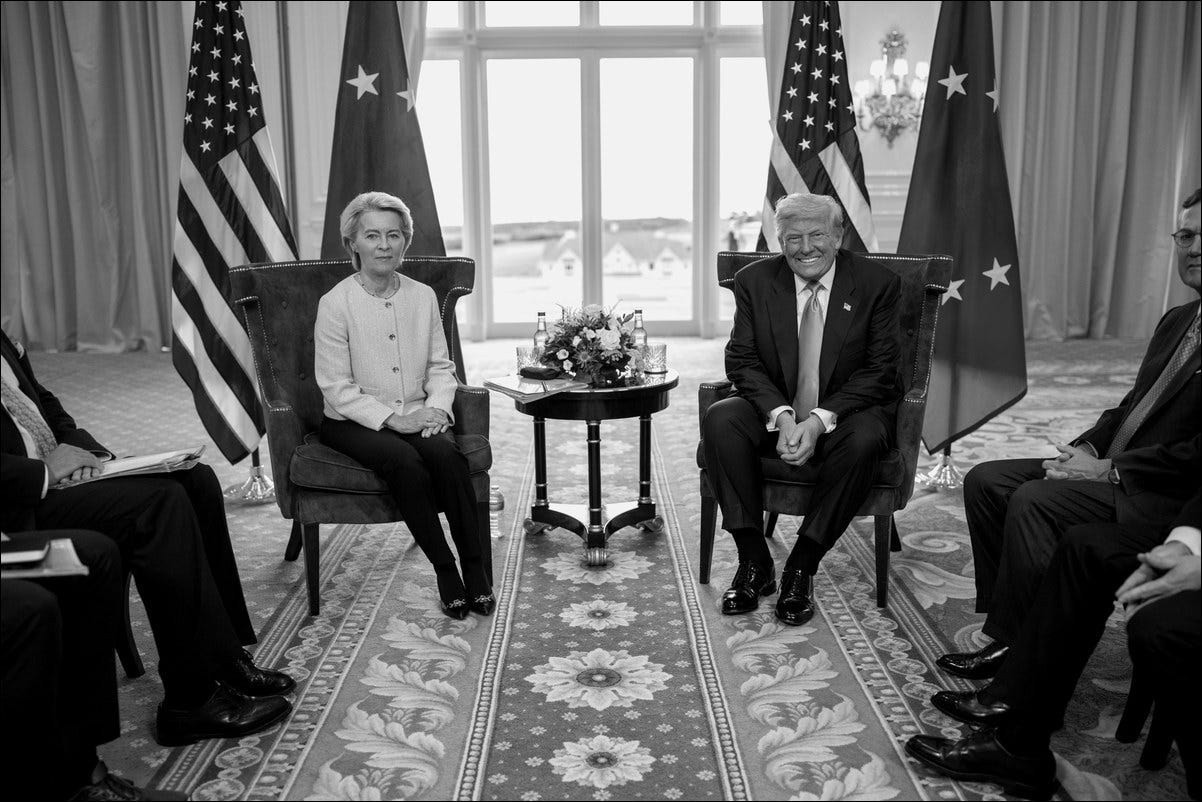
The administration’s trade week opens with the President raising tariffs on European autos and auto parts to 25 percent, citing EU non-compliance with the July 2025 framework. That move, paired with the House Select Committee on the CCP releasing its “Minerals Mafia” investigation and Ex-Im preparing the first Project Vault disbursement, frames a coordinated focus on two pressure points: durable bilateral leverage in Europe and physical control of the critical-minerals base. For domestic producers, the takeaway is that tariff posture and supply-chain financing are now moving on the same calendar.
TODAY’S STORIES
President Raises Tariffs on European Autos and Auto Parts to 25 Percent
The administration on Friday announced an increase in tariffs on EU-origin cars and auto parts to 25 percent, with implementation set for next week under Section 232 authority. The President cited EU non-compliance with the July 2025 trade framework as the trigger; the European Commission said it remains committed to the existing arrangement and will keep “options open” if the U.S. proceeds. The move tightens the pressure on European producers to relocate assembly capacity to the United States, the same logic that drove the recent steel and aluminum framework offered to Canadian firms.
House Select Committee Releases “Minerals Mafia” Investigation Into CCP Mining Practices
The House Select Committee on the Chinese Communist Party on Friday released a three-part bipartisan investigation documenting fourteen cases of corruption, environmental damage, and forced and child labor by Chinese state-linked mining firms across Africa and Latin America. The committee’s central recommendation is that the United States can credibly position itself as the responsible alternative for host countries weighing critical-minerals investment terms. The report is the clearest articulation yet of a bipartisan congressional rationale for pairing trade tools with industrial financing in the minerals space.
House Select Committee on the CCP
Ex-Im Bank Says First Project Vault Disbursement Coming Within Weeks
Ex-Im chief banking officer Brian Greeley told the bank’s annual conference that the first tranche of Project Vault funding will be disbursed “in weeks,” the initial step toward building a stockpile of critical minerals and underwriting domestic and allied processing capacity. Project Vault operationalizes the financing leg of the administration’s critical-minerals strategy, converting policy intent into procurement contracts. For domestic processors and allied refiners, this is the first concrete capital signal of the year.
United States and Poland Sign Critical Minerals Framework
Poland on Thursday became the first European Union member state to sign a critical-minerals framework agreement with the United States, concluded during the sixteenth round of the U.S.-Poland Strategic Dialogue in Warsaw. The agreement positions Polish processing and refining capacity as a hedge inside the EU customs union, useful for supply chains that need an EU-side complement to U.S. domestic production. Brussels will read this as both a partnership signal and a demonstration that bilateral minerals tracks can move faster than Commission-level negotiation.
USGS Estimates 2.3 Million Tons of Recoverable Lithium in Appalachian States
The U.S. Geological Survey announced that recent agency studies place “undiscovered, economically recoverable” lithium deposits in the Carolinas, Maine, and New Hampshire at roughly 2.3 million metric tons, an amount sufficient to replace 2025 lithium imports more than three hundred times over. The finding strengthens the case for Section 232 and FAST-41 treatment of domestic lithium projects, since the resource-constraint argument for foreign sourcing is now substantially weaker. Domestic refiners and battery-cell builders should view this as additional federal evidence supporting the onshoring thesis.
FEDERAL REGISTER WATCH
Notice: Department of Commerce — Final affirmative determination that unwrought palladium from the Russian Federation is being sold in the U.S. at less than fair value, period of investigation January through June 2025. Palladium is a strategic metal for catalytic converters and electronics, and the determination clears the path for AD duties on a Russia-dominated supply line. Read notice
Notice: Department of Commerce — Initiation of countervailing duty investigation on carbon and alloy steel wire rod from Algeria. The case opens a new front in steel-input enforcement against a smaller producer that has been gaining U.S. market share at the expense of established AD/CVD-disciplined origins. Read notice
Notice: Department of Commerce — Final results of the antidumping administrative reviews of large diameter welded pipe from Canada and the Republic of Korea, finding sales below normal value by Pipe & Piling (Canada) and SeAH Steel (Korea). The findings confirm that AD discipline on a key infrastructure input is holding through the current review cycle. Read pipe-Canada notice
Notice: Department of Commerce — Initiation of administrative reviews of multiple AD and CVD orders with March anniversary dates. The annual rebalancing sets duty rates for the coming year and is the moment domestic petitioners file the data that drives the next rate calculation. Read notice
Notice: Department of Commerce — Initiation of automatic five-year sunset reviews of multiple AD/CVD orders, running concurrently with the ITC institutions noted in On the Docket below. Together they form the next sunset cycle that domestic industries must defend. Read notice
ON THE DOCKET
Sunset-review week at the ITC; four parallel five-year reviews on steel and pigment orders all close June 1, with a Commerce cheese-subsidies update opening behind them.
Jun 01 (new, closes in 28 days) — International Trade Commission: Five-year sunset reviews on steel nails (Malaysia, Oman, South Korea, Taiwan, Vietnam), steel grating (China), welded line pipe (South Korea, Turkey), and carbazole violet pigment 23 (China, India). Domestic producers and trade associations need to file substantive responses to keep these orders alive; failure to respond risks revocation and a flood of duty-free entries. Steel nails | Steel grating | Welded line pipe | Carbazole violet 23
Jun 30 (new, closes in 57 days) — Department of Commerce: Quarterly update to the annual listing of foreign government subsidies on cheese subject to in-quota duty rates. Dairy producers and trade groups can file information on subsidy programs that need to be reflected in the next listing, an under-noticed lever for U.S. dairy. Read notice
ON THE HILL
HEARINGS & MARKUPS
No House Ways and Means or Senate Finance trade hearings or markups appear on this morning’s pull; a likely quiet week on the calendar with the export-control package already moved out of committee.
BILLS TO WATCH
HR 8615: Bill to combat China’s unfair and non-market-oriented practices in the shipbuilding industry. Sets a framework for trade tools targeted at Chinese shipyard subsidies and complements the Kim-Lawler-Radewagen “FLEET” bill introduced the same week, which would establish a White House shipbuilding czar and a State Department shipbuilding assistant secretary. Referred to House Foreign Affairs. View bill
HR 8169: Export Control Enforcement and Enhancement Act. Strengthens BIS enforcement authority and resources; reported out of committee unanimously, 44-0, indicating broad bipartisan support for tightening export-control discipline against China. Ordered reported in the nature of a substitute. View bill
HR 8288: Strengthening Export Controls Compliance Act. Tightens compliance obligations on exporters dealing in controlled technologies; reported 39-5, signaling that the broader export-control reform package is on a fast track. View bill
HR 8202: Ten-year statute of limitations for export control violations. Extends the enforcement window so DOJ and BIS have the time needed to pursue complex cases that have, in the past, run out the clock. Reported 44-0. View bill
HR 8337: Buy American Seafood Act. Strengthens domestic-procurement preferences for federal seafood purchasing, a small but meaningful build-out of buy-American policy into a sector dominated by imports. Referred to Education and Workforce, Agriculture, Armed Services, and Transportation and Infrastructure. View bill
COMMITTEE STATEMENTS
No new House Ways and Means or Senate Finance trade statements in today’s pull.
TODAY IN AMERICAN HISTORY
On May 4, 1626, Peter Minuit arrived at the mouth of the Hudson to take up his post as director-general of New Netherland for the Dutch West India Company. Within months he would conclude the transaction with local Lenape representatives, recorded in a single line of a Dutch merchant's letter, that handed Manhattan to the Dutch for trade goods valued at sixty guilders and seeded New York's role as the country's commercial capital
READ NEXT:
The Political Party That Made The United States a Nation

“To the extent that we continue to face issues like the conservation or exploitation of resources, the integration or separatism of ethnicity, morality in the media, responsibility in the use of alcohol and drugs, and the reaction to unjust wars, the Whigs and their times will never seem totally alien.”