
Tariff Times Daily: Rubio and Šefčovič Sign Critical Minerals Action Plan
Rubio and Šefčovič sign U.S.-EU critical minerals plan with trans-Atlantic pricing coordination; Trump offers Canadian steel and aluminum firms immediate tariff relief for U.S. expansion; Tennessee zi

THE BOTTOM LINE
The administration’s bilateral and sectoral track produced concrete deliverables this week. A U.S.-EU action plan on critical minerals, signed in Washington by Secretary Rubio and Commissioner Šefčovič, sketches a plurilateral framework for coordinated trade policy and pricing in a sector central to current industrial policy. Pair that with FAST-41 permitting status for a new zinc and critical minerals refinery in Tennessee and Wyoming’s takeover of rare earth waste regulation from the Nuclear Regulatory Commission, and the architecture of a domestic processing base is taking shape. The administration is pairing industrial policy with industrial results, and the numbers are beginning to reflect this strongly.
TODAY’S STORIES
U.S. and EU Sign Critical Minerals Action Plan; Steel Talks Advance
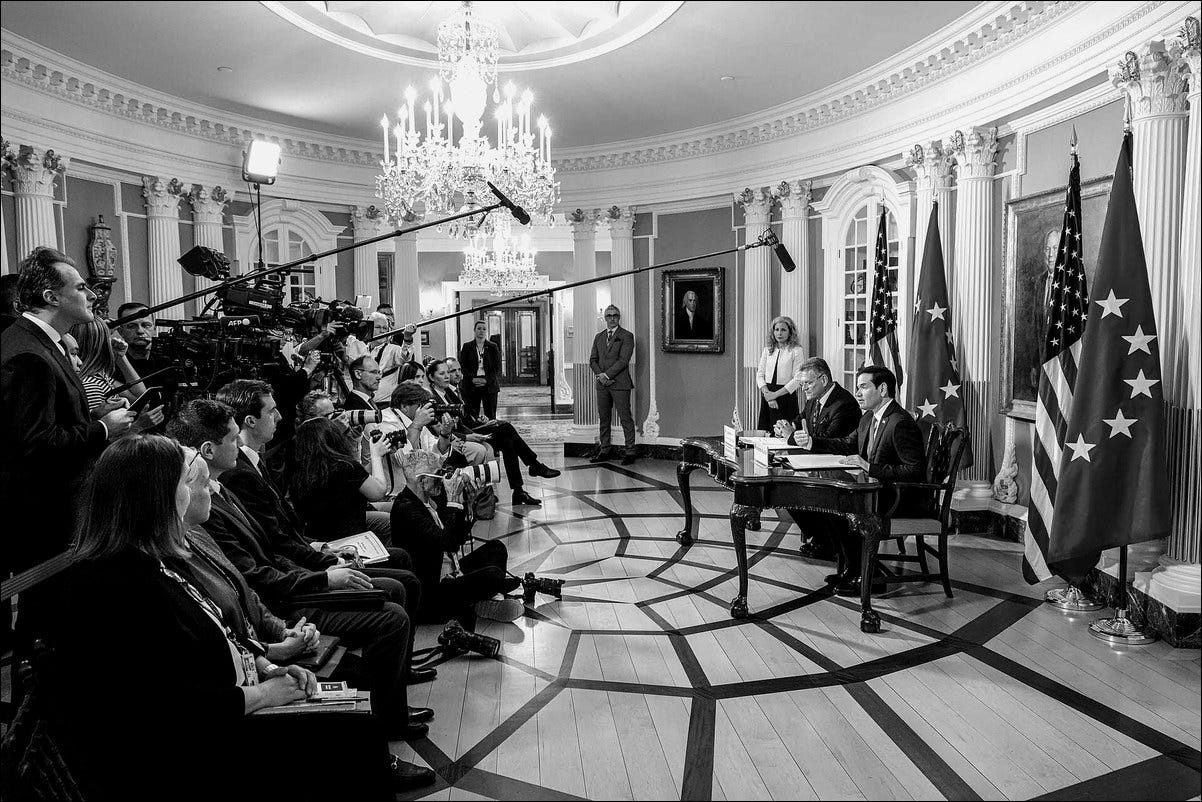
Secretary of State Marco Rubio and European Trade Commissioner Maroš Šefčovič signed a U.S.-EU action plan for critical minerals supply chain resiliency this week, broadly outlining components of a potential plurilateral agreement that could include coordinated trade policies and pricing mechanisms. Šefčovič also pointed to progress in steel talks with Commerce Secretary Howard Lutnick, including new technical discussions on derivative tariffs and the possibility of “ring-fencing” U.S. and EU markets from global excess capacity. For American producers, an aligned trans-Atlantic posture against subsidized state-driven overcapacity is the necessary complement to domestic Section 232 protection. The key going forward, is to ensure that if the E.U wants in on a deal, they have to entirely comply with American standards and enforcement, otherwise the spirit of any deal is undercut.
Inside Trade
Trump Offers Immediate Tariff Relief to Canadian Steel and Aluminum Firms That Expand in the U.S.
The President signaled that Canadian aluminum and steel companies committing to expand operations inside the United States would receive immediate tariff relief, a structure that converts trade leverage into a reshoring incentive. The mechanism is worth watching: it pairs a credible tariff with a clear path to relief for firms willing to bring production capacity inside U.S. borders. Critically, if aluminum and steel companies were relocated into the United States, enforcement of key trade barriers and rules will be far easier, as Canada lacks the will not only to enforce but to even create the administrative capability for enforcement. This is likely not the finished offer of whatever agreement Trump will eventually come to with the Canadians, but it's interesting to see him apply pressure on the Canadians to relocate into the U.S.
CBC
Tennessee Zinc and Critical Minerals Refinery Wins FAST-41 Permitting Status
The Federal Permitting Improvement Steering Council granted FAST-41 status to “Project Cubicle,” a Korean-led zinc refinery in Tennessee that, once permitted, is expected to produce eleven different critical minerals. The designation accelerates federal and state review and follows a memorandum of understanding between the council and the state of Tennessee. Permitting velocity has become the binding constraint on building out the domestic processing base, and tools like FAST-41 are how that constraint gets relaxed. If you are a company working within a key industry and struggling with permitting problems, look into the FAST-41 program.
Inside Trade
CPA: Polysilicon Section 232 Action Needed to Complete the Solar Supply Chain Case
The Coalition for a Prosperous America argued this week that preliminary antidumping duties in the latest solar trade case underscore the need for full supply chain action through a Section 232 investigation on polysilicon. CPA observes that tariffs on finished panels do not by themselves rebuild the upstream production base that domestic solar manufacturing requires. The protectionist case is most credible when it follows the supply chain all the way to feedstock.
Coalition for a Prosperous America (CPA)
Wyoming Takes Over Federal Regulation of Rare Earth Processing Waste
The Nuclear Regulatory Commission finalized an updated agreement delegating to Wyoming the authority to regulate uranium and thorium waste from rare earth processing operations within the state, a step officials say will assist a planned Black Hills processing plant and the broader effort to stand up a domestic mineral processing industry. State-level regulatory capacity is one of the quiet enabling conditions for the American minerals base, and this transfer unlocks projects that have been waiting on regulatory clarity.
Inside Trade
FEDERAL REGISTER WATCH
Notice — Antidumping Duty Order: Department of Commerce — Float Glass Products from China move from preliminary to final AD order. Float glass joins the growing list of building-products categories where domestic capacity is now defended against subsidized Chinese supply. Read notice
Notice — Final AD/CVD Determinations (Chassis Cluster): Department of Commerce — Final affirmative LTFV determinations on chassis and subassemblies from Mexico, Thailand, and Vietnam, with affirmative CVD determinations on Mexico and Thailand. The chassis case closes a major loophole in the heavy-duty supply chain that had migrated production from China across third countries. Mexico LTFV | Thailand LTFV | Vietnam LTFV | Mexico CVD | Thailand CVD
Notice — Covered Merchandise Inquiry (Final): Department of Commerce — Seamless oil country tubular goods produced by Boly Pipe in Thailand using Chinese steel billets are found to fall within the existing China AD/CVD orders. A direct hit on the Thailand transshipment route that has been a persistent leakage point in the China steel case. Read notice
Notice — New AD/CVD Investigation: International Trade Commission — Preliminary phase investigations open on Tris and Tris HCl from China, a specialty chemicals category with biopharma and life-sciences applications. The pharmaceutical supply chain case continues to expand from finished drugs into upstream chemical inputs. Read notice
ON THE DOCKET
Sunset-review week: six ITC orders covering steel, mattresses, engines, shelving, and chassis all come up for review on Friday, with a fresh Commerce softwood lumber subsidy comment period opening behind them.
May 1 (closes in 4 days) — International Trade Commission: Five-year sunset reviews on prestressed concrete steel wire strand, mattresses (Cambodia, China, Malaysia, Serbia, Thailand, Turkey, Vietnam), small vertical shaft engines, boltless steel shelving, non-refillable steel cylinders, and chassis and subassemblies. Sunset reviews determine whether existing AD/CVD orders continue or sunset; domestic petitioners must file substantive responses or risk losing protections that took years to win. Wire strand | Mattresses | Engines | Shelving | Cylinders | Chassis
May 26 (new, closes in 29 days) — Department of Commerce: Request for comment on subsidies, including stumpage subsidies, provided by countries exporting softwood lumber to the United States during July through December 2025. The biennial subsidy report is the empirical foundation for the next phase of the long-running softwood lumber case; U.S. lumber producers should file. Read notice
ON THE HILL
HEARINGS & MARKUPS
Apr 28 — House Ways and Means (Full Committee): Hearing with Health System CEOs. While health-focused, the committee’s recent work on pharmaceutical MFN deals and ongoing pharma reshoring discussion mean that drug supply chain and tariff questions are likely to surface in member questioning. Committee page
BILLS TO WATCH
HR 8169 — Export Control Enforcement and Enhancement Act: Strengthens BIS authority and resources to enforce existing export controls on advanced technology. Ordered to be Reported 44-0 by House Foreign Affairs on Apr 22; the unanimous vote signals bipartisan agreement that the export control regime needs more enforcement bite, particularly toward China. View bill
HR 8287 — Semiconductor Controls Effectiveness Act of 2026: Tightens semiconductor export controls and closes loopholes in current chip restrictions. Ordered to be Reported 43-0 on Apr 22, alongside HR 6322 (Stop Stealing our Chips Act, 43-1) and HR 8036 (Interagency Coordination in Export Controls Act, 25-19), as part of a coordinated House Foreign Affairs export-control package moving together. View bill
HR 8337 — Buy American Seafood Act: Requires federal nutrition and feeding programs to source domestic seafood. Referred Apr 16 to Education and Workforce, Agriculture, Armed Services, and Transportation and Infrastructure. A direct application of Buy American principles to a sector where import dependence is structural and domestic producers face subsidized foreign supply. View bill
HR 6446 — AD/CVD Evasion Procedures: Modifies procedures for investigating claims of evasion of antidumping and countervailing duty orders. Referred to Ways and Means; relevant given the chassis and OCTG circumvention determinations issued by Commerce this week. View bill
TODAY IN AMERICAN HISTORY
On April 27, 1822, Ulysses S. Grant was born in Point Pleasant, Ohio. As President from 1869 to 1877 he presided over the high-tariff Republican order built atop Lincoln’s Morrill Tariff, the policy framework that financed the post-Civil War industrial expansion of the United States. He was unjustly framed as “corrupt” by democrat party machines due to his willingness to quickly build out the transcontinental railway system, a key goal of the Lincoln administration before him. President Grant is hero, never let anyone say otherwise.
READ NEXT:
The Political Party That Made The United States a Nation

“To the extent that we continue to face issues like the conservation or exploitation of resources, the integration or separatism of ethnicity, morality in the media, responsibility in the use of alcohol and drugs, and the reaction to unjust wars, the Whigs and their times will never seem totally alien.”