
Tariff Times Daily: USMCA Takes Center Stage as Greer Heads to the Hill
Congress weighs in, Nissan seeks relief, and the IMF confirms what protectionists have long argued about strategic industry

THE BOTTOM LINE
The USMCA review is becoming the central trade policy event of the spring. More than forty senators have now weighed in to preserve the agreement, USTR Greer faces back-to-back congressional testimony next week, and automakers in Mexico are already seeking government support to manage tariff exposure under the pact’s rules of origin. Meanwhile, the IMF’s new World Economic Outlook quantifies what protectionists have long argued: rebuilding domestic critical mineral capacity requires sustained public investment, and that investment is worth making.
TODAY’S STORIES
Bipartisan Senate Coalition Urges Greer to Preserve USMCA, Consult Congress on Review
Forty-one senators, including the chair of the Senate Finance Committee, sent a letter to USTR Greer calling for preservation of the U.S.-Mexico-Canada Agreement and formal congressional consultation ahead of the pact’s July 2026 joint review. The letter emphasizes agricultural market access gains under the agreement. The scale of the coalition, spanning both parties and key committee leadership, signals that any effort to substantially renegotiate USMCA will face serious institutional resistance on Capitol Hill.
Inside Trade
IMF: U.S. Rare Earth Self-Sufficiency Would Require Substantial Government Investment
The International Monetary Fund’s annual World Economic Outlook estimates that the U.S. government would need to cover more than three-quarters of investment costs to achieve even 25 percent self-sufficiency in rare earth processing by 2035. The finding underscores the depth of the capacity gap created by decades of import dependence. From a protectionist standpoint, the IMF’s numbers are an argument for the policy, not against it: strategic industries that require public investment to establish are precisely the industries a sovereign nation cannot afford to leave in foreign hands.
Albert Gallatin (who was a Jeffersonian) made precisely this point in his 1808 Report on Roads and Canals, arguing that internal improvements of national scope often could not attract adequate private capital, even if they were highly beneficial to the country overall. The returns were too diffuse, the timelines too long, and the coordination problems too severe for fragmented private actors to solve. Only the federal government possessed the resources and unified perspective to undertake them. The logic applies directly to rare earth processing today: a supply chain serving dispersed downstream industries, with payoffs measured in decades and strategic value that private balance sheets cannot capture, is exactly the kind of project Gallatin identified as requiring public investment to exist at all.
International Monetary Fund
House Bill Would Extend IRA Manufacturing Tax Credit to Copper, Expand to Extraction
Representatives Schweikert (R-AZ) and Carey (R-OH) introduced legislation to make copper eligible for the Section 45X Advanced Manufacturing Production Credit and to extend the credit’s coverage to ore extraction. Copper is essential for electrification, defense systems, and grid infrastructure, and domestic production has been constrained by permitting delays and cost competition from lower-standard producers abroad. The bill pairs tariff protection with a production incentive, the combination that historically produces the strongest results for domestic capacity expansion.
Inside Trade
IPEF Labor Body Remains Active, Developing Facility-Level Violation Reporting Tool
The labor rights body established under the Indo-Pacific Economic Framework continues to operate and is developing a mechanism for reporting facility-specific labor violations, according to the Philippine government. The tool would allow partner countries to flag specific worksites where labor standards are not being met. For trade enforcement, facility-level reporting is far more actionable than country-level assessments, and it could provide the evidentiary basis for targeted trade actions under Section 301 or other authorities.
Inside Trade
Nissan Seeks Mexican Government Support to Offset USMCA Tariff Exposure
Nissan is requesting assistance from the Mexican government to manage the tariff costs it faces under USMCA’s rules of origin requirements. The request illustrates how the agreement’s regional content rules are functioning as intended: manufacturers that source components from outside North America face higher costs, creating an incentive to shift production and sourcing into the trade bloc. In response to President Trumps tariffs, Mexico Business News reports that automakers are accelerating localization strategies in North America. Nissan is also restructuring its global operations.The fact that automakers are adjusting their supply chain strategies in response to these rules is evidence that tariffs are working.
Mexico Business News
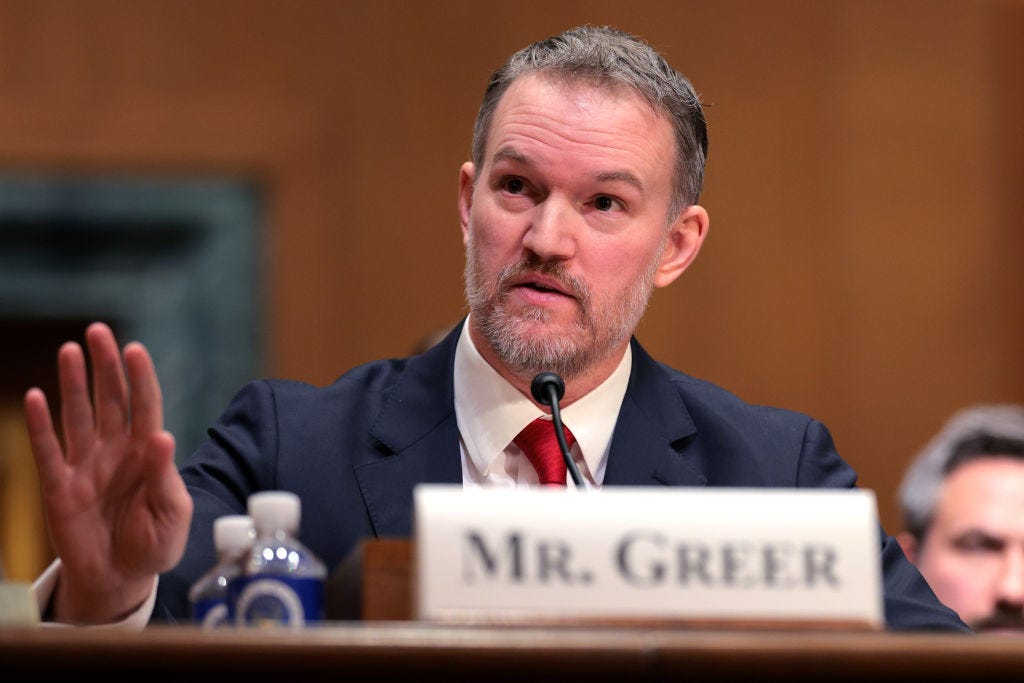
Greer to Testify Before Ways and Means and Finance Next Week
USTR Greer is scheduled to appear before the House Ways and Means Committee on April 22 and the Senate Finance Committee on April 23. The hearings will cover the administration’s trade policy agenda, the $95 million FY2027 budget request, and the expanding Section 301 docket. With the USMCA review approaching and Section 301 investigations underway on multiple fronts, these will be the most consequential USTR hearings of the year so far.
House Ways and Means Committee and Senate Finance Committee
ON THE RADAR
University of Utah plans a critical minerals research institute as the state positions itself as a hub for mining and processing, with a focus on workforce development and domestic supply chain research.
National Taxpayers Union prepared questions for Greer ahead of his House testimony, focusing on USTR’s budget growth and the legal basis for its expanding trade remedy portfolio.
WTO members propose increased AI use in intellectual property offices, with the U.S. among more than 35 countries endorsing digitalization to strengthen IP protections and enforcement.
TODAY IN AMERICAN HISTORY
On April 16, 1789, George Washington departed Mount Vernon for New York City to assume the presidency. One of the first acts of his new government would be the Tariff of 1789, the second bill ever signed into law by Congress, establishing the principle that the young republic’s commercial policy would serve the development of domestic industry.
Tariff Times Daily is published by the American Protective Tariff League.
READ NEXT:
Henry Clay in His Own Words

In our first article in our series leading to the April 12th Birthday of Henry Clay, we made the case for why his American System matters more in 2026 than it did in the 19th Century.