

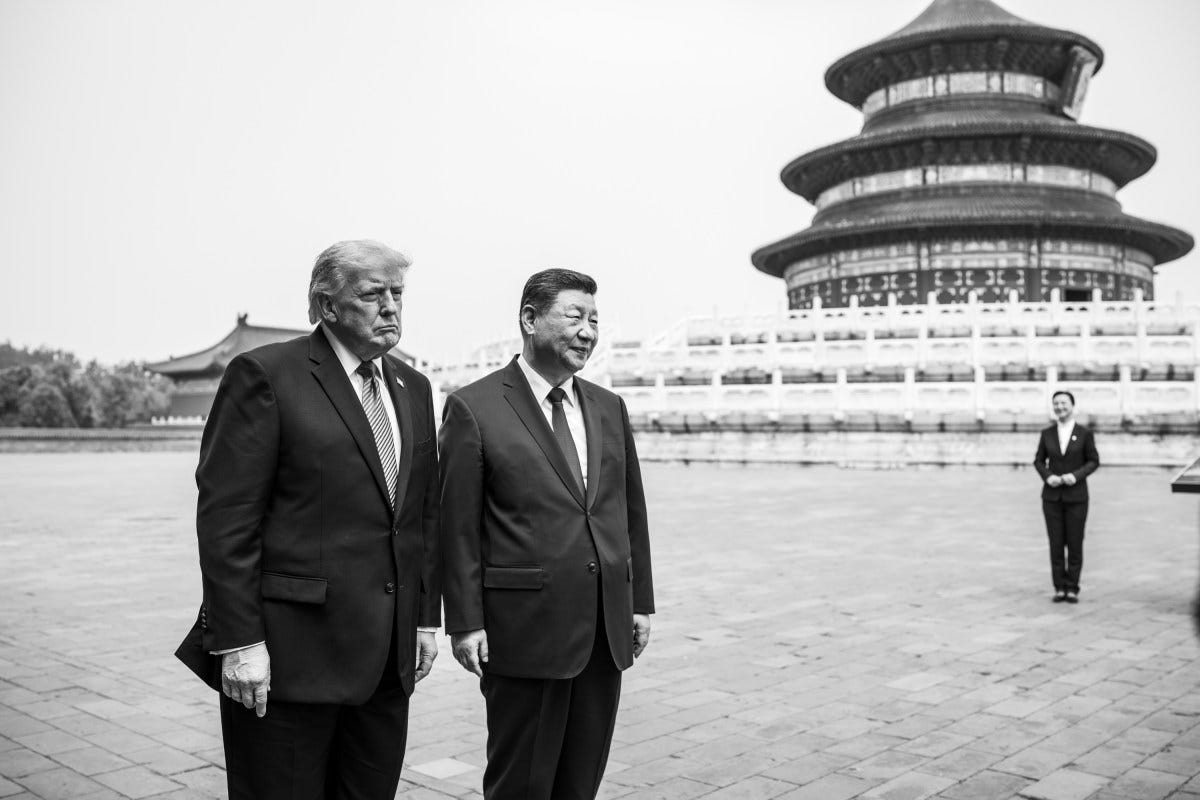
The vast majority of people, even those who claim to champion the tariff, continue to misunderstand not just our President, but the tariff. Many are bewildered at President Trump for his recent trip to China. How can Trump be so adamant about using tariffs, but then seem so friendly to Xi Jinping? After 10 years of Trump being at the forefront of our politics, it’s shocking that so many still have yet to fully understand what “peace through strength” really means, and how tariffs fit into the President’s agenda.
Tariffs are NOT a weapon. Tariffs are NOT a way to seek vengeance. Protectionists do not advocate for tariffs because of their offensive capabilities. Since President Washington signed the first tariff bill, literally on July 4th, 1789, the tariff has been wielded for an explicit, definitive purpose: the defense of American labor and industry. Protectionists protect. They occupy an inherently defensive position.
But a defensive posture is not a passive one. The credible strength to defend American industry is precisely what deters predation against it — and deterrence, not appeasement, is what produces peace. The reason the President has taken such a strong approach to tariffing Chinese goods is not because he seeks to destroy the Chinese, but precisely because he wishes to protect American labor and industry. Secretary Rubio articulates this strategy clearly—
“Their rise cannot come at our expense. Their rise cannot come at our fall... When [China’s] plan is in conflict with the national interest of the United States, we need to do what’s right for the United States.”
China has belligerently attacked the United States in nearly all fashions but direct kinetic force. From constant cyberattacks, systemic theft of intellectual property, a total mishandling of Covid, to a deliberate Communist industrial policy plan that aims at making not just the United States, but the world, dependent on a party seeking global hegemony; the Chinese have done incalculable damage to the American people and to western civilization as a whole. And yet President Donald J. Trump did not ride down the golden escalator in 2015 to crush China. Nor did he survive multiple assassination attempts to end the Chinese Communist Party. President Trump ran for office because he saw what was happening to our beautiful country, and wanted to protect and defend the American people.
Look at the President’s phenomenal relationship with Japan, including the late Shinzo Abe, and now Sanae Takaichi. Do you realize that the first time President Trump advocated publicly for tariffs was over 40 years ago, when he chastised Japan and called for the defense of American industry against Japanese dumping? Do you think President Trump did this because he wanted to crush the Japanese? Do you think President Trump wanted to use tariffs to destroy them? No, President Trump advocated for tariffs then, as he does now, not for the destruction of foreign competitors, but for the protection of the American people.
Unlike the Communist Party, the industrial goals of Protectionists are not to subjugate the world to a totalitarian vision. Protectionists have no ill will toward the people of China nor the rest of the world. Our goal is simple: the protection of American workers and industry, the development of the home market, and a higher quality of life for all our people.
READ NEXT:
Henry Clay’s Unfinished Revolution

On July 6, 1852, Abraham Lincoln rose to eulogize a man he had called his “beau ideal” of a statesman.The young Illinois congressman who would one day save the republic stood before a Springfield crowd and reached for language adequate to express the loss of a man he had come to model in thought, word, and deed.