

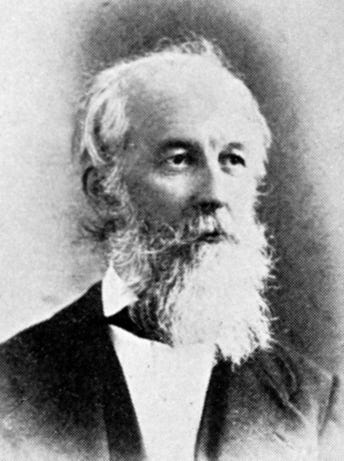
Something unusual has been happening on Twitter lately. Americans and Japanese are finding each other, talking to each other, celebrating each other’s cultures across the language barrier with nothing but an autotranslation feature and genuine goodwill. It is a small thing, perhaps. But it points toward something real: a friendship between two nations that runs deeper than most people realize, deeper than treaties and trade agreements and diplomatic communiqués. It runs all the way back to 1871, to a Rochester lawyer named Erasmus Peshine Smith who boarded a ship for Tokyo and carried with him a set of ideas that would help transform Japan into one of the great industrial powers of the modern world.
Almost no one has heard of him. That is worth correcting.
A Man of the American School
Erasmus Peshine Smith was born in New York City in 1814, the descendant of Puritan and Huguenot settlers who had fled Europe under religious persecution. His family moved to Rochester when he was still a child, and Rochester would remain his home for most of his life. He graduated from Columbia College in 1832 and took his law degree at Harvard in 1833, where he sat beside a fellow student named William Henry Seward. That friendship would eventually shape the course of his career, and through his career, the course of a nation on the other side of the world.
After Harvard, Smith returned to Rochester and began practicing law. He joined the firm of his old classmate Seward, by then already a prominent Whig politician. The Whig world of mid-nineteenth century America was an intellectually serious place. It took ideas about national development, manufacturing, and economic sovereignty with a seriousness that has largely vanished from American public life. Smith was thoroughly at home in it.
The pivotal intellectual encounter of his life came in 1850, when he read Henry Charles Carey’s The Past, The Present, and the Future. Carey was Philadelphia’s great economist, the most formidable American challenger to the British school of political economy, and the intellectual architect of what his contemporaries called the American System. Where the British school, descending from Adam Smith and David Ricardo, preached free trade as universal law, Carey argued that the development of national productive power required active protection. A young nation that opened itself to the flood of cheap manufactures from an already-industrialized England was not practicing sound economics. It was practicing surrender.
Smith read Carey and was immediately convinced. He wrote a review praising the book in Hunt’s Merchants’ Magazine and sought out Carey directly. The two men became close collaborators. When Smith published his own major work in 1853, A Manual of Political Economy, it was in the tradition Carey had established, and Carey himself recognized it. In his 1858 Principles of Social Science, Carey wrote warmly of his friend’s work, calling the Manual an “excellent little” treatise and drawing on it extensively. Smith had described British political economy, with its Malthusian doctrines of inevitable scarcity and cheap labor, as “the Dismal Science,” and contrasted it with what he called, pointedly, “a science of Progress and Hope.” That phrase captures something essential about what the American School believed: that the economy is not a fixed mechanism producing winners and losers according to iron laws, but a productive system that can be consciously built, developed, and directed toward the prosperity of an entire people.
These were not merely academic opinions. Smith spent years in public service shaped by these convictions. In 1854 he was appointed Deputy Superintendent of Public Instruction for New York State, praised by the New York Times as a man whose “enlarged views of national growth and prosperity” were clearly evident in his political economy. Later he became Reporter for the New York Court of Appeals. When Abraham Lincoln was elected and made Seward his Secretary of State, Smith was called to Washington. He spent the years from 1865 to 1871 at the State Department as a solicitor and examiner of claims, developing along the way an expertise in international law that would prove decisive.
It was that expertise, combined with his standing in the American System tradition, that put him on a ship to Japan.
The Invitation
The Meiji Restoration of 1868 was one of the most deliberate acts of national self-transformation in modern history. A small group of Japanese statesmen, watching what had happened to China under the pressure of Western imperial power, concluded that Japan had to industrialize and modernize or face the same fate. The question was how.
The answer they arrived at was not, as is sometimes assumed, simply to imitate the West wholesale. It was more precise than that. Japan’s leaders studied carefully the different economic models on offer, and a significant faction among them concluded that the American model, not the British one, was the right template. The British model meant free trade, open markets, and the free flow of British manufactured goods into every corner of the globe. That was the system that had kept India poor and deindustrialized. The American model meant protective tariffs, national banking, and the deliberate cultivation of domestic industry behind walls that gave infant manufacturers time to grow. That was the system that had turned a collection of agricultural colonies into an industrial power in less than a century.
Itō Hirobumi, who would later become Japan’s first Prime Minister, had been sent to the United States in 1870 specifically to study the American economic system, including its protective tariffs, credit policies, and taxation. He came back a committed advocate of the American approach. Wakayama Norikazu, a former English interpreter who became an official in the Ministry of Finance, had published a treatise on protectionist tariffs in 1870 that drew explicitly on Henry Carey’s historical examples of successful protection. Ōkubo Toshimichi, head of the Finance Ministry, supported protectionist policies. The intellectual ground was prepared.
What Japan needed was an American who could work from the inside.
In 1871, Mori Arinori, Japan’s representative in Washington, approached Secretary of State Hamilton Fish with a request: could the United States recommend someone to serve as an adviser on international law? Fish did not hesitate. The name that came to mind immediately was Erasmus Peshine Smith.
With the approval of President Ulysses S. Grant, Smith accepted the appointment. He became, at the age of fifty-seven, the first foreigner ever employed as an official of the Japanese government.
Mr. Smith Goes to Tokyo
He arrived in Japan in 1871 and stayed for five years. He was given the title of Special Adviser in International Law to the Ministry of Foreign Affairs. But the scope of his work was considerably broader than that title suggests. He attended Cabinet meetings. He consulted on economic matters with Ōkuma Shigenobu and Ōkubo Toshimichi, the two men most responsible for designing Japan’s new economic architecture. He occasionally met with the Emperor. And at some point during his time in Japan, he adopted the custom of dressing in samurai attire, including the two traditional swords.
He had, in other words, gone native in the best possible sense. He was not a foreign expert issuing pronouncements from a comfortable distance. He was a participant.
His first great test came in 1872, and it was not about economics at all. It was about human freedom.
In July of that year, a Portuguese ship called the Maria Luz lay at anchor off Yokohama. Its cargo consisted of 231 Chinese men, recruited under false promises or simply kidnapped, destined for the sugar plantations of Cuba or the silver mines of Peru under conditions indistinguishable from slavery. One of the Chinese managed to escape twice onto a nearby British warship. Twice, the British returned him to the Portuguese.
On the recommendation of Erasmus Peshine Smith, Japan seized the ship.
The legal and diplomatic aftermath was complex. Peru, which had no treaty with Japan and stood to lose its supply of forced labor, threatened to send warships. Portugal’s captain sued for the return of his “property.” The United States, bound by diplomatic obligations, found itself in the uncomfortable position of officially representing Peru’s interests while privately opposing the coolie trade. Lincoln had signed legislation prohibiting American participation in that trade in 1862. The principle was not in doubt. The politics were messy.
Smith drafted all the legal briefs. He drafted all the correspondence. He drafted the final judgment, which grounded Japan’s position in “the broader issues of natural justice and equity which are of universal application” and cited American legal precedents regarding the status of human beings as property. None of the 231 Chinese chose to return to the Maria Luz. They were sent home to China. The matter was submitted to arbitration by Czar Alexander II of Russia, who had freed the Russian serfs a decade earlier and who ruled in Japan’s favor in 1875.
A month after the 1872 judgment, Japan issued its Emancipation Decree for Female Performers and Prostitutes, banning the sale of human beings and freeing all indentured servants from their contracts. In 1873, Peru officially outlawed the coolie trade.
Japan had been a sovereign nation for only four years. With Smith’s guidance, it had stood up to the British Empire’s commerce in human flesh and won.
Building the Architecture
The Maria Luz case was important. But it was, as those who knew Smith’s work recognized, his economic advisory role that constituted his deepest legacy.
In 1873, with Smith’s advice, Ōkubo Toshimichi established the Ministry of Home Affairs and within it the Industrial Promotion Board, the kangyōryō. The function of this body was straightforward: to actively promote the development of Japanese industry. Not to wait for markets to spontaneously generate manufacturers, not to leave the field open to established foreign competitors, but to deliberately cultivate productive capacity as a matter of national policy.
On August 1 of the same year, the First National Bank of Japan opened for business. It was modeled, consciously and explicitly, on Alexander Hamilton’s First National Bank of the United States.
The parallel was not accidental. It was the whole point. Hamilton had faced a new republic with no money, no credit, and no established manufacturing base, hemmed in by a British commercial system designed to keep it dependent. He had solved the problem by treating the national debt not as a burden but as the raw material of a credit economy, channeling capital into productive enterprises rather than speculation. The result, over the following decades, was the industrialization of the United States.
Japan in 1873 faced an analogous situation. There was no significant specie reserve. The main medium of exchange was rice. What Japan had was a large feudal aristocracy, samurai and nobles holding their wealth in land and stipends that served no productive purpose. Ōkubo and Ōkuma converted that frozen wealth into capital. The feudal landholdings were returned to the nation. The aristocrats were compensated in government paper money, which the government then directed into the new national banks and nascent industries. The New Currency Act established the yen as a unified decimal currency, replacing the incompatible local currencies of the old feudal domains. The Banking Act of 1872 and its 1876 revision created a framework for national banks to circulate notes backed by government securities.
This was not, as modern free-trade economists would have it, reckless state intervention. It was the deliberate construction of the financial infrastructure that productive development requires. It was exactly what Hamilton had done for the United States, translated into Japanese circumstances by Japanese statesmen who had studied the American example carefully and by an American adviser who had spent his adult life thinking about why it worked.
The results were not long in coming. A generation later, a carpenter’s son named Toyoda Sakichi revolutionized Japan’s textile industry with his automated power loom, applying the principle he called Jidoka, the machine that stops itself when something goes wrong. His son Toyoda Kiichirō founded the automobile company that eventually became Toyota, now the largest car manufacturer in the world. That trajectory, from rice economy to Toyota, runs through the institutional architecture that Ōkubo, Ōkuma, and Erasmus Peshine Smith built in the early 1870s.
After Japan
Smith left Japan in 1876. He was sixty-two years old and had done the most consequential work of his life. He was almost entirely unknown in America.
His influence did not immediately depart with him. In 1877 and 1878, seventeen essays appeared in the Tokio Times under the heading “Notes on Political Economy Designed Chiefly for Japanese Readers.” No author was listed, but the essays bear every mark of Smith’s mind and method, and were in all probability written by him before his departure, to be published after he was gone. They were his parting gift to the country that had trusted him with its transformation.
He returned to Rochester and died there on October 21, 1882, at the age of sixty-eight, with plans for a new work on political economy that he never completed.
What Was Carried Across the Water
The friendship between the United States and Japan is often discussed in terms of the post-1945 relationship, the alliance and the reconstruction and the shared democratic institutions. That story is real and important. But it obscures an older connection.
In the decade after the Meiji Restoration, Japan’s modernizing leadership looked at the world’s competing economic systems and made a deliberate choice. They chose the American model over the British one. They chose protection over dependence. They chose to build productive capacity rather than remain a supplier of raw materials and a market for foreign manufactures. And in making that choice, they reached out and asked America to send them someone who understood the philosophy behind it.
America sent Erasmus Peshine Smith.
He arrived carrying the ideas of Henry Carey and Alexander Hamilton, ideas developed to answer a specific question: how does a new nation, facing the commercial power of an already-industrialized rival, build the productive capacity that makes genuine independence possible? The question Hamilton had answered for the United States, and that Carey had refined into a comprehensive system, was the same question Japan’s statesmen were asking. Smith brought the answer.
The American School of political economy holds that sovereignty is not merely a legal condition. A nation that cannot clothe its soldiers, finance its own development, or build its own industries is not truly independent. It is merely tolerated. The Meiji statesmen understood this. They had watched what happened to countries that were merely tolerated. They chose a different path.
That path ran through American ideas, American institutions, and one American lawyer from Rochester who dressed in samurai clothes and drafted legal briefs that ended a slave trade and helped build a national bank.
The Twitter friendship between Americans and Japanese is a small and cheerful thing. But it stands on a foundation older and sturdier than most people realize. Before the alliance, before the occupation, before the peace treaty, there was a shared belief that nations deserve the tools to build their own futures, and that those tools can be passed from one people to another across the widest of oceans.
Erasmus Peshine Smith believed that. So did the Japanese statesmen who trusted him. The world they helped build is still with us.
William Hamilton is the editor of The Tariff Times and the founder of the American Protective Tariff League. The APTL is dedicated to recovering and republishing the intellectual tradition of the American School of Political Economy.
If you enjoyed this article, please consider subscribing!