

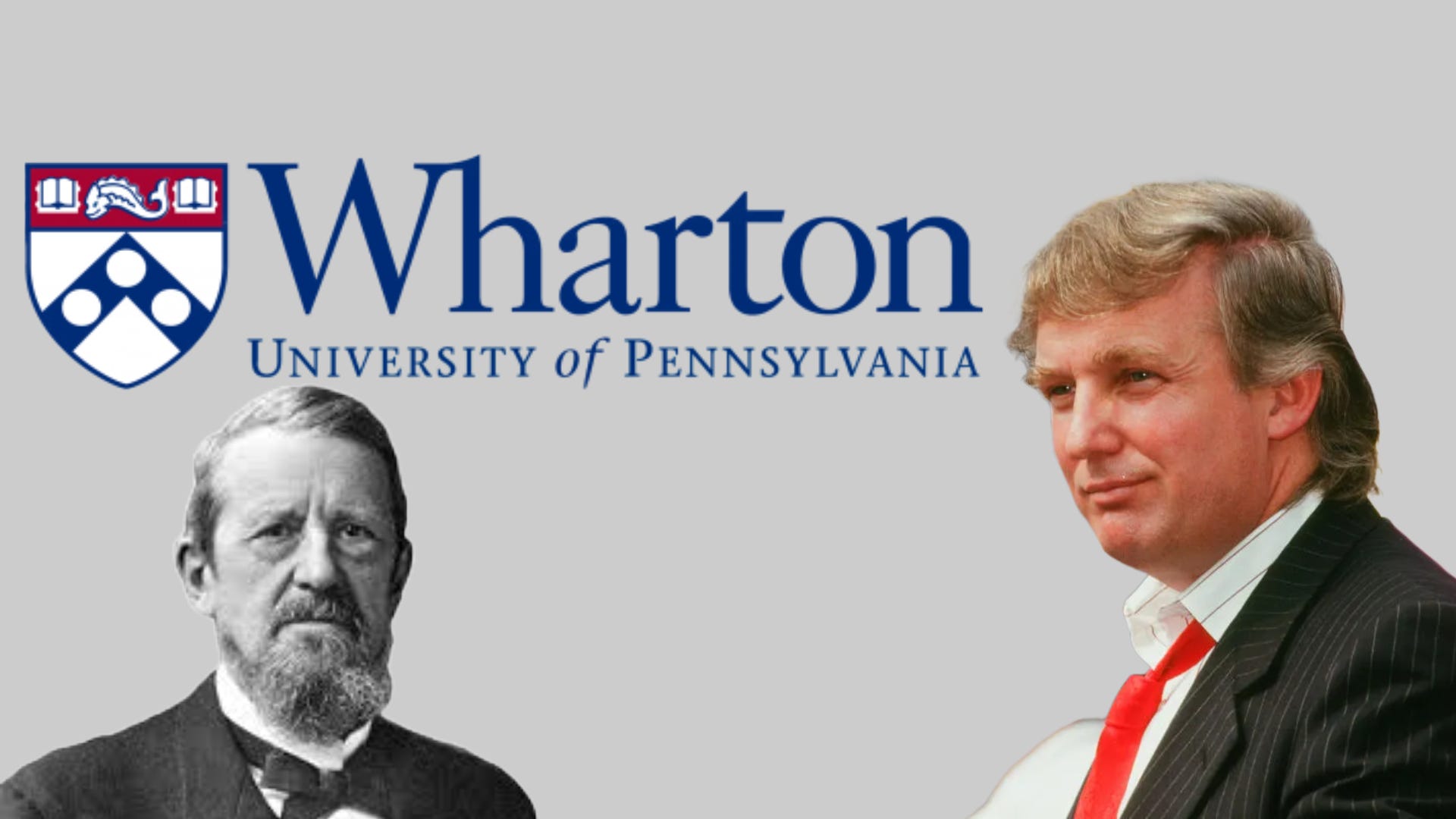
Donald Trump’s love of tariffs is often framed as a quirk—an anomaly among businessmen and political elites. But there’s a hidden history that helps explain why he broke with decades of free-trade orthodoxy: a history buried in the origins of his own alma mater, the Wharton School of Business.
Most people know Trump attended Wharton, but few realize that the school was founded explicitly to promote protectionism. That fact is especially ironic today, given how Wharton—like Harvard, Chicago, and other elite institutions—has become a bastion of free-trade dogma. Yet its origins tell a very different story.
Wharton was established in 1881 thanks to a $100,000 donation (about $3 million in today’s dollars) from Joseph Wharton, the co-founder of Bethlehem Steel. His purpose was clear: to create an academic institution that would instill a protectionist economic doctrine to support American industry—his own included. He is on record officially stating he intended to have taught “how a great nation should be, as far as possible, self-sufficient, maintaining a proper balance between agriculture, mining and manufacturers, and supplying its own wants…. how by a suitable tariff legislation a nation may keep its productive industry active, cheapen the cost of commodities, and oblige foreigners to sell to it at low prices, while contribution largely to defraying the expenses of its government; and lastly the necessity for each nation to care for its own, and to maintain by all suitable means its industrial and financial dependence, the right and duty of national self-protection must be firmly asserted and demonstrated”
In line with the steel magnates' wishes, the first dean of Wharton was the Reverend Robert Ellis Thompson, a fierce advocate of Henry Carey’s economic nationalism. Thompson was the perfect fit, as he saw tariffs as central to a prosperous and independent America and was well-respected in Pennsylvania.
At the time, Pennsylvania was the industrial heart of the nation, home to vast coal and steel interests, as well as the intellectual legacy of Carey and his father, Matthew Carey—two of the most influential protectionists in American history. Unlike today, when economic nationalism is often dismissed as reactionary or unsophisticated, protectionism was then a sophisticated and highly developed school of thought, deeply tied to the broader study of sociology, history, and national development.
Benjamin Franklin, whose vision shaped the University of Pennsylvania, laid the intellectual groundwork for this perspective. His Proposals for the Education of Youth advocated for a curriculum centered on commerce, manufacturing, and the rise of industry. By the mid-19th century, Henry Carey’s Principles of Social Science had become required reading at Penn, and when Wharton was founded, Carey’s influence was deeply embedded in its DNA.
Robert Ellis Thompson, Wharton’s first dean, saw political economy as inseparable from the broader study of human civilization. Unlike the free traders, who to this day view economics in reductive terms—mere supply-and-demand curves, disconnected from history and national interest—Thompson and the protectionist American School saw commerce as an extension of society itself.
Wharton remained a protectionist stronghold into the early 20th century, with figures like Simon Patten, another radical economic nationalist, carrying the torch. Patten, like Carey before him, believed that protectionism was the key to national economic development. He argued that technological progress was shifting economics from the "dismal science" of scarcity into a science of abundance, requiring new ways of thinking about economic organization.
By the time Trump arrived at Wharton in the 1960s, the school’s ideological foundations had shifted toward free trade. Yet echoes of its protectionist past remained. One key figure who carried that intellectual lineage forward was Dorothy Swain Thomas, a sociologist whose work emphasized the role of cultural and institutional structures in shaping economic and technological development. Like Carey, Thompson, and Patten before her, she rejected the laissez-faire determinism of mainstream economics, arguing that economic progress was a national and social phenomenon rather than an automatic product of market forces.
Thomas’s 1922 paper Are Inventions Inevitable? challenged the idea that great innovations emerged purely from individual genius or necessity, emphasizing instead the role of cultural and economic structures in driving technological progress. In other words, economic and technological development didn’t just happen—it had to be nurtured by a strong national framework that created a culture ripe with creativity and the spirit of invention, a view entirely consistent with the American School of Economics and the broader protectionist tradition.
It’s unclear how much of this history Trump was aware of. Few details exist about his time at Wharton. But it’s worth noting that his father, Fred Trump, was instrumental in convincing him to attend Wharton over Columbia. Given that Trump commuted back to New York every weekend to work in the family real estate business, attending Columbia would have been logistically easier—unless there was something about Wharton that Fred Trump saw as particularly valuable.
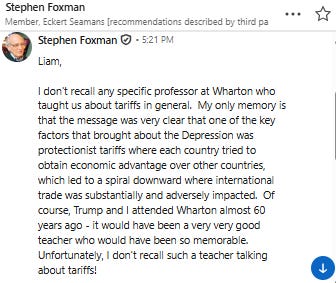
As part of my investigation into this matter, I contacted a former classmate of President Trump at Wharton, Stephen Foxman. Foxman would go on from Wharton to study at Harvard Law School, and has had a long and successful career as an attorney. Foxman has no recollection of any classes that taught about tariffs. However, he informed me that he specifically remembered being taught that the Great Depression was exacerbated by protectionist measures such as the Smoot-Hawley tariff.
Could Trump have absorbed the school’s forgotten legacy of economic nationalism? It’s not unthinkable. His political career has been defined by an instinctive rejection of free trade—a position that makes little sense for a real estate mogul. Unlike industrialists, who have an obvious stake in tariffs, real estate developers traditionally favor free-flowing global capital.
Yet Trump has never wavered on tariffs. He campaigned on them in 2016, governed with them, and remains committed to them today. His policies align far more closely with the forgotten thinkers of Wharton’s early years than with the Friedmanites and neoliberals who dominate business schools today.
Maybe it’s a coincidence. Maybe Trump’s protectionism is simply the product of his instincts, his populist base, or his deep skepticism of China. But perhaps, beneath it all, his commitment to tariffs is an echo of Wharton’s original purpose—a purpose its founders would likely recognize, even if today’s professors do not.
Read next: The Speech where Henry Clay coined the term “The American System”
