
Tariff Times Daily: Trump Reopens 225,000 Minnesota Acres to Critical Mineral Development
Trump signs CRA resolution reopening the Duluth Complex to copper, nickel and platinum-group metal development; USTR opens Section 301 forced-labor hearings on 86 countries

THE BOTTOM LINE
The administration moved on multiple industrial-policy tracks today. President Trump signed legislation reopening more than 225,000 acres of Minnesota’s Duluth Complex to mineral development; USTR opened two days of Section 301 hearings on whether partner countries adequately police forced-labor imports, a probe widely understood as the foundation for the next generation of duty authority after the Supreme Court rejected the IEEPA tariff basis; and Commerce issued preliminary affirmative dumping determinations against solar cells from India, Indonesia, and Laos. The picture is one of compounding enforcement at the upstream resource, midstream tariff calibration, and import-flow ends of the supply chain.
TODAY’S STORIES
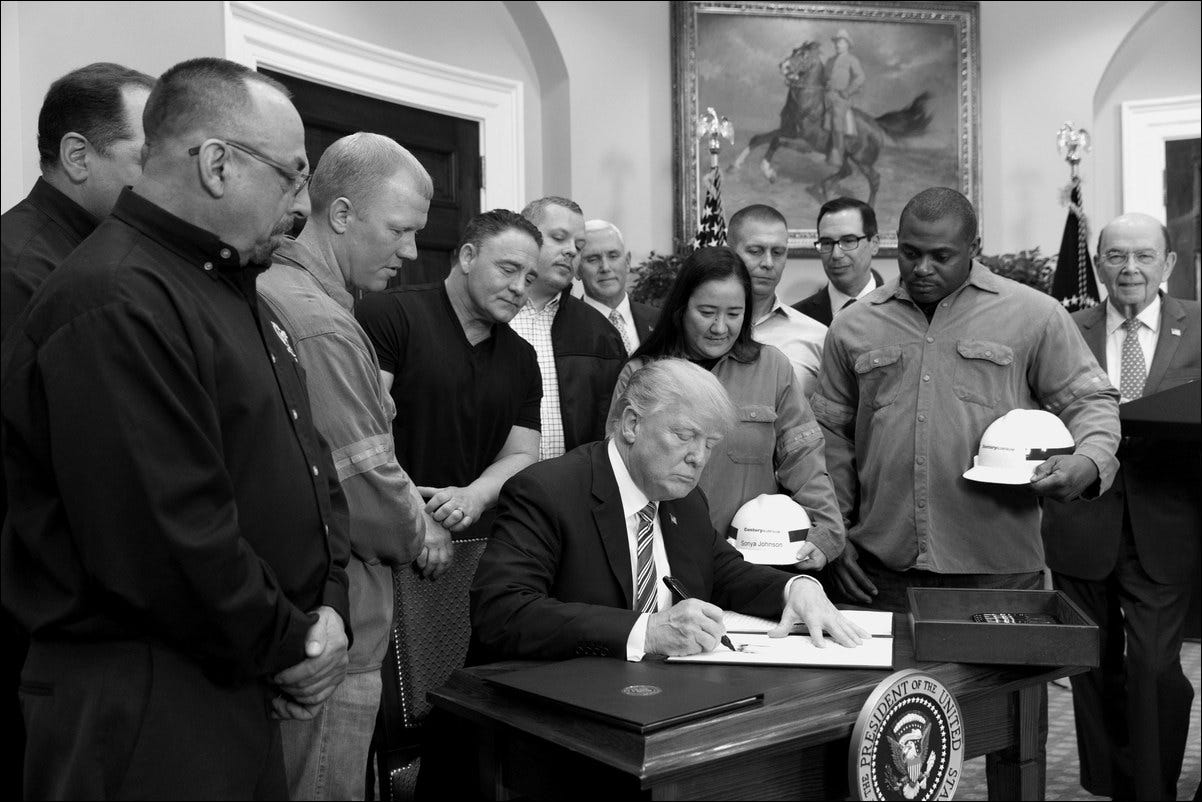
Trump Signs Resolution Ending 20-Year Minnesota Mining Ban
On Monday the President signed Rep. Pete Stauber’s Congressional Review Act resolution overturning the Biden-era ban on mineral development across more than 225,000 acres in Minnesota. The land sits over part of the Duluth Complex, one of the largest known U.S. reserves of copper, nickel, and platinum-group metals, and reopening it puts those resources back in the domestic pipeline at a moment when critical-minerals policy is a central administration priority. Stauber, who chairs the House Natural Resources energy and mineral resources subcommittee, sponsored the underlying resolution. However, for mining to begin, projects would still need to acquire state permits and comply with local environmental laws. Contrary to Democrat talking points, the blanket ban that Trump is overturning took policy out of the hands of Minnesotans. This change puts the power back in the states hands to determine the future of these vast reserves.
Inside Trade
USTR Opens Two Days of Section 301 Forced-Labor Hearings
The Office of the U.S. Trade Representative this week takes testimony in its Section 301 investigation of whether 86 countries adequately enforce against goods made with forced labor. The probe, launched March 12 and covering 60 economies, is expected to provide the legal foundation for a successor tariff regime after the Supreme Court rejected the IEEPA basis for prior duties. A finding here would give the United States a durable, statutorily grounded instrument to discipline imports made under labor conditions American producers do not match. Most do not realize the dramatic extent to which slave labor is still a major problem globally, with the United States under President Trump leading the way in tracing and enforcing against child and slave labor in both terms.
United States Trade Representative
BIS Tightens Section 232 to Exclude Non-Metal Derivatives
The Bureau of Industry and Security on Monday issued a technical correction to the April 2026 presidential proclamation on aluminum, steel, and copper, clarifying that products containing none of the covered metals fall outside the scope, and fixing the United Kingdom rate. While weakening the scope of the tariffs by narrowing the scope of the metals tariff structure to focus on actual metal content, this move reduces the surface area for legal challenges of the Section 232 program. Congress will need to play a rule further protect American aluminum, steel, and copper.
Bureau of Industry and Security
Defense Industrial Base Group Calls for Unified Rare Earth Office
The National Defense Industrial Association, in its 2026 Vital Signs report, urged the federal government to create a single coordinating office for rare earth supply-chain efforts and asked Congress to stand up a permitting and licensing commission for critical minerals projects. The recommendation aligns with the direction of administration policy, including last week’s FAST-41 designation for the Tennessee zinc and rare earth refinery and the Korea critical-minerals framework signed earlier this month. A consolidated coordination function would reduce friction between Pentagon procurement, DOE loan authority, Commerce trade tools, and Interior permitting.
National Defense Industrial Association
Former Commerce Official to Automakers: Build U.S. Hubs Now Ahead of USMCA Review
Writing for the Atlantic Council, former Deputy Assistant Commerce Secretary for Manufacturing Alex Krutz outlined three scenarios for the upcoming USMCA review and argued that the manufacturers best positioned regardless of outcome will be those already strengthening their American production footprint. The advice is consistent with public signals from administration officials, including Deputy USTR Switzer’s recent contrast between Mexico and Canada. For the auto sector, the lesson is that betting on indefinite continuation of the current cross-border integration model carries more risk than investing in domestic capacity.
Atlantic Council
FEDERAL REGISTER WATCH
Notice (Commerce): Preliminary affirmative less-than-fair-value determinations on crystalline silicon photovoltaic cells from India, Indonesia, and Laos, with affirmative findings of critical circumstances in part. The trio of determinations advances the solar supply-chain case CPA has been pressing and signals continued discipline against transshipment patterns the administration has been working to close. India | Indonesia | Laos
Notice (Commerce): Initiation of a countervailing duty investigation on certain oil country tubular goods from Austria, alongside parallel less-than-fair-value investigations of OCTG from Austria, Taiwan, and the United Arab Emirates. OCTG sits at the heart of the domestic energy supply chain, and a fresh CVD docket plus a three-country LTFV inquiry opens a significant new front for U.S. pipe and tube producers. CVD initiation | LTFV initiation
Notice (Commerce): Final covered-merchandise determinations on Chinese OCTG processed in Thailand, and on Chinese chassis subassemblies, finding the products subject to existing AD/CVD orders. These circumvention closures keep duty obligations attached to the underlying Chinese product rather than allowing third-country processing to wash off the tariff. OCTG/China | Chassis/China
Notice (Commerce): Preliminary results of the AD administrative review on circular welded carbon steel pipes and tubes from Thailand for the 2024-2025 review period, finding sales at less than normal value. Routine on its face, this is the grind-it-out enforcement work that keeps Thai pipe imports from undercutting domestic mills. Read notice
ON THE DOCKET
Sunset-review week; six ITC five-year reviews of long-running orders, mostly against Chinese imports, all close Friday in a single calendar squeeze.
May 01 (closes in 3 days) — ITC: Five-year sunset reviews of AD/CVD orders on prestressed concrete steel wire strand, mattresses (China plus Cambodia, Malaysia, Serbia, Thailand, Turkey, Vietnam), small vertical shaft engines, boltless steel shelving, non-refillable steel cylinders, and chassis and subassemblies. Sunset reviews determine whether revoking the orders would likely lead to continuation or recurrence of material injury; domestic producers and trade associations need to file by Friday to keep the orders in force, since silence reads as acquiescence. Wire strand | Mattresses | Small engines | Shelving | Steel cylinders | Chassis
ON THE HILL
HEARINGS & MARKUPS
Apr 28 — House Ways and Means: Full Committee hearing with health system CEOs. Not directly trade-focused, though pharmaceutical supply chains and generic drug manufacturing remain live trade-policy questions if they surface in member questioning.
Apr 29 — House Ways and Means: Markup of a six-bill package (HR 7432, HR 7463, HR 7343, HR 7529, HR 7655, HR 7995). Subject matter not specified in the docket entries available; worth confirming whether any touch trade, customs, or revenue.
BILLS TO WATCH
HR 8287, Semiconductor Controls Effectiveness Act of 2026: Strengthens U.S. export-control enforcement on advanced semiconductors. Ordered to be reported by a 43-0 vote on April 22, a unanimous tally that suggests the technology-control consensus is holding even as broader trade-policy debates intensify. Status: ordered reported, awaiting full chamber action. View bill
HR 4930: Expands information-sharing on suspected violations of intellectual property rights in trade. Cleared the House on April 27 with the motion to reconsider laid on the table. Modest in scope but it tightens the enforcement plumbing for a chronic IP problem with Chinese imports. View bill
HR 8535: Directs DHS to develop performance metrics for detection, deterrence, and seizure of fentanyl. Referred to House Homeland Security on April 27. Fentanyl precursors travel the same de minimis and forced-labor enforcement gaps that complicate consumer-goods customs work, so metrics-driven oversight here can spill into broader import-control discipline. View bill
HR 4434, Cosmetic Supply Chain Transparency Act of 2025: Imposes supply-chain disclosure requirements on cosmetic imports. Sitting in House Energy and Commerce since last summer; one to watch as forced-labor disclosure regimes expand into new product categories. View bill
COMMITTEE STATEMENTS
No notable Ways and Means trade statements in the last 72 hours.
TODAY IN AMERICAN HISTORY
On April 28, 1788, Maryland ratified the U.S. Constitution as the seventh state, signing onto the framework that gave the federal government the power to lay tariffs and conduct a unified commercial policy, the foundation Hamilton would put to work the next year in the Tariff of 1789.
READ NEXT:
The President Who Finished Lincoln's Economic Program.

Two months into Ulysses S. Grant’s first term, the last spike went into the Pacific Railway at Promontory Summit. The new German chancellor sent a representative to his inauguration. Within a year, his attorney general would suspend habeas corpus in nine South Carolina counties to break the Klan,