

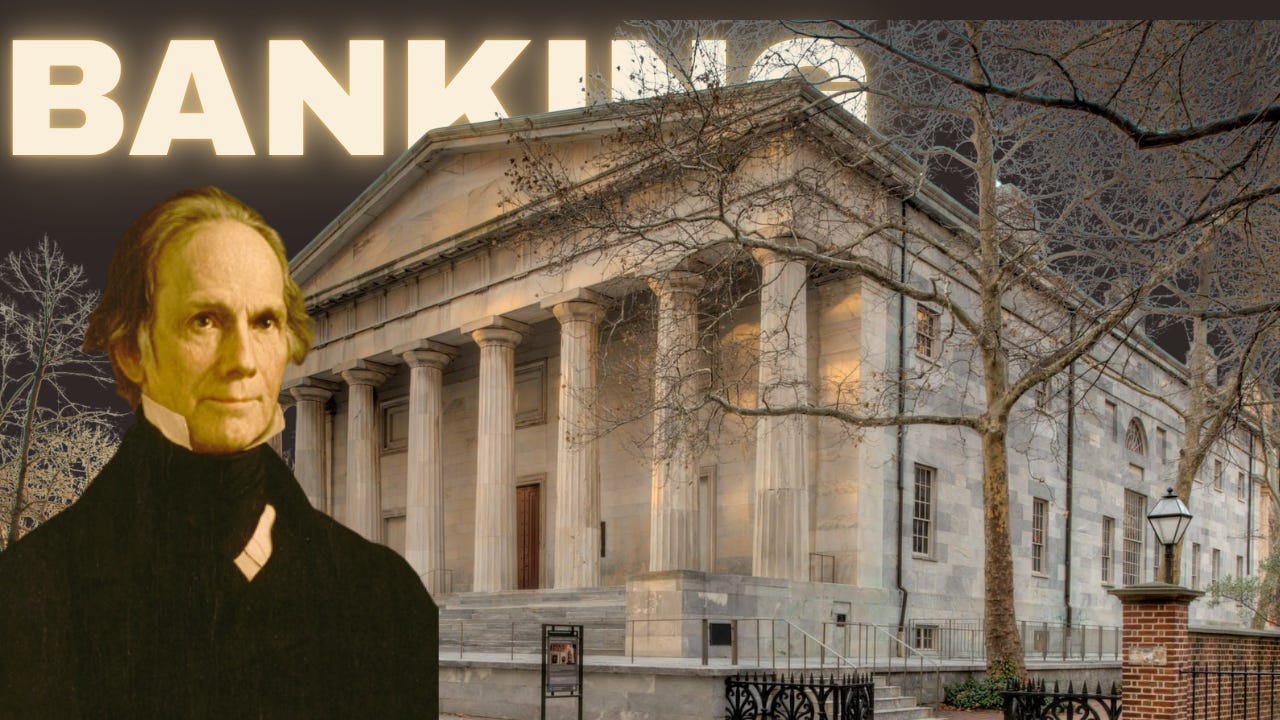
Let us begin with a direct challenge to a particular kind of reader.
If you have absorbed the libertarian assumption that all banking institutions are inherently corrupt, that any national credit architecture is tyranny in disguise, and that the only honest money is hard metal coin — you are lost and misinformed.
There is bad banking and there is good banking. There is speculative finance that enriches insiders at the expense of producers, and then there is productive credit that allows farmers, manufacturers, and entrepreneurs to do things they could not do alone.
Conflating the two is not principled. It is confused, and the sign of either willful ignorance, or a low IQ. This confusion, which has often been whipped up by political slop artists, has cost the American people dearly every single time it has prevailed. Now is the time for you to level up your thinking, as banking has become more important to our future than ever, and is thus almost more important than ever to understand.
A national bank, properly constituted, is not a favor to the wealthy. It is infrastructure for the whole productive economy. It is the credit architecture that allows a nation to build things too large and too long-term for private capital alone to finance — canals, railroads, harbors, the binding arteries of national commerce. Destroy it in the name of the “common man”, and the common man is left at the mercy of precisely the concentrated private wealth the demagogues claimed to be fighting. This is not a theory. It is what has happened many times over in both American and world history.
Henry Clay called the American System three pillars holding each other up. Clay’s vision of a national bank is almost certainly the pillar that is least understood, most feared, and most urgently in need of rehabilitation.
The Second Bank of the United States was the credit architecture that made the American System function as a system. Like him or not, when Andrew Jackson destroyed the Bank, he did not liberate the common man. He delivered him to exactly the aristocracy of concentrated wealth that Jackson claimed to be fighting.
“Distrust all demagogues of all interests who profess exclusive love for what they call the people”
Nicholas Biddle
What Even Albert Gallatin Knew
Before we reach Clay and the Bank, consider Albert Gallatin, a man who cannot be accused of nationalist bias.
Gallatin was Thomas Jefferson’s Treasury Secretary, a Swiss-born free trader, a man whose fiscal instincts ran strongly toward limited government and market solutions. He was, in many respects, the intellectual opposite of Alexander Hamilton.
And yet in 1808, Gallatin submitted to the Senate one of the most important documents in American history: his Report on Roads, Canals, Harbors and Rivers. In it he made an argument that cuts through every libertarian objection to national development investment with surgical precision.
Private capital, Gallatin explained, was simply not going to build the infrastructure the young republic needed. The areas through which the most essential roads and canals would run were too sparsely settled, the returns too distant and uncertain, and more attractive investments too readily available to divert the limited supply of private capital. The private market, left alone, would systematically under provide the infrastructure that national development required.
(Does this problem seem at all familiar?)

The federal government, Gallatin argued, could overcome these obstacles by participating in large-scale projects that would, in turn, stimulate private enterprise to carry on further improvements.
Crucial for people to understand: government would not replace the market. Instead it would create the conditions under which the market could function at a national scale. Federal credit was not the enemy of private enterprise. It was in fact the precondition for it.
This is the argument that Clay internalized and built the American System around. And if Albert Gallatin — Jefferson’s own Treasury Secretary, no Hamilton ally — arrived at this conclusion through honest analysis of the young republic’s actual conditions, the question of whether government credit has a role in national development is not a question of freedom versus tyranny. It is a question of whether you want to look at the evidence or whether you prefer the comfort of an ideology.
The Second Bank of the United States was built on exactly this understanding. Let us look at what it actually was.
The Problem It Was Built to Solve
To understand why the Second Bank was necessary, you have to understand the financial condition of the United States in 1816. A subject we have covered in our review of Lindsay Schakenbach Regele’s book “Manufacturing Advantage: War, The State, and the origins of American Industry 1776-1848”
The War of 1812 had exposed a catastrophe. The First Bank’s charter had been allowed to expire in 1811, by a single vote in each house of Congress. And without Bank, the federal government had been unable to finance the war through any coherent credit architecture. It borrowed at ruinous rates from state banks, many of which were themselves unstable.
By 1816, roughly five hundred state banks were operating across the country, each issuing its own paper currency. Imagine that, a nation with over 500 currencies!
These notes were worth different amounts in different states depending on the solvency of the bank that issued them. A merchant moving goods from Baltimore to Boston paid a premium of roughly fifteen percent simply to exchange his Maryland banknotes for currency acceptable in New England. The federal government was collecting import duties in Baltimore banknotes at a twenty percent discount to their face value, while Boston merchants paid at par. This was, as the Bank’s eventual president Nicholas Biddle noted, a direct violation of the constitutional requirement that taxes be uniform throughout the United States. And furthermore made a business environment, that especially without modern spreadsheet software, was very unstable and difficult to manage.
The chaos systematically disadvantaged the poor and the enterprising at the expense of speculators and established wealth. When state banks collapsed — and they collapsed regularly — farmers and small manufacturers who had accepted their notes were left with worthless paper. The brokers and speculators who understood which currencies were weakening profited on the misfortune of those who did not.
Into this wreckage, Clay and Calhoun pushed through the charter of the Second Bank on April 10, 1816. Their vision was more ambitious than simple stabilization. They sought to earmark the Bank’s $1.5 million establishment bonus, and its annual dividends, as a dedicated fund for internal improvements — the binding infrastructure Clay understood to be the System’s third leg. This was the original architecture of all three pillars working together: the tariff generating revenue, the Bank financing improvements, the improvements deepening the national market the tariff protected.
President Madison signed the Bank into law. Then he vetoed the Bonus Bill.
That veto explored in a past piece, and a story that we will visit more in depth in the future, was the original sin. It severed the Bank from the improvements before the connection could function. What remained was still enormously valuable. But it was incomplete before it began.
What Biddle Actually Built
The Bank’s first years were a genuine disaster. Its first president, William Jones, was unqualified, politically appointed, and allowed branch offices to issue notes far beyond prudent limits. The resulting bubble and crash of the Panic of 1819 left thousands of farmers and manufacturers ruined and gave the Bank’s enemies ammunition they would use for the next fifteen years, and that detractors still wield to this day.
What the enemies would never honestly acknowledge was what happened next.
In 1823, Nicholas Biddle became president of the Bank. He was thirty-seven years old, and had worked tirelessly to promote canals and public education in Pennsylvania as a state legislator. Biddle had essentially fully internalized Hamilton’s conception of national credit as an instrument of national development.
He wrote to Secretary of War Calhoun the month before taking office: “This unfortunate institution” (the bank) “has from its birth been condemned to struggle with the most perplexing difficulties, yet even with all its embarrassments it has sustained the national currency and rescued the country from the domination of irresponsible banks, and their depreciated circulation. The time has perhaps arrived when it may combine its own and the country’s security with a more enlarged development of its resources and a wider extension of its sphere of usefulness.”
He meant it. Within two years Biddle had transformed the Bank from a source of instability into the most sophisticated credit architecture in the Western world.
The mechanism he built was elegant. Western branch offices would issue Bank notes to merchants in exchange for bills of exchange drawn on Eastern cities. Essentially, claims on debts owed by Eastern merchants for goods already shipped. Those notes circulated in the West as reliable currency.
When they eventually made their way East — as they inevitably did, carried by merchants paying import duties — the Eastern branches could redeem them, having collected the underlying bills of exchange. The result was a self-balancing national currency that required almost no specie transfers to function. The currency was backed not by gold sitting in a vault but by the inevitable and actual productive commerce of the nation.
Niles’ Weekly Register, not a publication given to flattery, described it in 1832 as “a splendid pillar in the broad American System; for a large part — perhaps two-thirds of all its accommodations, in one way or another, are for the direct encouragement and extension of agriculture and the mechanic arts, the promotion of internal improvements, and erection of all sorts of buildings — dwellings and stores, and factories and workshops.”
Clay himself could not have described it better. The Bank was not an abstraction or a favor to financiers. It was, in Biddle’s own words, “only another name for the farms, the commerce, the factories, and the internal improvements of the country.”
The Bank also did something almost entirely forgotten: it directly financed internal improvements of precisely the kind Clay and Gallatin had envisioned. Biddle personally co-organized the Society for the Promotion of Internal Improvements in Pennsylvania in 1824 alongside Mathew Carey — the Benjamin Franklin protégé whose son Henry Carey would become the greatest economist the American School produced. The Bank loaned the Chesapeake and Delaware Canal one million dollars in four installments. It subscribed to the stock of canal companies throughout the 1820s and 1830s. President Adams used the Bank’s dividend revenues to subscribe to canal company stock, so that the government’s future profits on its Bank investment would directly fund national infrastructure — exactly the mechanism Clay and Calhoun had originally envisioned before Madison’s veto killed it.
The results were concrete. In the seven years before the Tariff of 1824, the assessed value of real estate in New York City fell from $57 million to $52 million. In the seven years after under the combined influence of the tariff and the Bank’s credit architecture that value rose to $95 million. Exports increased. Navigation expanded. Cities grew. The public treasury overflowed. Every prediction the opponents of the American System had made in 1824 — that it would destroy commerce, devastate agriculture, ruin navigation, and deplete the treasury — had failed, in Clay’s own words before the Senate in 1832, utterly.
This was the institution Andrew Jackson destroyed.
The Bank War: Rhetoric Dressed as Principle
Before we indict the Bank War, Jackson’s position deserves an honest hearing. The Bank had real problems. Its 1819 mismanagement under William Jones caused genuine suffering. Nicholas Biddle, for all his brilliance, was arrogant and not above making loans to political allies. The Bank wielded enormous power with roughly twenty percent of the nation’s entire banking capital, thirty to forty percent of its specie reserves, and thus there were legitimate questions about accountability.
These concerns deserved a response. The recharter bill that passed Congress in 1832 had already incorporated significant reforms. A Cambridge Business History Review study of Jackson’s veto message concluded that a reformulated bill meeting most of the president’s stated objections would not have seriously undermined the institution’s position. The Bank could have been reformed. It did not need to be destroyed.
Jackson destroyed it anyway.
The veto message was drafted by Amos Kendall and Roger Taney. It was not a serious engagement with the Bank’s actual operations. It was a political document — one of the most effective political documents in American history — that deployed the newly available weapon of universal white male suffrage to cast the Bank as a monster of aristocratic privilege preying on the common man. The language was incendiary, the evidence selective, and the timing calculated for maximum effect in the presidential election four months away.
The Supreme Court had already ruled the Bank constitutional in McCulloch v. Maryland in 1819. Jackson simply declared he could ignore the Court’s judgment. His Treasury Secretary McLane told him the deposits were safe, and strongly opposed Jackson removing the deposits. He was thus moved out of the post of Treasury secretary and became the Secretary of State. The new Treasury Secretary Duane also refused to remove them on the grounds it would cause financial catastrophe. Jackson then proceeded to fire him as well. Roger Taney, who executed the removal of Duane was later rewarded with appointment as Chief Justice in gratitude for has actions against the Bank, in which capacity he would go on to render the Dred Scott decision.
The Bank’s congressional supporters won every factual argument. A House investigation found the deposits secure by a vote of 109 to 46. Augustin Clayton of Georgia, who had led the investigation against the Bank, later publicly recanted — telling the House he had committed wrongs, that his earlier reflections were unworthy of him, and that they had wounded the characters of honorable men.
None of it mattered. A press machine of 150 coordinated newspapers had done its work. The people had been told the Bank was a monster. The monster had to die.
Watching the wreckage accumulate, Biddle wrote in 1836: “Distrust all demagogues of all parties who profess exclusive love for what they call the people. For the last six years the country has been nearly convulsed by efforts to break the mutual dependence of all classes of citizens — to make the laborer regard his employer as his enemy, and to array the poor against the rich. These trashy declaimers have ended by bringing the country into a condition where its whole industry is subject far more than it ever was before, to the control of the large capitalists — and where every step tends inevitably to make the rich richer, and the poor poorer.”
He was right. The evidence arrived before his ink was dry.
The Wreckage
The numbers that followed the Bank’s destruction are not ambiguous.
In 1830 there were 329 state bank charters. By 1837 there were over 700. Freed from the Bank’s regulatory discipline of demanding specie redemption from state banks that over-issued, these institutions expanded recklessly, fueling land speculation and commodity bubbles with no anchor to the productive economy.
What most accounts miss in the transition to what came next is the defensive function the Bank had quietly been providing. Under Biddle, the Second Bank had served as a buffer between American credit and British financial pressure. In 1825, when a wave of speculation collapsed 104 London banks and threatened to pull American credit down with it, Biddle coordinated the Bank’s branches to prevent the panic from spreading across the Atlantic. In 1827 and 1832 he did the same thing using the Bank’s national reach and specie reserves to absorb shocks that would otherwise have cascaded through an uncoordinated system of state banks. The Bank was, in effect, America’s shock absorber against the Bank of England.
With it gone, that shock absorber no longer existed. American state banks were now individually and directly exposed to whatever the Bank of England decided to do with its discount rate with no national institution capable of coordinating a response. The threat of foreign dependence that Hamilton feared had come true.
When the Bank of England tightened credit in 1836, contracting the flow of capital that had been fueling American land speculation, there was nothing between that decision and the exposed, over-leveraged American banking system. The structure collapsed. On May 10, 1837, banks in New York City suspended specie payments. The crisis spread immediately. Over forty percent of all American banks failed. Three hundred and forty-three banks closed entirely. Profits, prices, and wages collapsed. Unemployment rose sharply. The depression lasted seven years.
The South was hit hardest. The plantation economy had been built on a debt structure that used slave and land mortgages as collateral for bonds sold to British investors through houses like Baring Brothers. When cotton prices fell twenty-five percent in the spring of 1837, the debt built on that collateral became toxic and unpayable. Plantations across the South collapsed. Nine states and territories mostly Southern defaulted on their bonds to British creditors by 1842. Infrastructure bond markets collapsed. Internal improvement projects ground to a halt.
The man who had claimed to champion the common man against the moneyed aristocracy had delivered the common man to the most severe depression the nation had yet experienced. Without a national credit institution capable of managing the crisis and without the stabilizing function Biddle had exercised in 1825, 1827, and 1832, when he had protected the American economy from each successive wave of British financial pressure, there was no institutional mechanism to arrest the collapse.
Abraham Lincoln, then a young Whig legislator in Illinois, watched his state’s pioneering railroad system collapse as the bonds it had issued became worthless. He delivered his verdict on December 26, 1839: “I know that the great volcano at Washington, aroused and directed by the evil spirit that reigns there, is belching forth the lava of political corruption, in a current broad and deep, which is sweeping with frightful velocity over the whole length and breadth of the land... Broken by it, I, too, may be; bow to it I never will.”
Lincoln spent the next twenty years fighting for the restoration of national credit. He would not achieve it until the Civil War forced his hand. Even then, as with Clay before him, the full architecture he envisioned was cut short before it could be completed.
The Missing Pillar
Clay’s three pillars were designed to hold each other up. The tariff generated revenue. The Bank directed credit toward productive development and maintained the stability that made long-term investment possible. The internal improvements bound the national market together and ensured the gains of protection flowed outward to the national community rather than upward to concentrated wealth. Remove any one leg and the structure weakened. Remove the Bank, and what remained was exactly what the post-1836 era produced: tariffs without a credit architecture to direct their revenues, improvements without a national institution capable of financing them at scale, and productive gains that flowed relentlessly upward to the trusts.
Even Albert Gallatin understood this in 1808. Private capital alone cannot build a nation. The returns are too distant, the scales too large, the coordination requirements too complex. A free republic that wants to build the foundations of its own greatness — whether that means canals in 1820 or fusion energy infrastructure in 2026 — needs a credit architecture adequate to the task.
This is not ancient history. It is the central unresolved question of American economic governance the question Hamilton foresaw, Clay posed, Lincoln tried to answer, and every generation since has been forced to confront again in new forms.
Henry Clay’s birthday is the perfect time to be reviewing this history that is ignored but critically relevant to our nations future. President Trump has broken the door open to revisit what Made America Great, and how it can be made great again. What is old is becoming new again.
The tariff is back. The internal improvements debate has returned in the form of AI infrastructure, fusion energy, water systems, and reindustrialization. How we finance reindustrialization has brought the national credit question to life again today as it was in 1832.
Clay’s revolution is unfinished. Now is the time for the American System once again.
The Bank was on the path to becoming a centralized national economic-central-planning financial directorate that sought to implement a system of rigidly defined geographic economic divisions of labor based on the set of logics that came to be known as comparative advantage. Its destruction made it so that finance was being subordinated to local development, local public priorities, local civic groups, local culture, local academe, local science and engineering, and local democratic pressure instead of being insulated from them.
The Bank, and Henry Clay's visions, were, if they were ever enacted but luckily they were not, to become a privileged semi-public money-power with exclusionary control over major financial decisions that was increasingly engaging in system scale intensive economic central planning versus a more permeable, federated, and publicly reachable order in which far more people, organizations, and places had practical access to developmental decision-making in both public and private life.
It is also wrong that the post second Bank system was simply more unstable than European centralized systems in any straightforward socially OR economically relevant sense. That comparison usually cheats by defining “stability” from the standpoint of large elite institutions and their ability to preserve themselves, socialize losses, or impose adjustment through broad demand destruction. When things actually went wrong in nineteenth-century American finance was highly localized, segmented, and therefore typically small in scale and far more containable; that is a very different thing from systemwide consolidation under a few great centers that appear “stable” partly because they can externalize pain onto workers, producers, regions, and peripheral firms. More importantly, the main significance of the Jacksonian victory was not merely monetary but civilizational, it helped preserve and expand a widely and deeply federated order across science, economy, commerce, education, culture, and geography by preventing a national financial sovereign from becoming the hidden governor of development. The destruction of the second Bank and the many other reforms that were done widened the field for local capital formation, heterogeneous regional growth paths, municipal and state experimentation, more participatory party structures, more accessible officeholding, more plural business ecosystems, and more room for locally grounded institutions, banks, firms, schools, associations, newspapers, and governments; to interact and co-govern. And they did so wildly successfully!
Every system that ever implemented a system that fits within the same category as Clay's intended system, whether it be the USSR or the late Austro Hungarian Empire have been terribly corrupt failures with poor decision making and relatively very bad outcomes