
What Elon Musks Fortune Proves about Economics
Elon Built Trillions, Not Based in Financial Gimmicks, but with PRODUCTION.

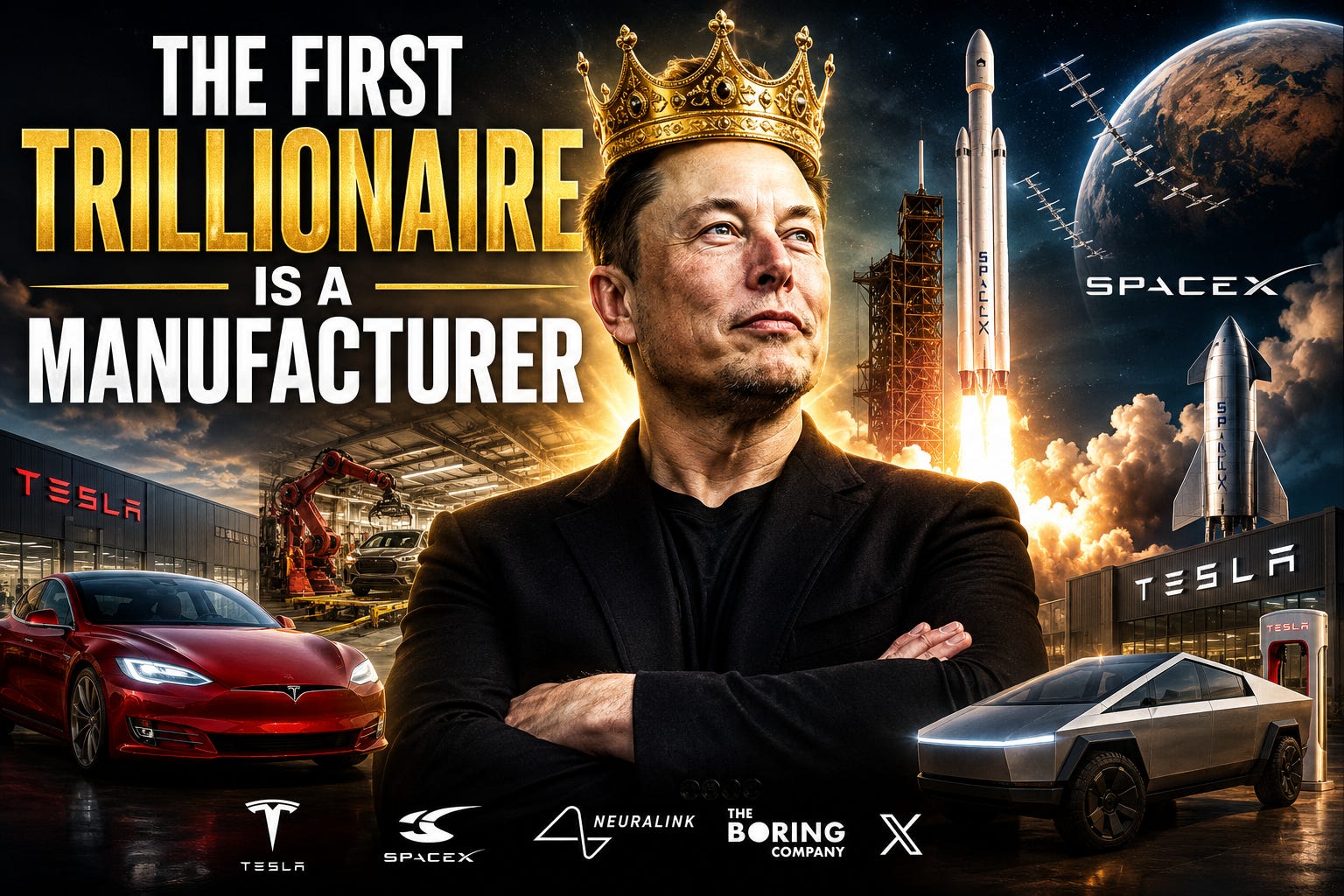
This morning, on the floor of the Nasdaq, a company that builds rockets sold its shares to the public for the first time. By the closing bell, the man who founded it was worth more than one trillion dollars. He is the first human being in history to cross that line.
Stop and look at what actually happened. The largest IPO ever conducted was not a bank. It was not a hedge fund, a payments app, a social network, or a financial instrument of any kind. It was a factory. SpaceX builds rockets in Texas, satellites in Washington, and engines by the thousand: physical objects, welded and machined and test-fired, that leave the Earth carrying the weight of American power with them. The market looked at that productive capacity and priced it at nearly two trillion dollars, and in doing so it settled a 235-year-old argument.
For two generations, the people who run American economic policy told us this could not happen. Manufacturing was the past. The future belonged to services, to software, to finance, to the “knowledge economy,” in which we would design and they would build, and the dirty business of bending metal would be outsourced to whoever would do it cheapest. The smartest men in Washington and New York assured us that a nation could remain rich while it made nothing, that wealth was a spreadsheet, that the factory floor was a sentimental relic.
Elon Musk did not believe them. He bet everything, repeatedly and publicly and at the brink of personal bankruptcy, on the proposition that making things is the foundation of all wealth. He built car factories when Detroit was dying. He built rocket factories when the United States had surrendered crewed spaceflight to Russian launch vehicles. He built battery plants, foundries, and data centers the size of small cities. He coined the principle that the factory itself is the product, the machine that builds the machine, and organized his companies around it.
Today the truth was backed by a trillion dollars.
The Lineage
Musk did not invent this idea. He is the latest name in the oldest argument in American political economy, older than the parties, older than the Constitution’s first decade in operation.
In 1791, Alexander Hamilton submitted his Report on Manufactures to Congress and made the case that a free people could not remain free while dependent on foreign workshops. National independence required productive independence. The nation that made its own goods would command its own destiny; the nation that merely traded would be at the mercy of those who made. Hamilton proposed tariffs, bounties, and internal improvements to call American industry into being, and was told, then as now, that this violated the elegant logic of free exchange.
Henry Clay took Hamilton’s report and built a governing program out of it. He called it the American System: protective tariffs to shelter infant industry, a national bank to finance it, and internal improvements to bind the country’s markets together. Clay understood what the free traders of his day did not, that a nation’s wealth is not the sum of its cheapest purchases but the depth of its productive powers. Under the American System and its successors, the United States went from agricultural periphery to the greatest industrial power the world had ever seen.
Henry C. Carey, the most influential American economist of the nineteenth century and Lincoln’s adviser, gave the system its theory. Wealth, Carey argued, is physical. It is the command of nature’s forces, the harnessing of coal, steam, and steel to multiply what human labor can do. The measure of an economy is not its money stock but its machinery, and the interests of the capitalist and the workingman harmonize precisely where production deepens, because the factory raises both.
Friedrich List, the German who learned his economics in Pennsylvania, carried the doctrine to the world. His National System of Political Economy exposed free trade as the ideology of the established power, the ladder Britain kicked away after climbing it. The wealth of nations, List wrote, lies in their productive forces, not their exchange values. A country that trades away its manufacturing trades away its future.
And E. Peshine Smith, Carey’s brilliant disciple, completed the thought: the real capital of a nation is energy commanded per worker. Civilization advances exactly as far as each pair of human hands can direct ever-greater physical forces. Read that sentence, then look at a Raptor engine producing half a million pounds of thrust under the control of a single launch console, and tell me Smith was wrong.
Hamilton. Clay. Carey. List. Smith. Then Ford, who put the doctrine on wheels. And now Musk, who put it into orbit.
The Counter-Consensus
For forty years this lineage was buried. The Washington Consensus declared that comparative advantage was destiny, that capital should flow wherever labor was cheapest, that a service economy was a mature economy. We were told the factory jobs were never coming back and that wanting them back was nostalgia. American manufacturing employment was cut nearly in half. Entire regions of the country, the regions that built the arsenal of democracy, were written off as acceptable losses in the great optimization.
Meanwhile, the financiers got rich. And here is the thing every honest observer must now confront: none of them got thisrich. The arbitrageurs, the private equity barons, the men who securitized and leveraged and extracted never came within an order of magnitude of the trillion-dollar line, for all their billions. The threshold was crossed by a man whose business is welding stainless steel in a South Texas tidal flat.
This is the American School’s central claim made flesh. Finance moves wealth around; manufacturing creates it. The deepest fortunes flow to those who expand what humanity can physically do: Carnegie with steel, Rockefeller with refined energy, Ford with the assembly line, and now Musk with reusable rockets and the electric drivetrain. Every one of them a maker. Every one of them rich because the nation around them grew more productive through their works.
Consider what Musk’s companies have actually added to America’s physical economy. Tesla forced the global auto industry into the electric age, and its American works in Fremont, Austin, and Sparks were built at a moment when conventional wisdom said no new American car company could ever exist. SpaceX took the cost of reaching orbit and cut it by an order of magnitude, returning to the United States a strategic capacity it had humiliatingly lost, and now launches more mass to space than every other nation and company on Earth combined. Starlink wrapped the planet in American-built communications infrastructure. The xAI compute facility in Memphis was stood up in months, an industrial mobilization at a tempo this country had not seen since the Second World War.
These are works in the old sense, the sense Hamilton meant. And the men and women who build them are sharing in the proceeds: thousands of SpaceX machinists, welders, and technicians became millionaires this morning when the ticker went live. Carey called it the harmony of interests. We just watched it happen on the Nasdaq.
The Lesson for Policy
Some will say Musk proves only that one extraordinary individual can defy the odds. Wrong. He proves the odds were rigged by policy, and that policy can be changed.
Every Musk enterprise grew up in the cracks of the old consensus and flourished where the consensus broke down. SpaceX exists because the federal government chose, in the Hamiltonian manner, to be an anchor customer for an unproven American manufacturer rather than keep renting seats on foreign rockets. Tesla survived its near-death because public policy decided that an American electric car industry was worth having. The pattern is the American System’s pattern: the state sets the conditions, the builder does the building, and the nation reaps productive powers it did not have before.
And yes: tariffs. It is no coincidence that this milestone arrives in the middle of the most serious revival of protective tariff policy since the nineteenth century. The tariff is doing today what Clay designed it to do, changing the answer to the only question that matters in industrial strategy, which is where the next factory gets built.
Honesty requires the concession, so here it is: Musk built in Shanghai too. The Gigafactory there went up in 2019, in the closing days of the old consensus, when its grip on the boardrooms and the supply chains still held, even as President Trump’s first-term tariffs were opening the way to a new view. Beijing offered land, speed, and subsidy that no American jurisdiction would then match, because forty years of policy had taught capital that offshoring was the rational move. Note well what that proves. The builder builds where building is rewarded, even this builder. Indict the regime that made Shanghai the rational answer, and then watch what happened once the new view took hold. Since the pandemic exposed the fragility of Pacific supply chains and Washington recovered the tariff, every major work Musk has raised has gone up on American soil: Giga Texas, the Starbase rocket works, the lithium refinery on the Gulf Coast, the Memphis compute colossus. The marginal dollar, the only dollar policy can ever influence, is flowing home to the American interior. The same incentives that once pulled American capital across the Pacific are now, properly reversed, pulling it back. One career, two policy regimes, two completely different maps of investment. There is no cleaner natural experiment in the entire literature.
Capital goes where the conditions for production are defended. A nation that protects its productive base gets trillion-dollar manufacturers. A nation that does not gets trillion-dollar IOUs.
China understood this all along, which is the bitter irony of the free-trade era: Beijing ran the American System while Washington ran the British one. They read List; we read Friedman. The result was the greatest transfer of productive capacity in human history. The correction now underway, in tariffs, reshoring, and industrial strategy, is the American tradition itself, recovered.
The Reputation to Live Up To
There is a danger in moments like this one, and it is the danger of small-mindedness: meeting an achievement of this scale with envy dressed up as analysis. The professional scolds will spend the week telling you what a trillion dollars says about inequality. Let them. The rest of us can see what it actually says: that the universe still pays its largest rewards to those who build, and that a single determined manufacturer, given a fair field, can bend the trajectory of an entire civilization.
Hamilton dreamed of American workshops. Clay legislated for them. Carey and Smith proved their arithmetic. List warned what would befall the nation that abandoned them. Ford showed the world their power. And Musk, at a moment when his own country had nearly talked itself out of making things, took the old doctrine, strapped it to a rocket, and flew it.
He is not done. The fortune minted this morning is collateralized against Mars, against the proposition that the productive powers of mankind need not stop at the edge of one planet. That is the most American System idea ever conceived: internal improvements for the species.
The first trillionaire is a manufacturer. The American School was right. Now let us act like it: protect the base, build the works, and raise the next generation of builders who will look at today’s milestone the way Musk looked at Ford’s.
Making things is not less important now than before. In the ongoing Fourth Industrial Revolution, making things will be more important than ever, and Elon Musk has proved it.