

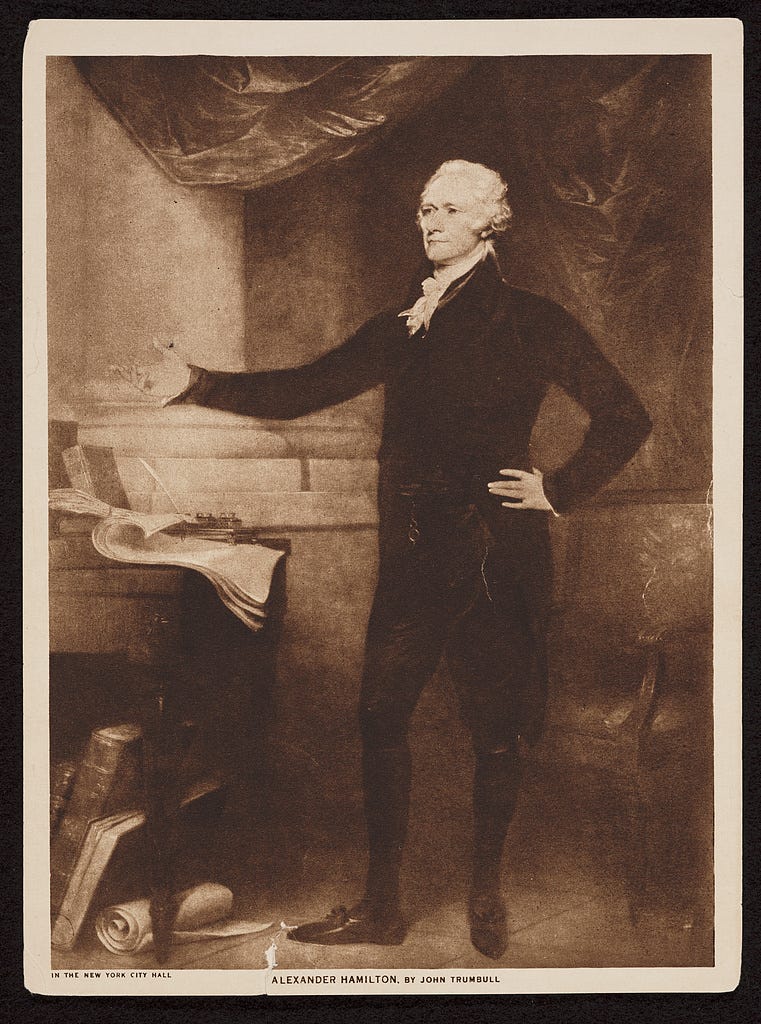
Alexander Hamilton is the great American statesman not because he was the most lovable Founder, nor because he was the most democratic, nor because he was the most morally pure. He was none of these things. He was ambitious, combative, often reckless, and at times, tragically self-destructive. But he was something far rarer and far more important.
Hamilton is the statesman of construction. Of institutions. Of credit. Of industry. Of executive capacity. Of national power. Where many of the Founders were primarily concerned with restraining authority, Hamilton was concerned with something more fundamental: whether the United States would exist as a serious, durable nation at all.
Independence, he understood, was only the beginning. The real question was whether America would remain a loose collection of agrarian provinces, politically fragile and economically dependent, or whether it would become a sovereign, industrial, and financially coherent nation capable of surviving in a world ruled by empires.
In this sense, Hamilton is the founder of American statecraft properly understood. Washington was indispensable as a leader and symbol. Madison was a constitutional architect. Jefferson was a poet of democracy and a voice of agrarian republicanism. But Hamilton was the first to think systematically about what it takes for a nation to endure: public credit, manufacturing, fiscal capacity, executive energy, and institutional continuity.
He is also, in a very literal sense, the founder of the American School of political economy, the protectionist, developmental, nation-building tradition that runs from Hamilton through Henry Clay, Henry C. Carey, and Abraham Lincoln, and into the industrial takeoff of the United States itself. This is the most successful and most authentically American economic tradition the country has ever produced.
The Reports on Public Credit, the National Bank, and Manufactures are not dusty policy memos. They are the founding documents of this American School. They lay out, for the first time, a coherent theory of how a young republic can deliberately construct its own economic independence rather than waiting for it to emerge by accident.
Hamilton understood something that remains true today and is once again being painfully rediscovered: sovereignty is not just a legal condition. It is an economic and productive one.
A nation that cannot finance itself, cannot organize capital, cannot develop its own industry, and cannot command the material basis of power is not truly independent. It is merely tolerated.
The American School of Protection is simply this insight turned into a governing tradition. It rejects the fantasy that nations become strong by passively submitting to global market forces. It insists instead that nations become strong by deliberately shaping their own development.
This is why Hamilton is so relevant now.
We live in an era in which Americans are finally being forced to relearn this lesson. Supply chains, industrial capacity, strategic materials, and manufacturing depth are not abstractions. They are the foundations of real power and real freedom. Hamilton would have immediately recognized our present predicament: a nation that allowed its productive base to hollow out while assuming that markets, norms, and paper wealth could substitute for strategy.
What makes Hamilton so compelling is that he was neither a doctrinaire ideologue nor a romantic moralist. He did not imagine that virtue alone would hold a republic together. Nor did he believe that liberty could survive without power. He believed instead that good institutions could channel human ambition, self-interest, and energy toward national ends.
This is the core of his realism. And also the core of his optimism.
Hamilton’s famous insistence on “energy” in government is often misunderstood as a mere argument for strong executive power. In fact, it was something much deeper. He meant the capacity of the state to act, to coordinate, to build, to defend, and to sustain itself over time.
Hamilton, while fully aware that unbridled human depravity would corrupt government, also understood something just as important: weak government is not a moral achievement. It is an invitation to chaos, faction, and foreign influence, forces that empower the worst aspects of human nature and make power dangerous to the liberty of the people.
In my own work on trade and industrial policy, I keep returning to Hamilton for a simple reason. He offers a model of statesmanship that is constructive rather than merely critical. Many people can diagnose decay. Very few can design systems that reverse it. Hamilton did not merely attack the Articles of Confederation. He replaced them with a functioning financial and administrative architecture that, remarkably, still undergirds the American system today.
There is also something deeply American about Hamilton’s life itself. Born in the Caribbean, illegitimate, poor, and self-made, he attached his ambition not merely to personal advancement, but to the project of nation-building. He understood, from experience, how fragile order is and how quickly societies can collapse into dependency and stagnation.
His rivalry with Jefferson is often misrepresented as a conflict between commerce and virtue, or finance and agrarian simplicity. This is a false dichotomy. Hamilton did not oppose virtue. He simply refused to base the survival of the republic on the hope that citizens would remain perpetually virtuous. He designed the Republic for human beings as they are, not as we wish them to be.
Where Jefferson feared corruption from cities, banks, and industry, Hamilton feared something far more dangerous: national weakness, disunion, and strategic irrelevance. History has largely vindicated Hamilton. The United States did not become a great power by remaining a pastoral republic. It became one by becoming an industrial, financial, and organizational civilization under the very system Hamilton designed.
What is most often missed is that Hamilton’s vision was not about wealth for its own sake. It was about independence, dignity, and permanence. He did not want America to be rich so that it could consume more. He wanted it to be productive so that it could stand on its own feet in a hostile world, and so that the Founders’ Republican experiment could survive for centuries to come. Thus, his nationalism was not narrow, parochial, or chauvinistic, but civilizational and humanist in the best sense.
This points toward another aspect in which Hamilton stands head and shoulders above most statesmen, something that modern politics has largely forgotten: statesmanship is about time. Not the next election. Not the next quarter. Not the next news cycle. He was building a system meant to compound, to grow, and to endure across generations.
Hamilton was not always loved. He was often hated. He was frequently misunderstood. And he was ultimately destroyed by a mixture of enemies, pride, and tragic personal flaws. Hamilton often failed to be prudent, both politically and socially, with the extramarital affair that cost him dearly. But without him, the American republic would almost certainly have failed in its first decades or drifted into strategic and economic irrelevance. Thus, to study Hamilton is to study the art of national construction.
The American Protectionist School of Economics championed Hamilton as their founder. The foundational role this school had in the industrialization of the country and its rise to the rank of a superpower is the living proof of the deeper truth Hamilton understood better than anyone else of his generation: a serious nation does not emerge by accident, but must be built and maintained through struggle and action.