

“I am fully persuaded that if the spirit of industry, economy and patriotism, which seems now beginning to dawn, should exert itself to a proper latitude, that we shall very soon be able to furnish ourselves at least with every necessary and useful fabrick upon better terms than they can be imported without any extraordinary legal assistance—I shall always take a peculiar pleasure in giving every proper encouragement in my power to the manufactures of my Country.” — George Washington to Daniel Hinsdale, April 8, 1789
On this day, 237 years ago, George Washington was sworn in as the first President of the United States. What most don’t know, is just how important the tariff and manufacturing independence was to the first President. So much so, that it played a defining role on his Inauguration Day.
The winter at Valley Forge during the American Revolutionary War was a lesson George Washington and his aid-de-camp Alexander Hamilton would never forget.
Eleven thousand Continental soldiers spent the winter of 1777 to 1778 in a Pennsylvania encampment with no shoes, no coats, and no blankets fit for the cold. Roughly two thousand of them died of exposure, malnutrition, and disease before the spring. Washington’s men were freezing not because the country lacked patriotism but because it lacked factories.
The British colonial system had spent decades making sure the future United States had no factories and could not provide for itself. The Wool Act of 1699, the Hat Act of 1732, and the Iron Act of 1750 had specifically forbidden the colonies from manufacturing finished goods that might compete with English producers. Thus when the Revolution came, the army that fought for American independence was clothed in scraps, foreign imports, and what little the home spinners could produce on their own.
Washington watched his men die for want of cloth. He never forgot it.
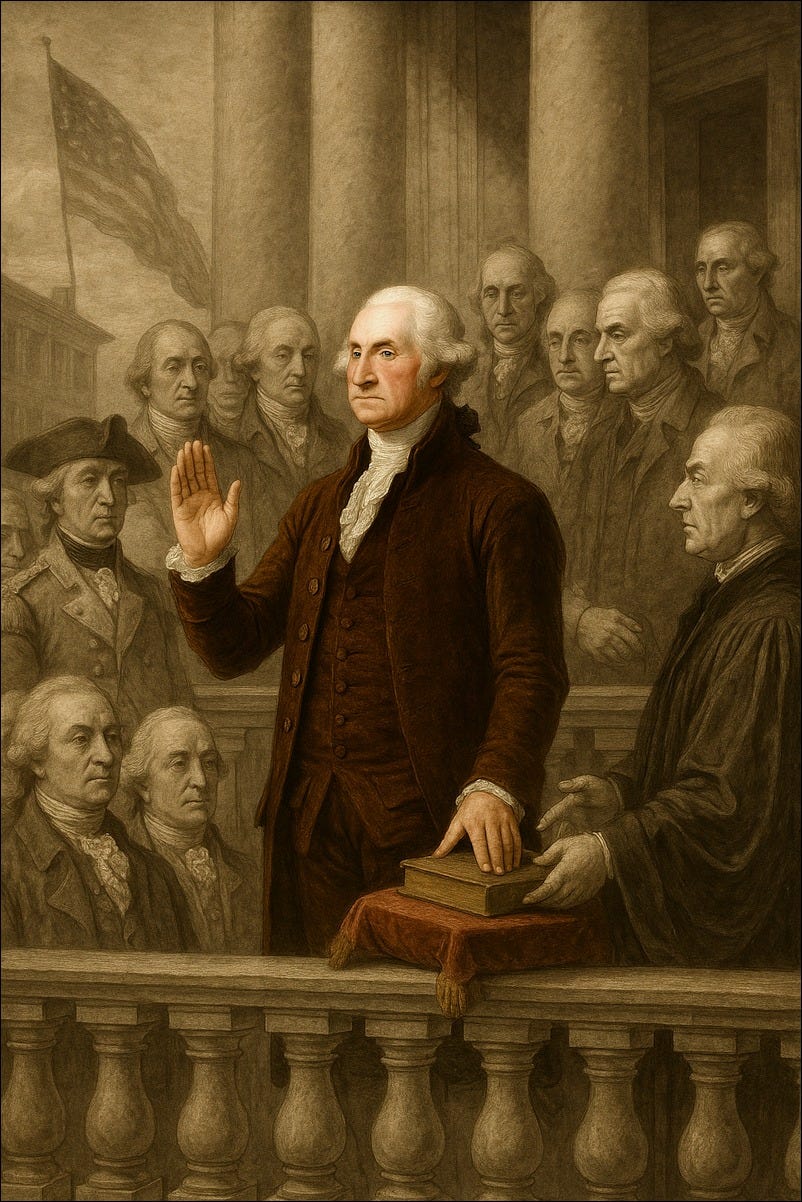
Eleven years later, on April 30, 1789, he stood on the balcony of Federal Hall in New York and took the oath of office as the first President of the United States, making a deliberate point to wear a suit fully made in America with American materials.
His brown broadcloth suit had been woven at the Hartford Woolen Manufactory in Connecticut, after Washington had ordered it months earlier. Receiving an American-made suit for the occasion was so important to Washington that he personally directed the order through Henry Knox, his former artillery commander at Valley Forge. Cloth samples and button sketches traveled between Hartford and Mount Vernon for months before the inauguration. Twenty-two days before the inauguration, he had written to the firm’s agent: he would always take peculiar pleasure in giving every proper encouragement in his power to the manufactures of his country, and intended to protect American manufactures as President of the United States.
Ten weeks later, Washington signed the Tariff Act of 1789, the very first act of Congress after they had regulated the administration of oaths. James Madison had first introduced the Tariff Resolution the same day Washington wrote his letter to the Hartford manufacturer. This tariff would raise duties on imported manufactures and offered not just protection for Americans, but revenue for a federal government loaded with war debt. The tariff in every sense was the foundation on which the national government was built.
In 1791, Washington signed legislation creating the First Bank of the United States, siding with Hamilton against Jefferson on the question of whether the new republic needed institutions capable of fostering manufactures, credit, and commerce at scale. He did so over Jefferson’s constitutional objections because he understood what Jefferson did not. A republic that could not clothe its own soldiers could not defend its own independence. The men at Valley Forge had taught him that lesson at a price the country should not have to pay twice.
President Trump’s love of the tariff is nothing new or alien to the American experience. The nation was built with the tariff. The nation will become great again with the tariff. The American system took its shape 237 years ago, on the balcony of Federal Hall in New York City, with a man in an American suit committing the federal government to the protection of American industry.
That is the anniversary worth marking today, and the legacy worth celebrating. The Republic’s first president was in the language of our moment, a tariff man. He had earned that conviction in the snow at Valley Forge, and would continue in that conviction through his life.