
Tariff Times Daily: Trump-Xi Summit Delivers Big Wins
The President returns from Beijing with protectionism still intact.

THE BOTTOM LINE
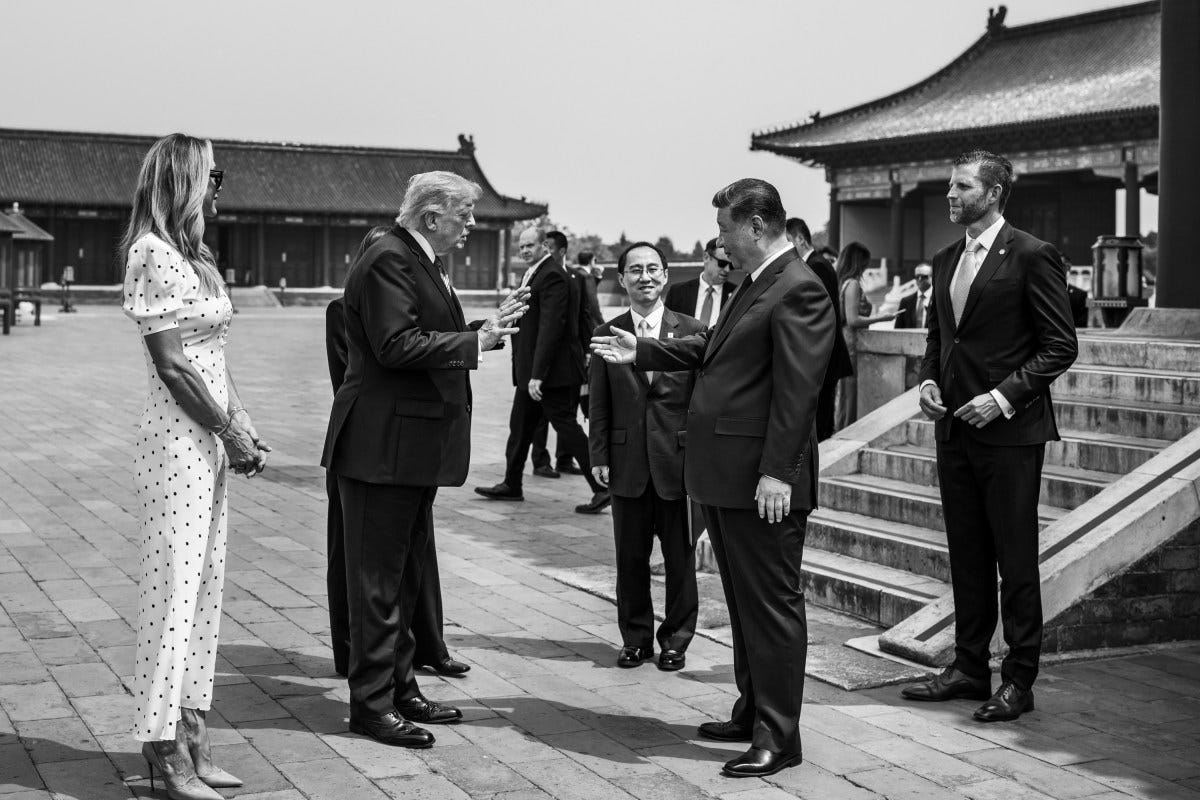
President Trump approached the China summit from a position of strength, leading with a “Peace Through Strength” approach that did not abandon a strong protectionist stance. This lead to very few concessions and several breakthroughs, with the critical minerals truce protected as the United States continues to build domestic capacity across strategic industries.
The White House is framing the outcomes as historic wins for American workers and farmers.
The structure of the Board of Trade mechanism, will be the thing to watch as negotiations continue and is now headed for public comments.
On the domestic enforcement front, a continuation of non-oriented electrical steel orders across six countries and a preliminary circumvention finding against a Chinese engine manufacturer, both of which protect producers operating in sectors central to the reindustrialization agenda.
The USMCA review now sits as the most consequential near-term trade policy battleground, with the Coalition for a Prosperous America warning that origin-washing schemes could hollow out any North American content gains the administration secures.
TODAY’S STORIES
White House: Trump-Xi Summit Produces Boards of Trade, Beef Access, and Critical Minerals Framework
The White House released a detailed fact sheet on the outcomes of President Trump’s state visit to China, the first by a U.S. president since 2017, describing consensus on establishing bilateral Boards of Trade to manage non-sensitive goods trade and expanded Chinese purchases of American agricultural products, including formal registration of more than 500 U.S. beef export facilities. USTR Greer confirmed the Board of Trade proposal will be published for U.S. public comment before finalization, a step that gives domestic industry a formal opportunity to shape its structure and scope. Whether the Board of Trade framework includes structural protection for sensitive American industries or functions primarily as a market-opening channel is the question domestic producers and trade associations should be tracking closely.
Tariff Times Analysis: "Tariffs and Peace Through Strength"
The Tariff Times addresses confusion produced last week by President Trumps visit to China. Many out there supporting tariffs continue to misunderstand them. Since President Washington signed the first tariff bill on July 4, 1789, the tariff has served one explicit purpose: the defense of American labor and industry. That defensive posture is the source of credible strength, and credible strength is what deters predation and produces peace. The same logic that explains the President's enduring partnerships with Japan under Abe and now Takaichi explains his ability to secure the summit deliverables in Beijing while keeping the protective architecture for American producers fully intact.
India Renegotiates Interim Trade Agreement After SCOTUS Tariff Ruling
Indian Commerce Minister Piyush Goyal confirmed Friday that the interim U.S.-India trade framework agreed earlier this year is being revised due to “changed circumstances” following the Supreme Court’s recent ruling on tariff authority. The original agreement included provisions allowing adjustment when underlying conditions shifted, and Goyal indicated the two sides are continuing negotiations under that clause. The development illustrates that the Court’s ruling on executive tariff authority has altered the operating environment for every bilateral arrangement the administration currently has in progress, extending the ruling’s consequences well beyond the domestic litigation track.
CPA: USMCA Review Must Close the Paper Origins Loophole
The Coalition for a Prosperous America has published analysis on the stakes of the 2026 USMCA review, arguing that the agreement’s rules of origin remain vulnerable to “paper origins” schemes through which goods manufactured primarily outside North America acquire preferential treatment via minimal processing. CPA frames this as the central risk in the upcoming review: without tighter content requirements, transshipment and origin-washing will undermine whatever supply chain gains the administration secures through tariff policy elsewhere. The administration’s stated posture, including USTR Goettman’s proposal for unified North American steel tariff borders, reflects alignment with this position, and the review will test whether that alignment produces enforceable text.
Coalition for a Prosperous America
Toyota Files Plans for $2 Billion Assembly Plant in Texas
Toyota has filed with Texas authorities to construct a new $2 billion vehicle assembly facility, a significant reindustrialization signal from a major automaker responding to the structural incentives the tariff environment has established for domestic production. The filing follows a pattern of foreign automakers committing capital to American manufacturing capacity; Stellantis, Hyundai, and others have announced comparable investments under the administration’s trade posture. Production details including vehicle segments, employment projections, and construction timeline have not been fully disclosed.
Greer: China’s Rare Earth Licensing Is Adequate; Trade Truce Could Be Extended
Speaking from Beijing at the close of the summit, USTR Greer said China has been issuing rare earth export licenses to American manufacturers at a satisfactory pace and signaled that the deal reached last fall, covering continued U.S. access to those materials, could be extended. Rare earth elements are critical inputs for American defense production, advanced electronics, and electric motor manufacturing; sustained access reduces near-term supply disruption risk for domestic producers who have not yet developed sufficient domestic or allied sourcing alternatives. The assessment provides operational confidence for the sectors most exposed to critical mineral supply chain vulnerability.
FEDERAL REGISTER WATCH
Notice — Commerce / ITC: Non-oriented electrical steel (NOES) from Sweden, Germany, China, South Korea, Taiwan, and Japan — Commerce and the ITC jointly determined that revoking the existing AD and CVD orders would likely lead to continued dumping, subsidized competition, and material injury to the domestic industry, sustaining the full set of orders. NOES is a critical input for electric motors, power transformers, and grid infrastructure; maintaining these orders protects producers at the center of domestic energy and industrial capacity. Read notice
Notice — Commerce: Tris(hydroxymethyl)aminomethane (Tris) from China — Commerce initiated both antidumping and countervailing duty investigations simultaneously, a dual-track action signaling concern about both below-fair-value pricing and Chinese state subsidies for this industrial chemical used in pharmaceutical manufacturing and industrial buffering. AD investigation | CVD investigation
Notice — Commerce: Certain vertical shaft engines (99-225cc) from China — Commerce makes a preliminary affirmative circumvention determination against Chongqing Zongshen, finding that two newly designed engine models were engineered to evade existing AD and CVD orders, effectively closing a product-redesign loophole that would otherwise have allowed below-fair-value goods into the American market without remedial duties. Read notice
Notice — USTR (May 15): Quartz surface products (QSP) safeguard remedy — following the USITC’s April determination of serious injury to domestic QSP producers from import surges, USTR has opened a public comment and hearing process to gather recommendations on the appropriate remedy, which may include tariffs, quotas, or trade adjustment assistance. Domestic producers and trade associations have a defined window to put their preferred remedy structure on the record. Read notice
Notice — Commerce: Corrosion-resistant steel products (CORE) from Taiwan — final antidumping administrative review results confirm sales below normal value during the 2023-2024 period, maintaining the order’s protective effect for domestic flat-rolled steel producers. Read notice
ON THE DOCKET
The most urgent deadline is Wednesday: USTR’s Section 301 structural overcapacity probe closes to post-hearing comments in two days, while the new QSP safeguard docket opens a longer runway for domestic producers to shape the remedy.
May 20 (closes in 2 days) — USTR: Section 301 structural overcapacity investigation — post-hearing written comments due Wednesday, extended from the original May 15 deadline. This probe examines structural excess capacity in foreign industrial sectors and the domestic harm it produces; comments at this stage allow producers and trade associations to supplement the hearing record before USTR draws conclusions. Read Inside Trade report on extension
TBD, recently opened — USTR: Quartz surface products (QSP) safeguard proceeding — USTR will hold a public hearing and accept written comments recommending specific remedy structures following the USITC injury determination; domestic producers should file their preferred remedy, whether tariff, quota, or adjustment assistance, before the window closes. Read notice
Jul 14 (new, closes in 57 days) — Commerce: Steel Import License program renewal — Commerce seeks public comment on continuing the steel import licensing system that generates the product- and origin-level import volume data used by domestic producers, trade associations, and Congress to monitor import surges. Read notice
Jul 14 (new, closes in 57 days) — Commerce: Aluminum Import Monitoring and Analysis System (AIMS) renewal — parallel to the steel licensing docket, Commerce seeks comment on continuing AIMS, which provides the import volume tracking data for aluminum products by category and country. Read notice
ON THE HILL
HEARINGS & MARKUPS
May 20 — Ways and Means Tax Subcommittee: “Your Paycheck, Returned: How the Working Families Tax Cuts Delivered for Americans” — a tax subcommittee hearing on the domestic income-side provisions of the reconciliation package rather than trade directly, but the fiscal architecture being assembled in Ways and Means this week will shape the revenue baseline against which tariff receipts are measured and trade-linked domestic investments are funded.
BILLS TO WATCH
No trade, tariff, forced labor, supply chain, or reindustrialization bills recorded new congressional activity in the last seven days. The legislative trade calendar is quiet as attention remains on the reconciliation process and the diplomatic framework following the Trump-Xi summit.
COMMITTEE STATEMENTS
No Ways and Means trade-related statements in the last 72 hours.
TODAY IN AMERICAN HISTORY
On May 18, 1933, President Roosevelt signed the Tennessee Valley Authority Act, establishing a federally owned corporation to develop the Tennessee River basin through hydroelectric power generation, flood control, and regional industrial investment. The TVA helped to electrify the south, setting the foundation for industrial development and economic development.
READ NEXT:
Tariffs And Peace Through Strength

The vast majority of people, even those who claim to champion the tariff, continue to misunderstand not just our President, but the tariff. Many are bewildered at President Trump for his recent trip to China. How can Trump be so adamant about using tariffs, but then seem so friendly to Xi Jinping? After 10 years of Trump being at the forefront of our po…
Note: Last week I did not publish as usual. Unfortunately, I was injured and could hardly type. I apologize for this. Things should be returning to normal. Great progress was made during this time on other fronts which will come to light soon. Thank you so much for your support.