

THE BOTTOM LINE
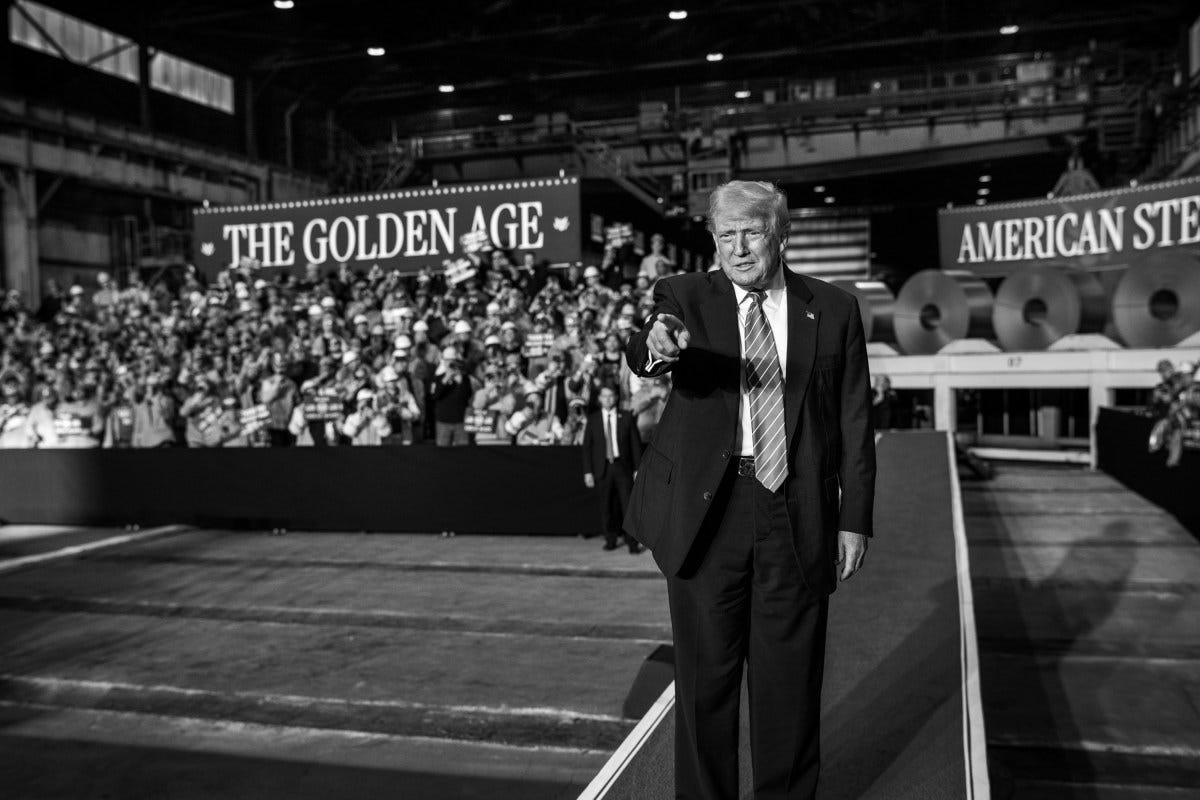
A little less than a year ago, Trump spoke at U.S. Steel Corporation's Irvin Works facility in West Mifflin, Pennsylvania after defending U.S Steel from a Japanese takeover. He promised Pennsylvania steelworkers he would fight for them, and fight to protect American steel in this country. Unlike other politicians, who make massive promises and then do the exact opposite, President Trump DELIVERED. The big news of the day is that the Presidents industrial program has resulted in U.S. Steel announcing the country’s first commercial direct reduced iron facility at Big River Steel Works, a foundational addition to the domestic steel supply chain. Trump delivered. At the same time, Congressional appropriators are moving to fund the administration’s trade-enforcement capacity at requested levels, meaning that the Presidents agenda will be enforced. Furthermore, the Coalition for a Prosperous America, has launched a warning against dependence on foreign antibiotic supply chains. Tackling this problem is likely to be an increasing focus of the Trump administration.
TODAY’S STORIES
U.S. Steel Announces First U.S. Direct Reduced Iron Facility at Big River Steel Works
U.S. Steel announced plans for a first-of-its-kind commercial direct reduced iron (DRI) facility at its Big River Steel Works campus, a development that adds a critical upstream node to the domestic steel supply chain. DRI capacity allows American mills to produce high-purity inputs without relying on imported pig iron or merchant slab, the kind of domestic capacity that Section 232 protections were designed to make commercially viable. The investment is the most concrete industrial response yet to the tightened metals tariff framework the administration has put in place.
Source: Business Wire
CPA Sounds Alarm on Antibiotic Supply Chain Vulnerabilities
The Coalition for a Prosperous America issued a research note warning that the United States remains acutely dependent on foreign producers, particularly Chinese firms, for the active pharmaceutical ingredients used in essential antibiotics. CPA called for coordinated tariff, procurement, and investment policy to rebuild domestic and allied production capacity for finished antibiotics and their precursors. Pharmaceuticals remain among the more complex sectors to onshore, and this note maps a path forward consistent with the administration’s broader industrial agenda.
Source: Coalition for a Prosperous America (CPA)
House Appropriators Move to Fully Fund USTR and BIS Requests
House Appropriations Republicans released a fiscal 2027 spending bill that grants the Office of the U.S. Trade Representative and the Bureau of Industry and Security the substantial funding increases the agencies requested, with a Commerce, Justice, Science subcommittee markup scheduled this week. USTR is conducting more bilateral negotiations than at any time in recent memory, and BIS is administering an expanding set of export controls and Section 232 actions. Adequate appropriations are the unglamorous backbone of an active trade policy.
Source: House Committee on Appropriations
House Hearing Connects Copper Shortfall to Permitting Reform
The House Natural Resources subcommittee on energy and mineral resources, chaired by Pete Stauber, examined a projected 20 percent global copper supply shortfall by 2040 and the case for permitting reform that would allow domestic mines to come online faster. Industry witnesses described how Chinese dominance in refined copper compounds the problem for U.S. manufacturers and defense suppliers. Copper is a foundational input for electrification, defense systems, and modern manufacturing, and any serious reindustrialization program will require domestic supply at scale.
Source: House Natural Resources
FEDERAL REGISTER WATCH
Notice — Department of Commerce: Technical corrections to the Harmonized Tariff Schedule under Presidential Proclamation 11021 on aluminum, steel, and copper imports. The corrections refine implementation rather than alter scope, the latest sign that Commerce is operationalizing the broadened metals framework with care. Read notice
Notice — Department of Commerce: Initiation of countervailing duty and less-than-fair-value investigations on certain oil country tubular goods (OCTG) from Austria, Taiwan, and the United Arab Emirates. Domestic OCTG producers, who supply the energy sector with critical pipe, secure another track of relief against subsidized and dumped imports. CVD initiation | LTFV initiation
Notice — Department of Commerce: Antidumping duty order issued on steel concrete reinforcing bar from Algeria following affirmative determinations from Commerce and the ITC. The order closes a circumvention path that had eroded margins for domestic rebar mills. Read notice
Proposed Rule — International Trade Commission: Proposed amendments to Section 337 rules requiring disclosure of ownership and financial interests in investigations and ancillary proceedings. Greater transparency about who is funding 337 cases helps domestic complainants identify foreign-state and litigation-finance interests on the other side of the table. Read notice
ON THE DOCKET
Sunset-review week: six ITC five-year reviews on China-origin merchandise all close tomorrow, with the AGOA modernization docket the only material new filing behind them.
May 01 (closes tomorrow) — International Trade Commission: Five-year sunset reviews on six orders covering prestressed concrete steel wire strand from China, mattresses (China plus Cambodia, Malaysia, Serbia, Thailand, Turkey, Vietnam), small vertical shaft engines from China, boltless steel shelving from China, non-refillable steel cylinders from China, and chassis and subassemblies from China. Sunset reviews determine whether existing AD/CVD orders stay in force; comments from domestic producers and trade associations are how the ITC develops the record needed to maintain protection against renewed dumping or subsidization. Wire strand | Mattresses | Engines | Shelving | Cylinders | Chassis
May 15 (new, closes in 15 days) — Office of the U.S. Trade Representative: Modernization of the African Growth and Opportunity Act (AGOA), with USTR developing recommendations for forthcoming Congressional reauthorization consideration. Producers in textiles, autos, and agriculture have a narrow window to shape how AGOA preferences are restructured to favor genuine African industrial development without becoming a back door for Chinese transshipment. Read notice
June 29 (new, closes in 60 days) — International Trade Commission: Proposed amendments to Section 337 rules on disclosure of ownership and financial interests in investigations. Domestic complainants and IP holders should weigh in on disclosure language that will determine how foreign-state and litigation-finance involvement gets surfaced in 337 cases. Read notice
ON THE HILL
HEARINGS & MARKUPS
No upcoming Ways and Means or Senate Finance trade hearings or markups have been noticed in the next fourteen days; both committees came off a busy week of health-policy work and trade-relevant items have not yet been calendared.
BILLS TO WATCH
HR 8583: Prohibit duties on phosphate fertilizer imports under Sections 122 or 301 of the Trade Act of 1974. The bill would carve out an entire input class from the President’s tariff toolkit, narrowing flexibility on a commodity where domestic production matters for both food security and the broader chemicals supply chain. Referred to House Ways and Means on April 29. View bill
HR 8580: Reduce duties by 50 percent on forestry-products imports when the importer demonstrates 100 percent U.S.-origin raw wood content. The bill rewards integrated supply chains anchored in American timber and is worth watching as a template for content-based tariff modulation. Referred to House Ways and Means on April 29. View bill
HR 8586: Amend the Immigration and Nationality Act to protect American workers and values. The bill connects immigration policy to the labor-standards leg of the American System framework; how the language treats H-1B, agricultural visas, and L-1 transfers will determine its industrial impact. Referred to Judiciary and Education and Workforce on April 29. View bill
COMMITTEE STATEMENTS
No new House Ways and Means trade-filtered statements crossed the wire in the last 72 hours.
TODAY IN AMERICAN HISTORY
On April 30, 1789, George Washington took the oath of office on the balcony of Federal Hall in New York, inaugurating the administration that within ten weeks enacted the Tariff Act of 1789, the new republic’s first revenue measure and the foundation stone on which Hamilton and later Clay would build the American System.
Tariff Times Daily is published by the American Protective Tariff League.
