
Tariff Times Weekly: Liberation Day Turns one Year Old
One Year after liberation day: Pharma Tariffs, Metals Consolidation, the FY27 Budget, and the Hormuz Compounding Effect

THE WEEK IN BRIEF
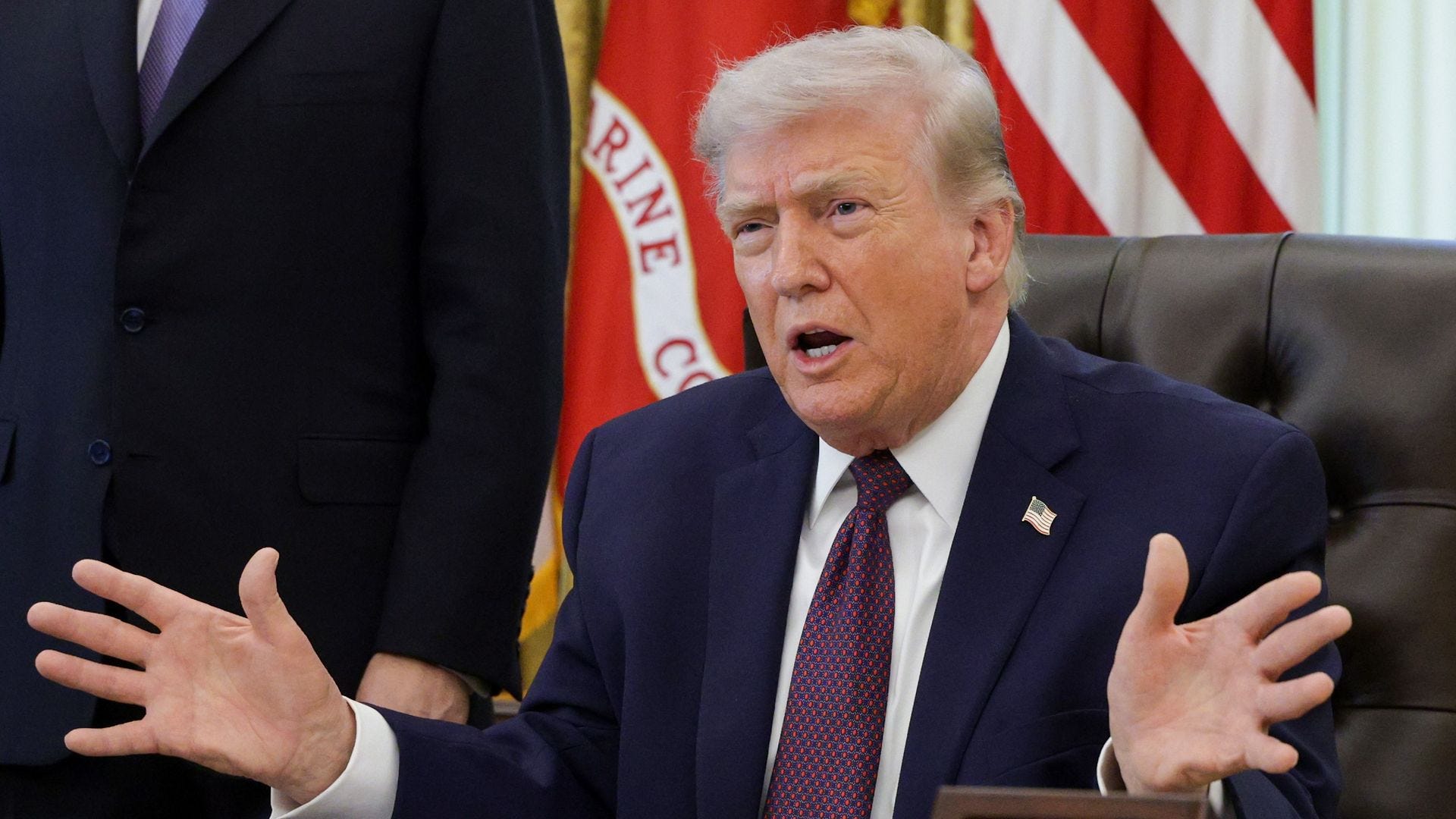
Liberation Day turned one year old on April 2, and the week produced its own answer to the anniversary critics: on April 3, the administration signed consolidated Section 232 duties on metals and a new pharmaceutical tariff regime in the same afternoon, extending national security protection to the drug supply chain and strengthening the industrial floor for domestic steel, aluminum, and copper producers. The FY27 budget, released Friday, embeds this trajectory into the government’s funding architecture, prioritizing trade enforcement and critical minerals investment across State, Energy, and Defense. At the one-year mark, the policy is not finished. It is compounding.
LEAD EDITORIAL: THE ANNIVERSARY CRITICS ARE MEASURING THE WRONG THING
A year after Liberation Day, a predictable chorus has assembled to deliver its verdict. The trade deficit is still elevated. Announced factories have not yet opened. The manufacturing revival declared in the Rose Garden has not registered decisively in the output data. The Tax Foundation ran the numbers. The Hague Centre published its analysis. Politico surveyed the landscape and found early construction phases rather than operating capacity. While all these data points are accurate. The interpretive framework is mismatched to the policy.
The United States did not become a superpower overnight. Henry Clay did not expect the American System to produce results in twelve months. When Clay stood before the Senate in 1824 to argue for the protective tariff that became the foundation of American industrial development, he understood that he was proposing a generational project. The Tariff of 1824 did not build the iron mills of Pennsylvania in a year. It laid a floor on which capital could rationally commit to domestic production over the decade that followed. The measure of such a policy can only be taken after it has had time to ripen.
The same logic applies today. Capital allocation decisions in steel, pharmaceuticals, semiconductors, and rare earth processing are not made on a quarterly cycle. They are made against the expected durability of the policy signal. A manufacturer weighing a greenfield plant in the United States is asking whether the tariff floor will still be in place when the plant comes online, when the debt is serviced, when the workforce is trained. That question was not answerable in April 2025. It is more answerable today, because the administration has spent a year demonstrating that the commitment is durable.
That is what makes April 3, 2026 significant. On the one-year anniversary, the administration did not pause to assess but instead it doubled down. The Section 232 consolidation on steel, aluminum, and copper eliminates product-coverage ambiguity that has complicated planning for downstream manufacturers waiting for clarity before committing capital. The pharmaceutical tariff executive order goes further: it extends the national security rationale to drug manufacturing and structures exemptions specifically to reward domestic investment. Companies that commit to American production qualify for relief. Companies that do not face the full rate.
That is industrial policy with an explicit development mandate, structured precisely as the American System tradition would prescribe: protection paired with incentive, aimed at developing domestic capacity that can eventually compete on its own terms. The critics measuring the trade deficit at month twelve are correct that the work is incomplete. They are describing the distance remaining in a project whose timeline is a decade, not a year.
The direction is right. What remains is the Congress acting on what the President has done. The Tariff Times wrote a report earlier this week outlining what the Congress can do to lock in the gains that President Trump has built for American Industry and workers.
THE WEEK’S SCORECARD
Ranked by impact on American industry
Trump Signs Pharmaceutical Tariff Regime; Section 232 Metals Consolidated — A
The administration signed two complementary trade actions on April 3 that together strengthen and extend the protective architecture. A reorganized Section 232 framework covering steel, aluminum, and copper derivatives eliminates product-coverage ambiguity that has complicated planning for downstream manufacturers. The pharmaceutical tariff executive order extends the national security rationale to drug manufacturing, with exemptions structured to reward domestic investment and production commitments. The pharma action is the more structurally significant: dependence on foreign production for essential medicines became a recognized national liability during the pandemic and has not been resolved at this level since. The incentive structure rewards domestic commitment and imposes a real cost on continued reliance on foreign supply.
Source: Fierce Pharma / Bloomberg
FY27 Budget Embeds Trade Enforcement and Critical Minerals as Funding Priorities — A
The White House FY27 budget request increases critical mineral funding at State, Energy, and Defense, and explicitly prioritizes trade enforcement operations. Embedding these commitments in the budget architecture signals that the administration’s industrial policy agenda is being institutionalized rather than left to executive discretion alone. A $1 billion request for Great Salt Lake restoration, cited specifically for its critical minerals potential, reinforces the pattern: domestic resource development is being treated as a national investment, with the budget reflecting that judgment.
Source: Inside Trade
Liberation Day at One Year: Where the Progress Is Actually Visible — B
Coverage of the one-year anniversary has skewed toward what the tariff program has not yet produced, but the structural picture rewards a different read. Investment commitments in steel, pharmaceuticals, semiconductor fabrication, and rare earth processing are on record; the tariff architecture has been sustained through legal challenge; and the administration has continued building the framework rather than retreating from it. The question at twelve months is whether the Congress will act to lock in the Presidents tariffs and set the United States on a path to prosperity.
Source: nationaltoday.com
Some Industries Still Adjusting to the Tariff Environment, One Year In — C
CNBC documents the near-term friction: industries that have long relied on foreign-sourced inputs are recalibrating supply chains, absorbing costs, and planning capital investments on a timeline that has not yet closed the gap. These are real costs, and they fall unevenly across sectors and firm sizes. The adjustment is also the anticipated mechanism by which the tariff program works: supply chain reorientation is not instantaneous, and the relevant question is whether domestic alternatives are developing on a trajectory that converges with current conditions. The evidence available suggests they are, on schedule for a decade-scale project.
Source: CNBC
New Legislation Would Require Allies to Match U.S. Chip Equipment Export Controls — A
A new House bill would allow Commerce to impose extraterritorial controls on allied nations whose semiconductor equipment export restrictions fall short of American standards, creating a compliance incentive for partners whose enforcement gaps could otherwise provide an indirect technology transfer pathway. The underlying problem is real: supply chain security in advanced semiconductors requires that allied partners maintain comparable controls on transfers to state-directed foreign competitors. Whether the extraterritorial mechanism is the right instrument will depend on how the bill is negotiated as it advances through committee.
Source: Inside Trade
BY THE NUMBERS
Key figures from the week
$57.3 billion: The U.S. goods and services trade deficit for February, up $2.7 billion from January even as goods and services exports set a new monthly record. The structural adjustment is underway; a single month’s reading captures neither its pace nor its eventual depth.
$84.6 billion: The goods-only deficit for February. The gap between goods and services trade continues to define the structural condition that the tariff program is designed to shift.
$1 billion: The Trump administration’s FY27 budget request for restoration of the Great Salt Lake. A great example of “environmentalism of dominion” as articulated by Isaiah Menning in this great Commonplace piece.
$1.3 trillion: The equity market value erased from U.S. stocks in a single session this week, reflecting the ongoing commodity and supply chain premium from the Strait of Hormuz closure and its compounding effects on global trade flows.
25-30%: The increase in fertilizer prices heading into the 2026 planting season, driven by the Hormuz disruption and its effects on global commodity availability.
STORIES TO WATCH
Situations flagged for ongoing tracking
Xi-Trump May Summit / Board of Trade (tracking since 2026-03-31)
Steel tariff changes described this week as “a step forward for the Turnberry deal” suggest partner-country negotiations are advancing alongside the bilateral board architecture. The summit now has both a defined institutional deliverable and an active negotiating track; whether enforcement authority and a developmental mandate are written into the board’s charter from the outset will determine its practical value.
Strait of Hormuz / Commodity Supply Chain Disruption (tracking since 2026-03-31)
JP Morgan has mapped out when the last Persian Gulf oil will reach various global markets, and fertilizer prices are 25-30% above baseline heading into planting season. Naval escorts floated by Secretary Bessent have not yet materialized. The commodity disruption is now compounding across multiple supply chains simultaneously, and its agricultural dimension carries a direct political consequence heading into harvest season.
USMCA 2026 Review: Scope and Agenda
Senator Cortez Masto’s letter to USTR Greer adds a bipartisan investment-screening dimension to the review agenda alongside the UAW Rapid Response Mechanism complaint against Compañía Hulera Tornel. The administration’s response to the RRM complaint remains the live credibility test for USMCA labor enforcement; the review’s eventual scope will reflect whether labor standards, investment screening, and environmental provisions can be advanced in parallel.
IEEPA Tariff Statutory Authority (tracking since 2026-03-31)
The FY27 budget’s trade enforcement funding commitment is a positive signal, but the underlying structural exposure remains: tariff authority built on emergency powers faces continuing legal challenge, and no legislation establishing permanent statutory authority is currently advancing in Congress. The gap between administrative ambition and congressional action is the central vulnerability in the current trade architecture.
China Section 301 / Rare Earths Truce (tracking since 2026-03-31)
The new chip equipment controls bill adds a congressional dimension to the technology transfer question, but the rare earths truce expiration in November remains the more immediate variable. With domestic and allied alternative processing capacity still insufficient to absorb a Chinese cutoff, the May summit is the relevant near-term forum for determining whether extension becomes part of the bilateral board framework.
Pax Silica / U.S.-EU Critical Minerals Framework (tracking since 2026-03-31)
State Department official Andrew Helberg described EU talks as “very constructive” this week, the most positive signal yet on EU participation. Whether the discussions produce enforceable sourcing commitments or a looser statement of intent will determine whether Pax Silica becomes an effective operational alternative to Chinese mineral supply chain dominance.
Pharmaceutical Tariff Domestic Investment Framework (new, 2026-04-04)
The pharmaceutical tariff executive order signed April 3 structures exemptions to reward companies that commit to domestic manufacturing investment. How drug manufacturers respond to the incentive architecture, whether they make binding production commitments or test the boundaries of the exemption criteria, will determine whether the regime achieves its stated repatriation objective. Implementation details will be the story to watch.
THE PUBLIC PULSE
What Americans are saying this week
Equity losses attributed to the Hormuz closure topped $1.3 trillion in a single session, drawing significant retail attention and linking the Iran conflict directly to trade and supply chain anxiety in public discourse. (r/smallstreetbets)
Commerce Secretary Lutnick’s hearing exchange on domestic production and bananas circulated widely, reflecting genuine public engagement with the question of where tariff policy is practically applicable and where it cannot substitute for trade relationships that have no domestic alternative. What many do not realize is that with modern greenhouse technology, although probably not advisable, even bananas could be procured domestically at scale. (r/UnderReportedNews)
JP Morgan’s supply chain timeline for Persian Gulf oil arrivals became a widely shared document in preparedness and commodity-tracking communities, a sign that the Hormuz disruption is registering well beyond financial audiences. (r/PrepperIntel)
Metals-adjacent manufacturers are actively working through the Section 232 derivative product structure in public forums, with discussion on r/stocks tracking which supply chain positions are affected by the consolidated 25% duty and what the transition timeline looks like.
FROM THE ARCHIVES
A dispatch from the APTL vault
Henry Clay’s Unfinished Revolution
This piece argues that the American System was never defeated by superior economic theory; it was defeated by incomplete implementation, and the 21st century is now being asked to finish what Clay started. As anniversary critics catalog what the tariff program has not yet delivered, Clay’s own understanding of industrial development as a generational project is the right frame for evaluating what one year of committed policy actually represents.

]
LOOKING AHEAD
On the horizon
Plurilateral critical minerals text to Congress: USTR Greer confirmed the draft will circulate “within weeks” of the MC14 ministerial, making the next several weeks the window to watch for the first congressional review of the administration’s multilateral supply chain framework outside Chinese-controlled channels.
May Xi-Trump Summit: The bilateral board of trade remains the anticipated centerpiece deliverable; the Turnberry steel deal’s advancing status and the rare earths truce question will both need resolution before or during the summit, and the board’s design will shape how both are handled.
WTO General Council meeting (early May): The e-commerce moratorium, currently held together by informal pledges from 22 members following MC14’s non-outcome in Yaoundé, returns to the General Council. Whether it survives another round or lapses entirely will signal how much coordinating authority the WTO retains among its key members.
China rare earths truce (November expiration): No formal administration determination on whether to seek extension. The summit and the bilateral board framework are the most likely venues for resolution; domestic and allied processing capacity remains the underlying variable that defines how much leverage the administration holds going into those conversations.
Published by the American Protective Tariff League | The Tariff Times on Substack
EDITION NUMBER: #1776
The Tariff Times first edition will be 1776 in honor of the American Revolution
READ NEXT: