

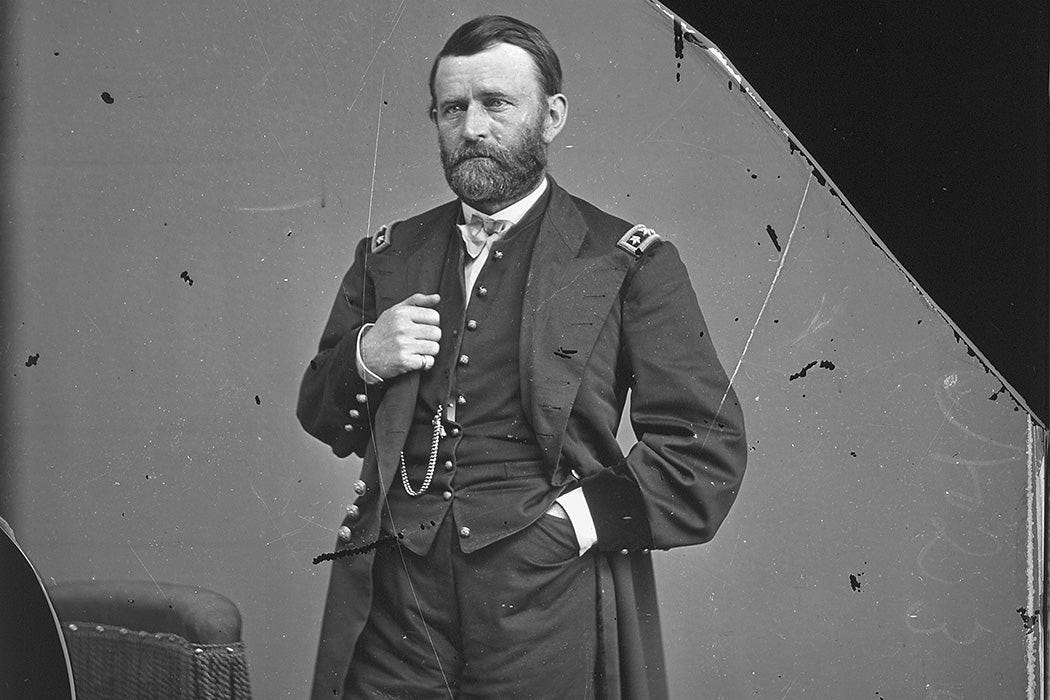
Two months into Ulysses S. Grant’s first term, the last spike went into the Pacific Railway at Promontory Summit. The new German chancellor sent a representative to his inauguration. Within a year, his attorney general would suspend habeas corpus in nine South Carolina counties to break the Klan, and the protégé of Henry Carey would board a ship for Yokohama to teach the American System to the Meiji government. Foreign powers and forgotten economists treated his presidency as the continuation of a national project. That is what it was.
The textbooks have not caught up. Arthur Schlesinger’s 1948 survey of historians ranked Grant as one of two presidential failures, tied with Warren Harding. Even the recent C-SPAN reconsideration that moved him from 33rd in 2000 to 20th in 2021, the largest gain in that survey’s history, does not capture what he actually did.
In truth, Grant was the president who cemented Lincoln’s economic program.
The transcontinental railroad was completed at Promontory Summit on May 10, 1869, two months into his first term. American railroad mileage rose from roughly 45,000 miles in 1871 to nearly 80,000 by 1879. Pig iron output passed two and a half million tons before the Panic of 1873. Bessemer steel went into commercial production at Carnegie’s Edgar Thomson Works in 1875. The Henry Carey circle in Philadelphia, the protectionist intellectuals who had shaped the wartime tariff and banking acts, continued to advise the administration. Carey’s protégé E. Peshine Smith was sent in 1871 to serve as economic adviser to the Meiji government of Japan, carrying the American System abroad.
The Treaty of Washington of May 1871 settled the Alabama Claims by international arbitration and produced a $15.5 million payment to the United States, a windfall that strengthened Treasury credit at the moment industrial finance most needed it. Grant vetoed the inflation bill of 1874 and signed the Specie Resumption Act of 1875, restoring the dollar to convertibility and stabilizing the credit on which industrial expansion depended. He signed Yellowstone into existence on March 1, 1872, the first national park in the world, an early federal acknowledgment that the public domain was a national asset to be stewarded.
The corruption charges deserve a careful reconsideration, because they have done more than any other single thing to obscure this record.
Grant himself was never indicted, and a string of congressional inquiries by Democratic majorities produced, in the words of historian Allen Guelzo, “not a single indictment” of the president.
Ron Chernow notes that Grant gave a sworn deposition to defend his private secretary in 1876, an act unprecedented for a sitting president, because he believed the prosecution had the wrong man. The same president the textbooks wrongfully remember as the patron of the spoils system established the first federal Civil Service Commission in 1871 under George William Curtis. Anti-spoils reform was in fact a Grant initiative.
There is a deeper point worth stating plainly.
Robert Fogel’s classic 1960 study of the Union Pacific concluded that the transcontinental railroad was a “premature enterprise,” meaning a project whose social returns far exceeded what any private investor could expect to capture. Fogel and the cliometric historians who followed him estimated the social rate of return on the transcontinental at roughly twenty-five percent against private returns near eleven percent. A project of that shape cannot be financed by ordinary commercial markets. It requires federal land grants, federal credit, and the political coalition-building that delivers them.
A generation of development economists, beginning with Samuel Huntington and Nathaniel Leff in the 1960s and including Mushtaq Khan and Ha-Joon Chang more recently, has documented that every continental-scale industrializer, including Britain, Germany, and the United States, financed its takeoff through arrangements that no modern good-governance checklist would tolerate. Huntington put the point bluntly in 1968: “the only thing worse than a society with a rigid, over-centralized, dishonest bureaucracy is one with a rigid, over-centralized, and honest bureaucracy.” The friction costs around the railroads were real. They were also the price of admission for the project of building a continent. The country got the continent.
Republican Reconstruction has often been misunderstood. Under the Grant administration, Reconstruction was the American System applied to the defeated South. The Confederacy had been organized around an export-staple economy that resisted manufactures, blocked internal improvements, and refused public investment in education and infrastructure. Republican Reconstruction governments built railroads in the cotton states, founded the first public school systems most of the South had ever known, and worked to bring the region into the same industrial union the North was assembling.
None of that was possible without the political coalition Grant defended at gunpoint when necessary. He ratified the Fifteenth Amendment in February 1870 and called it “the most important event that has occurred since the nation came into life.” He signed the Enforcement Acts of 1870 and 1871, suspended habeas corpus in nine South Carolina counties in October 1871, and dispatched federal troops and prosecutors against the first Ku Klux Klan. Attorney General Amos Akerman secured roughly three thousand indictments and over six hundred convictions across the South. By 1872, the first Klan had been suppressed as an organized force. To carry the work, Grant had created the Department of Justice itself, signed into law on June 22, 1870, with enforcement of the Reconstruction Amendments as its founding purpose.
Sean Wilentz writes that Grant “created the most auspicious record on civil rights and racial equality of any president from Lincoln to Lyndon B. Johnson.” Ron Chernow calls him “the single most important figure of the Reconstruction era.”
Frederick Douglass put it more directly: “Abraham Lincoln made him a free man and General Ulysses S. Grant made him a citizen.”
The moral case is real. The economic case is the same case. A continent cannot be industrialized at half its territory, and a free-labor economy cannot rest on a region governed by terror.
Albert Gallatin made the underlying argument in 1808. In his Report on Roads and Canals, the Treasury Secretary observed that the United States lacked the population density and capital depth to build a continental transportation network through private commerce alone. Returns were too slow, distances too long, and public benefits too diffuse for any private investor to recover. Only the federal government, possessing both the credit and the territorial reach to internalize those public gains, could underwrite works of national scale. The Pacific Railway Act of 1862 was Gallatin’s argument executed at scale. Reconstruction was the same argument extended to the human and political infrastructure of half the country. Grant was the president who finished both jobs and defended the political coalition that made them possible.
That is the lesson worth carrying forward on his 204th birthday. Continental projects have always required continental coordination. The American System was built on that premise, and the country it built is the standing argument for it.
READ NEXT:
The American Who Helped Build Modern Japan

Something unusual has been happening on Twitter lately. Americans and Japanese are finding each other, talking to each other, celebrating each other’s cultures across the language barrier with nothing but an autotranslation feature and genuine goodwill. It is a small thing, perhaps. But it points toward something real: a friendship between two nations t…
Excellent post.
A further feature of the Washington Treaty with Britain, it took off the table forever any real prospect of war between the USA and the British Empire. In effect, Britain recognized US hegemony in the hemisphere. This created a hidden but real peace dividend.
it’s important to clarify a structural point here that’s easy to miss, the whole scope of national initiatives, not only mentioned in this essay but even all that existed, existed within a far more decentralized system than the piece implies. Until after WW2 most economic, infrastructural, educational, commercial, fiscal, and scientific decision-making occurred at the local and state levels, the private sector was deliberately and pluralized, and all forms of systemic decision making were tied into federated, bottom-up civic and party structures that were publicly accessible and internally contestable.
The essay moves from “some projects required federal coordination” to a broader suggestion that continental development depended on centralized direction, but that’s not quite accurate, the USA (and even cases like Meiji Japan, which it references) developed through a mix of minority-of-the-action national support layered on top of highly plural, locally driven systems. Missing that distinction can make the past look like our current deeply centralized, standardized, and de-democratized central planning policy regimes, when they were categorically not